
How MCP accelerates agentic AI
Discover how MCP enables AI agents to dynamically use tools without custom integrations. This article clarifies key concepts including function calling, skills, and MCP apps.
Why MCP?
To understand MCP (Model Context Protocol) and why it emerged, we need to look at the recent evolution of Large Language Models (LLM) like ChatGPT, Gemini, or Mistral.
In late 2022, OpenAI launched its GPT-3.5 model, which achieved massive success with the general public.
The model can understand complex queries, synthesize information, and produce quality content.
But at this stage, it cannot act on tools or access external systems. For example, it is not yet able to fetch recent information from the web.
A few months later, OpenAI introduced the concept of tools in ChatGPT, which they called "function calling". Very quickly, this concept was adopted and integrated by other market players. Today, most modern LLMs allow the use of external tools.
The principle is simple: you describe to the LLM what a tool does, what information it needs as input, and what it returns as output (or what actions it can trigger, such as canceling an order).
Based on the user's question and context, the model can decide to use this tool at the right time. For example:
- Tool:
get_order_status(order_id) - User asks: "Where is my order?"
- The LLM understands that it should call this tool.
Here's how it works :
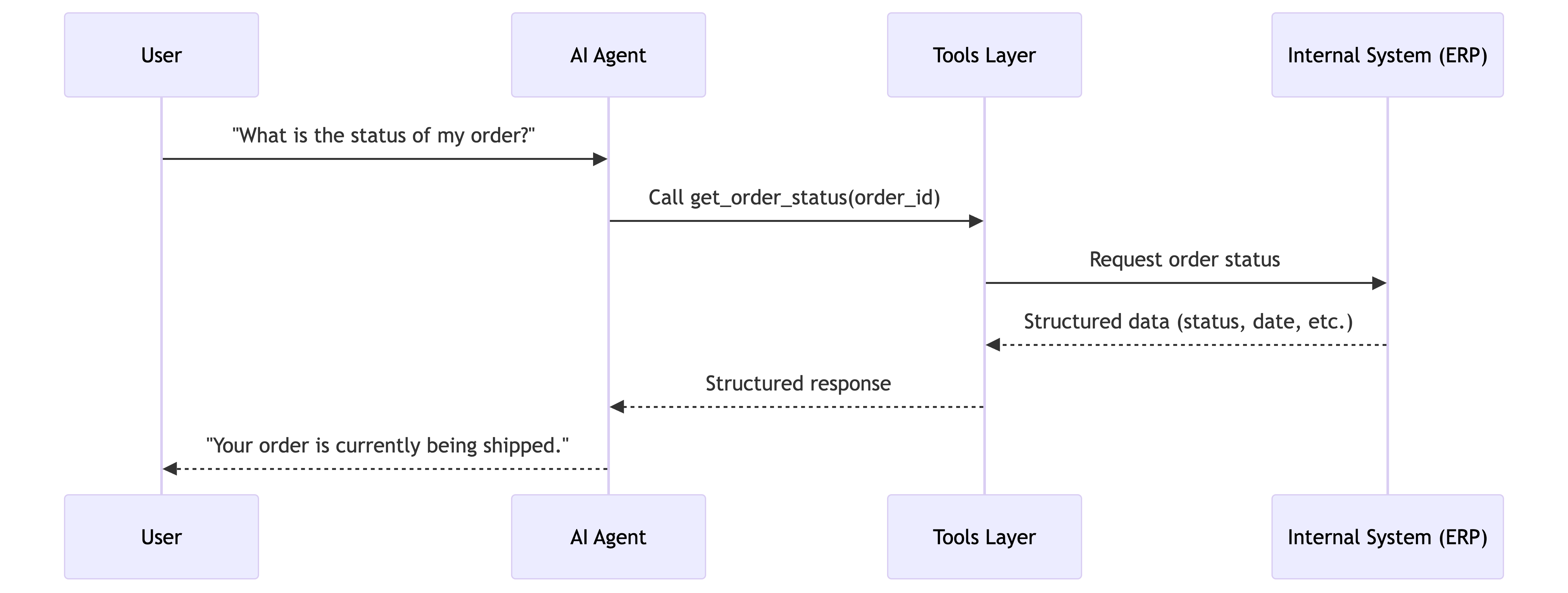 AI agent tool calling flow
For businesses, the ability to create dedicated tools for their AI agents open up so many time saving and automation opportunities.
For example, an agent can rely on tools to check the status of a quote or order, analyze operational indicators, update a logistics status, or validate invoicing.
But as tools multiply, a new difficulty appears: each tool must be specifically integrated for each agent.
This is precisely the problem that MCP was designed to solve.
Introduced by Anthropic (the creator of Claude) in 2024, MCP standardizes how tools and data are exposed, so that agents can:
- discover them dynamically,
- understand how to use them,
- and call them without specific integration
We move from custom integrations to AIs that can discover data and tools dynamically, truly accelerating the agentic promise for businesses.
How does MCP work in practice?
A server that implements MCP describes which tools are available, what data can be accessed, and how to use them: .
An MCP-compatible client can then connect to this server and automatically retrieve the list of proposed tools to make them available to the agent.
From there, the LLM can decide which tool to use based on the user's request and the conversation context.
Let's take a simple example: an agent that helps with travel planning.
To enrich this agent with surf data, the administrator doesn't need to develop a new integration. They simply need to enter the web address of an MCP server providing surf forecasts.
The platform automatically retrieves the list of available tools on this server and presents them to the administrator, who can choose which ones to activate for their agent.
Here's the tool discovery and selection process:
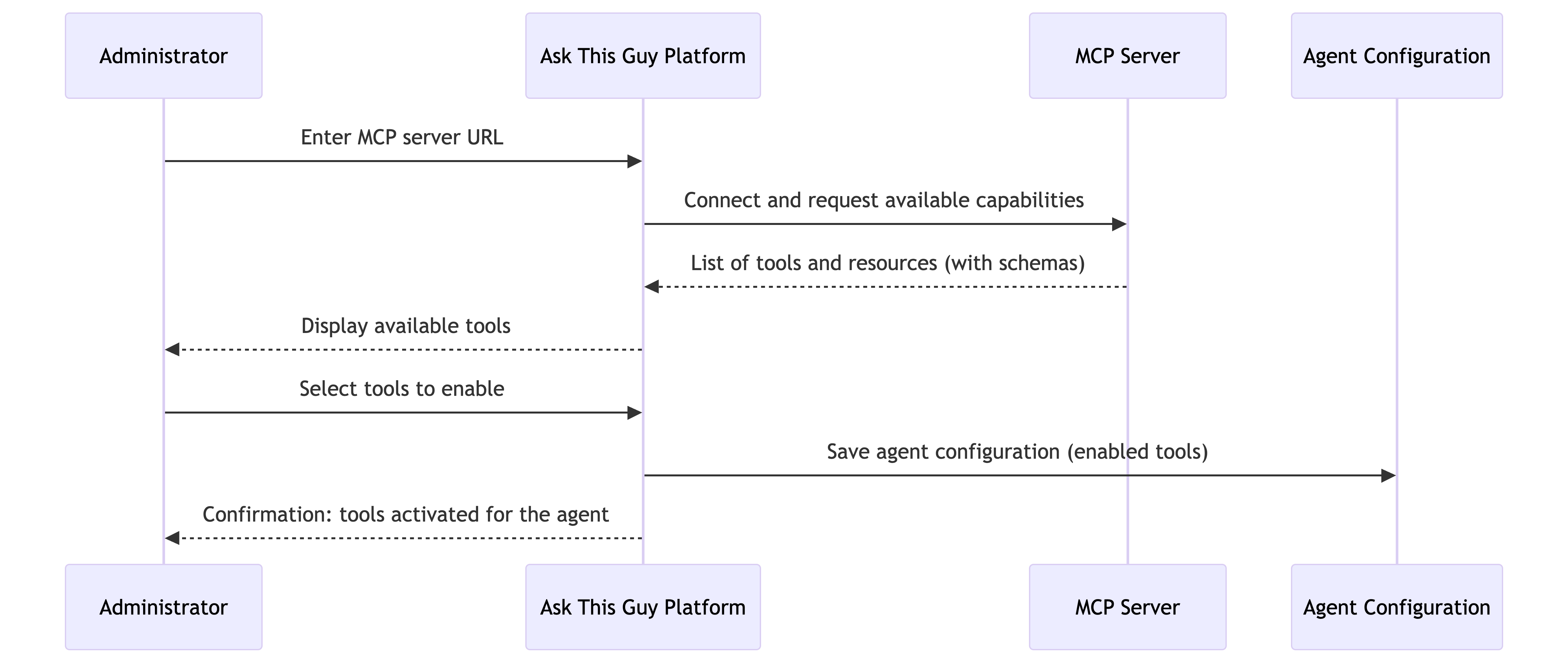 MCP tool discovery and selection process
And here's how it looks in the Ask This Guy interface:
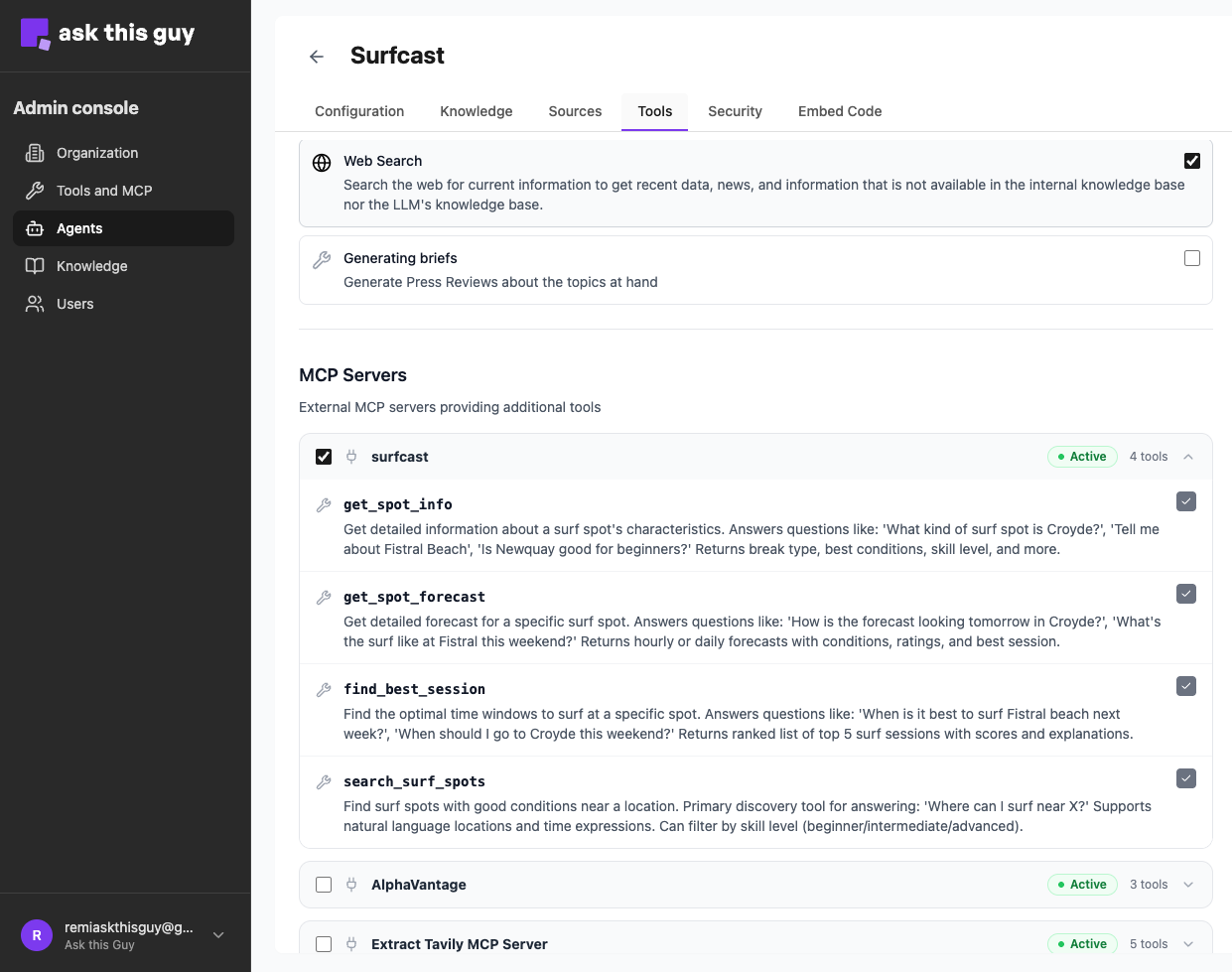 MCP tool configuration and selection in the admin interface
Once activated, the tools are made available to the agent on the fly, without any development.
When a user chats with the agent and asks "where could I surf next week around Bordeaux", the LLM understands that it can call the find_best_session tool to answer the user:
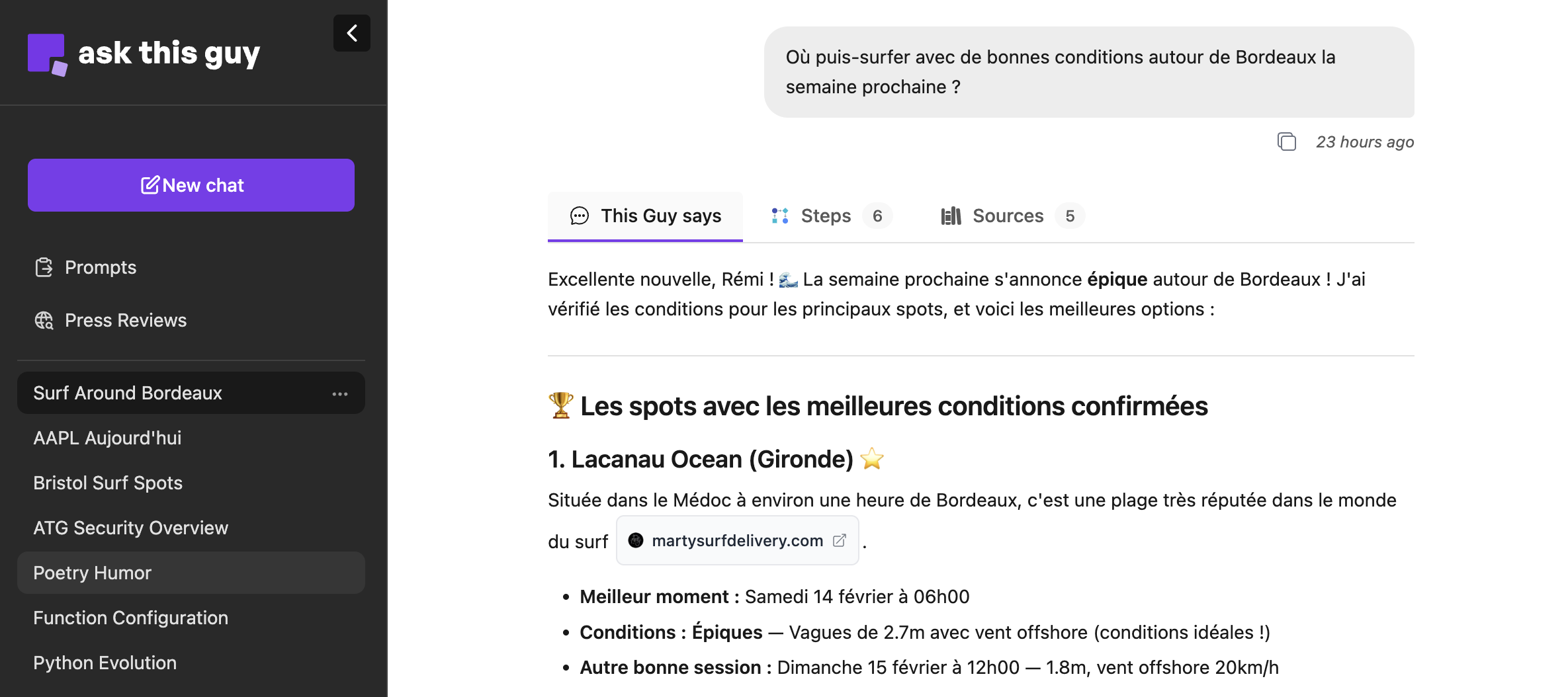 Ask This Guy Chat UI
With MCP, no application code modification is necessary; the server's tools are discovered and used dynamically.
This is where the real breakthrough lies and why MCP is often presented as a universal connector, giving the ability to plug in anywhere.
MCP and skills: their role in agentic architectures
One of the main challenges for agents is knowing how to orchestrate tools to respond well to complex questions.
The more tools an agent has, the more important it becomes to organize them well and guide their use, to avoid unnecessary or poorly adapted calls.
Skills were introduced to meet this need. They combine tools with a reasoning layer and, sometimes, user-specific preferences.
For example, a user asks "I want to surf in Bordeaux next week for less than €500". A "Surf Trip Planner" skill could call multiple tools (surf forecasts, weather, accommodation), apply business rules (user level, budget constraints), and return a tailored structured proposal.
In an agentic architecture, skills operate one level above MCP.
MCP exposes tools and data; skills define how to use them intelligently. The two are complementary.
The latest evolution: MCP Apps and the future of AI interfaces
Until now, the user experience in the SaaS world and that of AI agents lived in two parallel worlds.
On one side, we have SaaS applications with rich but rigid graphical interfaces (UI), where each action requires navigating between menus, tabs, and forms.
On the other, AI agents capable of reasoning, but limited to a text chat window: to act on your software, the agent had to either "describe" raw data to you or execute invisible commands in the background.
This disconnect forced the user to constantly switch between chat and their applications to verify or validate the AI's actions.
This is precisely the problem that MCP Apps solve. Launched in early 2026, this evolution of the protocol allows agents to no longer just exchange text, but to directly host interactive mini-applications within the conversation.
For example, rather than reading a text summary of your sales, the agent displays an interactive graph from your CRM directly in the chat. You can filter the data with your mouse, and the agent, observing your clicks in real-time (bidirectionality), adapts its analysis as you go.
This convergence between agents, tools, and interfaces will shape the future of business applications.
Ask This Guy's approach
At ATG, our approach is pragmatic. Our clients can rely on MCP servers when they help accelerate integration while developing more deeply integrated tools when these are required to improve agent performance.
Skills, introduced in the Anthropic and Google ecosystems, are beginning to be adopted by certain players, particularly in the world of IDEs and developer assistants. Their trajectory is promising, but still consolidating.
We already offer an approach to meet this need: each agent can be finely configured from the admin console, defining:
- its instructions,
- accessible tools: platform tools, client-specific tools, or any MCP tool
- authorized knowledge sources,
- and other options to improve the user experience in their conversation with the assistant.
We support our clients in:
- defining tools that are truly useful for their business,
- writing specifications for their MCP server,
- implementation and orchestration best practices that are fully managed on the Ask This Guy platform.
Ready to discover how Ask This Guy enables you to create integrated intelligent assistants?


.jpg)