
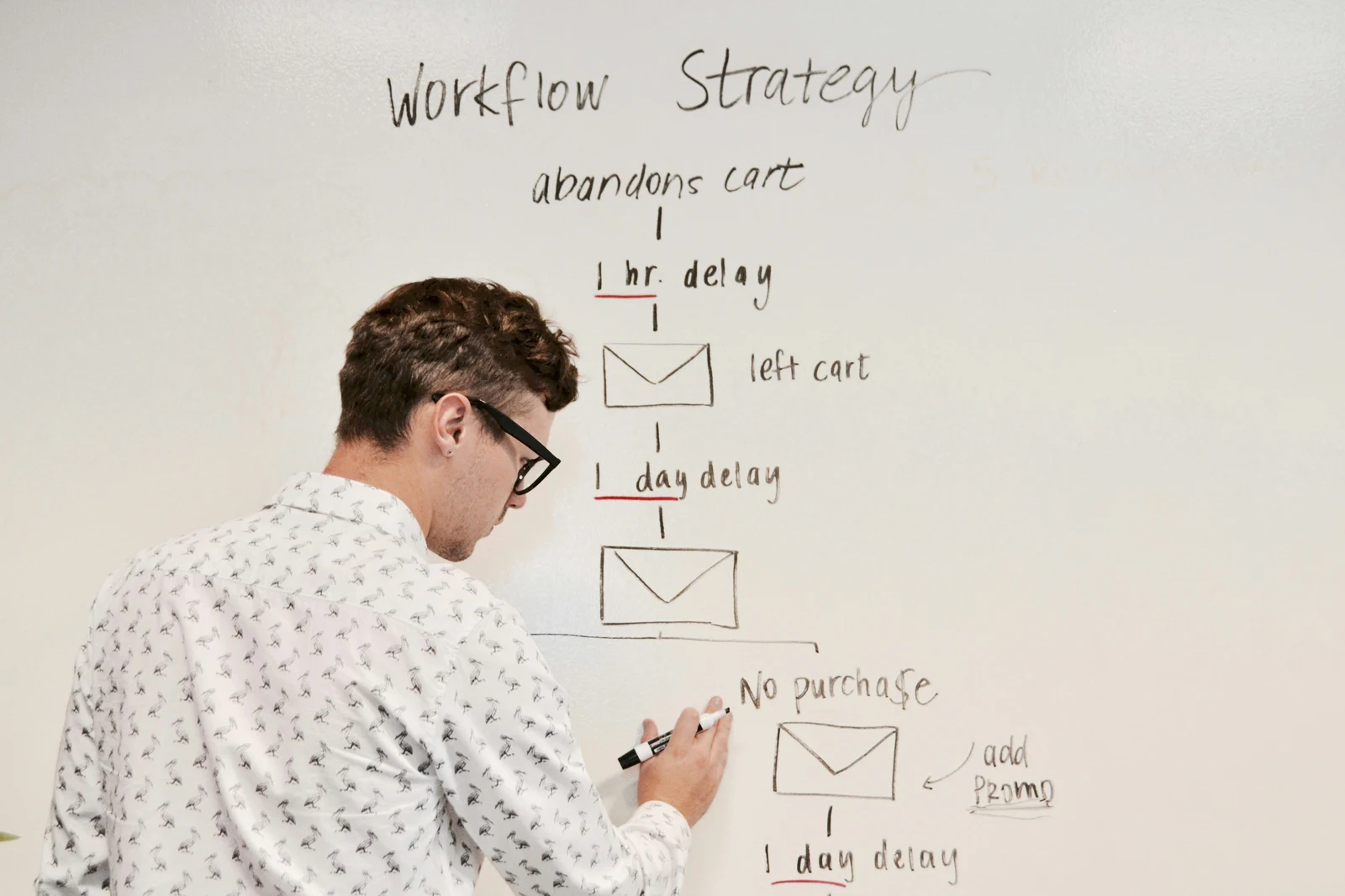
 Guide
GuideEnterprise AI agents: use cases and real costs
Enterprise AI agents: the definition, what an agent can really do, the method that gets it into production, and what it actually costs.
For operations and business teams
Our agentic-first platform creates practical automations: incoming file processing, database updates, report generation, external tool integration through MCP, and custom workflows.
Agentic AI refers to systems that receive a goal rather than a question. An enterprise AI agent picks the steps and tools it needs to reach that goal, runs the actions in your systems, checks the result and starts again if needed.
The difference from a conversational assistant is clear: a chatbot answers, an agent acts. That also shifts the stake, from the relevance of the answer to the reliability of the action and its traceability. Our deployments therefore rest on three principles: a narrow perimeter, inherited permissions, and complete logging of every decision and every tool call.
Full guide: enterprise AI agents, use cases and real costsROI in under 3 months
Many processes remain manual: collecting files, checking data, filling a database, producing a report, copying information from one tool to another. Ask This Guy turns these tasks into reliable agentic workflows, connected to your sources and easy to supervise.
Our developments, typically between €2,000 and €5,000, save 20 hours per month on average. Payback often comes in under 3 months, with fast production deployment and an architecture that can grow toward more ambitious use cases.
Extraction, validation, enrichment, and database updates from files received by email, deposit, or upload.
Agents retrieve data, apply your business rules, and produce recurring reports ready to share.
Connect internal tools, SaaS apps, databases, and APIs so agents can act inside your existing environment.
Resources
Selected articles and videos to better understand this solution and see how it works in practice.
GuideEnterprise AI agents: the definition, what an agent can really do, the method that gets it into production, and what it actually costs.
 Demo
DemoSpeed up tool integration into your agents with MCP.
 Guide
GuideWhat is AI automation? Benefits, examples, tasks worth automating, and key steps to do it right while using as little AI as possible in production.
Agentic AI refers to systems that receive a goal rather than a question, choose for themselves the steps and tools needed to reach it, check their result and start again if needed. Unlike a conversational assistant, an agent does not merely answer: it acts in your systems.
Classic automation runs a fixed, predefined sequence. It is more robust and cheaper when the process is fully deterministic. An AI agent becomes relevant when you need to interpret language, unstructured documents, or choose between several paths depending on context.
Three items: design and development of a production-ready agent, typically between €2,000 and €5,000 at ATG because the platform already provides connectors, ingestion, permissions and monitoring; runtime token cost, which varies widely with the task and must be estimated case by case; and maintenance, roughly one review per quarter. At ATG the whole thing is fixed and known before go-live.
MCP (Model Context Protocol) is a standard that lets you expose a tool once so that any agent can use it. In practice it removes the need to rebuild every integration for every agent, and clearly shortens time to production.
Under three conditions: a narrow and explicit perimeter, permissions inherited from the user or from a bounded service account, and complete logging of every decision and every tool call. On irreversible actions, we keep a human validation step.
A few days for a simple automation built on standard connectors. A few weeks if custom connectors have to be created, if the business rule needs formalising, or if the process touches irreversible actions requiring validation.
In 30 minutes, we identify a simple workflow, its development cost, and the expected ROI.