Can AI predict bitcoin? We tested Mistral's Timestral
We tested Timestral, Mistral's forecasting model, on eight years of bitcoin data. It cannot forecast the price, but it beats every model we tried on volume.
Can AI predict bitcoin? We put the question to Timestral, the forecasting model Mistral AI released on October 15, 2026, three days after its launch. Over eight years of Binance market data, we asked it for 68,252 hourly price forecasts and nearly 70,000 forecasts of traded volume, each made without seeing what came next. As far as we know, this is the first independent test of the model.
The result fits in one sentence. Timestral does not forecast the bitcoin price: in 2026, no model we tested, AI or classical, makes a better forecast than the assumption that the price will not move. It does, however, forecast the volume that will trade the next day better than every other model, and it has done so every year since 2019.
The reason goes beyond crypto. A forecasting model extends the structure of a series: its persistence, its seasonality, its regime shifts. The price of a liquid market has no exploitable structure; volume has plenty. And in a business, most of the series worth forecasting look like volume.
How did we test Timestral?
Timestral is a family of four time-series foundation models, from 5 to 209 million parameters, whose weights and code are public. You give it the history of a numeric series, and it returns a forecast range, with no prior training on your data. Mistral claims first place on three public benchmarks, but has not yet published a technical report.
We picked bitcoin because it is a closely watched, highly liquid financial series with a public, verifiable history. The data are the 15-minute candles of the BTC/USDT pair on Binance, from January 1, 2018 to October 17, 2026: 307,811 candles. We asked four questions: the price in 1 hour, the price in 24 hours, the volume traded over the next hour, and the volume of the next day.
Every forecast only sees the past. The price is forecast at every full hour from 2019 to October 2026, 68,252 forecasts in all; volume, 66,487 times hourly and 2,587 times daily. The classical models are refit every year: 2023, for example, is forecast by a model that has only seen 2018 to 2022. The year 2026 is the acid test, because it is the most recent and the least likely to appear in Timestral's training data, which Mistral has not published.
All four Timestral sizes were tested as is, with no tuning, and with 7 days to one year of history. The computation took about 12 hours on a laptop, with no GPU. The study code is not public; the PDF report describes the whole method.
The baselines to beat
A forecast is only worth something by comparison. We pitted Timestral against three families of competitors:
| Family | Examples | Role |
|---|---|---|
| Naive baselines | "the price does not move", "same as last period", "same day last week" | The minimum to beat |
| Simple statistical models | exponential moving averages, with an hourly or weekly profile | What an analyst builds in an hour |
| Trained models | linear and ridge regressions, refit every year | The best classical method for each question |
The first row is no straw man. In forecasting, the naive method, which the reference textbook by Rob Hyndman and George Athanasopoulos describes as using the most recent observation as a forecast, is often hard to beat. For the price of a financial asset, it has a name: the random walk.
Can Timestral predict the bitcoin price?
No: even with AI, the price is still not predictable. In 2026, over 6,957 one-hour forecasts, seven of eight Timestral configurations make larger errors than "the price does not move", by 0.28% to 0.93%. The best one, the 209-million-parameter model with three weeks of history, ties. The regressions refit every year do worse every year. At 24 hours it is even clearer: every Timestral configuration is worse than "price unchanged", every year from 2019 to 2026.
The hit rate on direction stays around 50%, a coin toss. The data explain why: in 2026, the return of the next 24 hours has almost no link with that of the past 24 hours (rank correlation of +0.001). There is nothing to extend.
Slightly more accurate in the past, not since 2025
In the past, Timestral was in fact slightly more accurate than a "nothing changes" forecast: between 2019 and 2024, the 209-million-parameter model beat the random walk every year, by 0.14% to 0.57%. The effect is statistically real. It exploited a slight reversal of small moves: when the price rose a little over the last 15 minutes, it tended to fall back a little within the hour. That link has nearly died out: its rank correlation went from -0.11 in 2019 to -0.015 in 2026, and Timestral's edge turned negative in 2025.
A gain below the fees
Even at its best, the signal did not pay. It earned 1.3 basis points, or 0.013%, per trade on average before fees. A regular account pays 0.1% per order on Binance, 10 basis points. Once fees are deducted, a strategy that buys or sells every hour on the forecast loses almost its entire stake.
What Timestral still brings on price
Timestral does not forecast direction, but it estimates the size of possible moves well. Its ranges are calibrated: in 2026, the interval it gave as 80% contained the actual price 80.8% of the time. One hour ahead, it beats a classical risk model based on the normal distribution by 2% to 3%. That is useful for sizing risk or setting an alert level.
The edge shrinks, though, against a well-built classical model that accounts for the time of day and the day of the week: it went from about 3.5% in 2019 to 0.5% to 1% in 2025 and 2026.
Why can Timestral forecast volume?
Trading volume, on the other hand, follows a structure. It has persistence: a busy day is often followed by another, and "same hour yesterday" already makes 54% more error than "same as the previous hour". It follows a calendar, quieter on weekends. It shifts regime with the market, and those regimes last for months. These are exactly the patterns a foundation model learns to recognize during pre-training.
Price, by contrast, is set by a market where thousands of participants hunt for the same regularity. As soon as one appears, it is exploited and vanishes. Hyndman and Athanasopoulos give the example of exchange rates: published forecasts move the rate itself, so forecasting its change is about as predictable as a coin toss. Of the four predictability factors they list, that is the one that dooms price: can the forecast change what it forecasts?
Here, AI beats a classical regression
On next-day volume, Timestral-209M with one year of history makes 4.6% less error than the ridge regression refit every year, the best classical method tested. It does better every year from 2019 to 2026, by 0.5% to 8.8%, and by 6.3% in 2026. Its ranges keep their promise: 81% and 91% coverage for intervals stated at 80% and 90%. Hourly, the edge is smaller (2.1%), but positive every year since 2022.
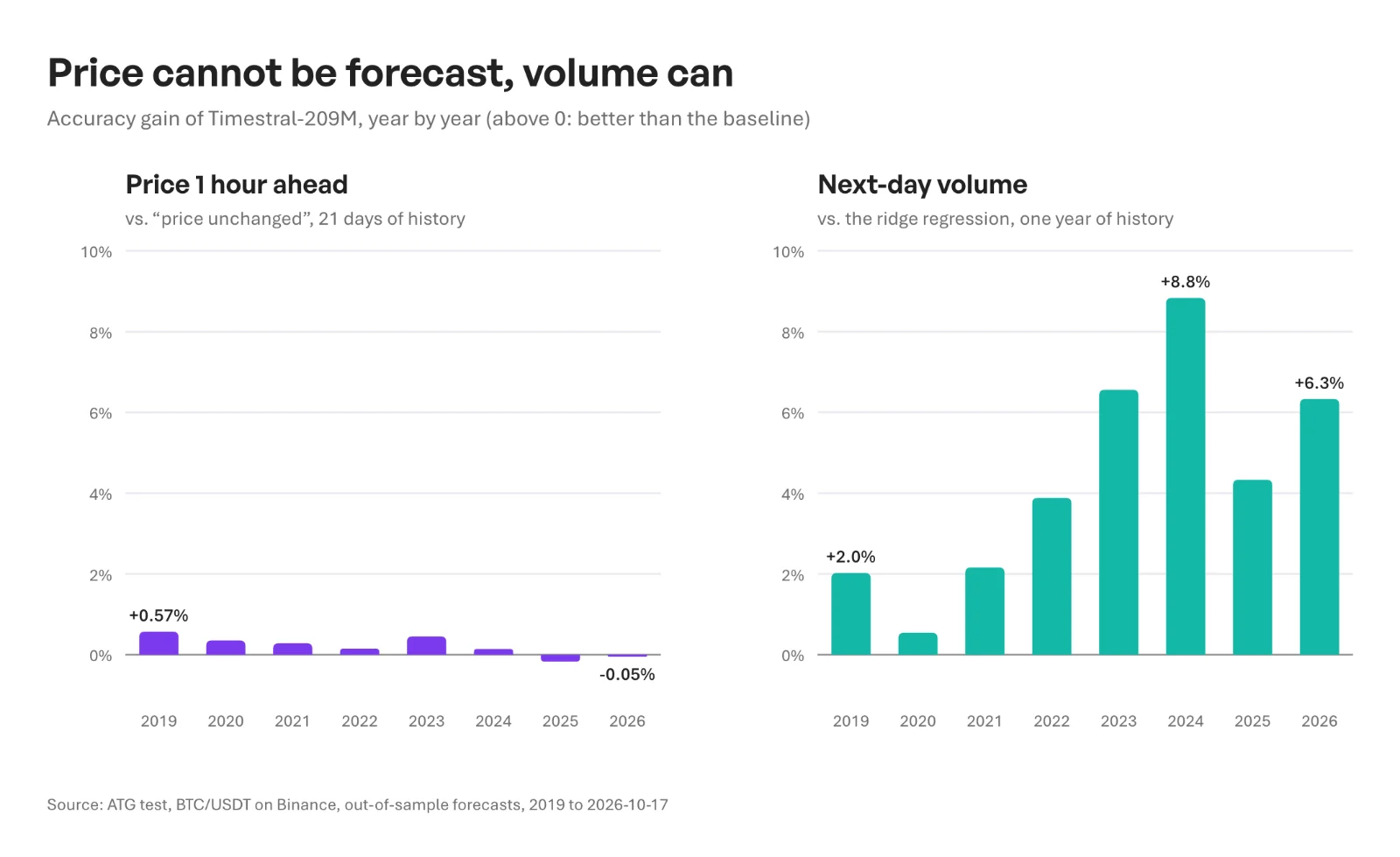 Timestral-209M gain year by year: on 1-hour price, from +0.57% in 2019 to -0.05% in 2026; on next-day volume, always positive, +6.3% in 2026
The comparison has to be made against that regression, not against a naive baseline. Against "same as yesterday", Timestral cuts the error by 32%, but the regression already does 28.7% better than "same as yesterday": what the model really adds is the 4.6%.
Context length weighed more than model size. On daily volume, going from 90 days to one year of history makes all the difference: -0.5% against the ridge with 90 days, +4.6% with one year. The model needs to see at least a year to recognize the current regime. Size helps after that (+1.1% for the smallest model, +4.6% for the largest), but on price it changes nothing.
What this test means for financial forecasting in business
The series a finance team wants to forecast also fall between two poles.
| Series | Behaves like | What to expect from an AI forecasting model |
|---|---|---|
| Orders, recurring revenue, cash collections | Volume: persistence, calendar, seasonality | A better forecast than the classical method, with no model to build, if the history is long |
| Support workload, traffic, energy consumption | Volume | Same, with ranges to size teams or capacity |
| Commodity prices, exchange rates, interest rates | Price: liquid market, information already priced in | No better than "unchanged"; the range serves scenarios and hedging |
A cash flow forecast mixes both. Customer collections and recurring payments behave like volume and suit a model like Timestral. The part indexed to a price or a rate behaves like price: for it, think in scenarios rather than a point forecast.
The change is mostly practical. According to the FP&A Trends Survey 2025, only 8% of organizations use machine learning to forecast, held back by a lack of data science skills and by data quality. A foundation model removes the first obstacle: there is no longer a model to build and tune for each series. The second one remains. You still have to extract clean, long series from the ERP, the CRM or spreadsheets, then explain the gap when reality falls outside the range. That is the work we do with finance teams in our AI for finance offering, and it is where a natural-language data access tool saves time.
One last legal point: the Timestral weights license excludes, without a contract, companies with more than $20 million in monthly revenue, about $240 million a year. A small or mid-sized company can test it freely; a large group has to negotiate with Mistral first.
Five rules for evaluating an AI forecast
We draw five rules from this test, valid for Timestral as for any other model, whether a vendor sells it or you build it in-house:
- Always a naive baseline. "Unchanged", "same as last period", "same period last year". If the model does not clearly beat them, it adds nothing.
- Then the best classical method. That is where the real gain is measured: 4.6%, not 32%, in our case.
- Out-of-sample, year by year. The model must never see the period it forecasts, and an edge that shrinks from one year to the next is a warning sign.
- Judge the range, not just the median. An interval stated at 80% should contain reality about eight times out of ten. The range is what drives decisions: safety stock, downside cash scenario, alert level.
- Give it enough history. At least one year for a daily series; otherwise the model sees neither the season nor the current regime.
These rules did not start with foundation models. In 2018, Spyros Makridakis and his co-authors compared statistical and machine learning methods on about a thousand series: a simple seasonal baseline beat half of the machine learning methods. Foundation models have arrived since; the discipline has not changed: without a naive baseline, no forecast can be judged.
Three methodological details changed our own conclusions during the study:
- With a forecast every four hours instead of every hour, the 1-hour price edge of the 209-million-parameter model looked two and a half times larger (+0.23% instead of +0.09%).
- A model that almost always forecasts a rise, on a market that goes up slightly more often than it goes down, shows a good hit rate while knowing nothing. The test has to correct for that lean.
- A single test period would have hidden that every edge on price eroded from one year to the next.
The limits of this test
The test covers a single asset on a single exchange (BTC/USDT on Binance), with no order book, derivatives or blockchain data. Timestral was used without adaptation: Mistral's tool for tuning it on your own data (Mistral Forge) was not tested, and adding volume as an extra input changed nothing in the price forecast. The classical models are well built but not tuned to the limit. The trading tests assume perfect execution, which flatters the results, still negative.
Bitcoin history may also be part of Timestral's training data, which Mistral has not published. That would favor the years 2019 to 2025. The price results are negative despite that possible advantage; the volume results hold in 2026, the least exposed year.
Frequently asked questions about AI bitcoin forecasting
Can AI predict the bitcoin price?
Not in a way that pays. In our out-of-sample test from 2019 to October 2026, neither Timestral nor the classical models did better in 2026 than "the price does not move", 1 hour or 24 hours ahead. The only edge we measured, between 2019 and 2024, earned almost eight times less than trading fees and has disappeared since.
Can AI predict the stock market?
No better than it predicts bitcoin. The price of a heavily traded stock is also set by a market where every visible regularity is exploited at once: the best forecast of its direction is still the current price. Our test covers bitcoin only and has not been repeated on stocks, but the mechanism is the same. A forecasting AI can, however, estimate the size of possible moves, which is useful for sizing risk, and forecast traded volumes, which do have a structure.
Why is traded volume more predictable than price?
Because it has a stable structure: persistence from one period to the next, a weekly rhythm, regimes that last for months. The price of a liquid market has no exploitable structure, because any visible regularity is immediately exploited by market participants, which makes it disappear.
What is a random walk in forecasting?
It is the forecast that repeats the last observed value: the price in an hour will be the current price. For a liquid financial asset, it is the hardest baseline to beat. A model that does no better than the random walk carries no information about the direction of the market.
Can Timestral be used for cash flow forecasting?
Yes for recurring flows, such as customer collections or regular payments, which have the persistence and seasonality of a volume series. It needs a long history, at least one year for a daily series. For the part of cash indexed to a price or a rate, scenarios work better.
How do you know whether an AI forecast is reliable?
Compare it first with a naive method, then with the best classical method, on periods the model has never seen, year by year. Also check that its ranges contain reality in the stated proportion, for example eight times out of ten for an 80% interval.
Timestral does not predict bitcoin, and no AI will from price history alone: this test confirms it over eight years. A forecasting AI is useful for extending numbers that have a structure, persistence and a calendar, and it does so with no training. It is useless for predicting the unpredictable. So before choosing a model for a financial forecast, look at the series. If it behaves like a price, none will beat "unchanged". If it behaves like volume, a foundation model fed a long history has a good chance of beating the classical method.