Jev alternatives: where decision models stand in Europe
Two months after Jev, 346 decision models are ranked and Jev is 79th. Jev alternatives: Cloudflare Clef and Clef-Flash, European hosts, Ollama run locally.

On September 15, 2026, TypeSafe AI released Jev, an AI model that writes nothing. You give it a text and closed questions, and it returns a decision with its probability. Two months later, the community Decision Index leaderboard lists 346 models of this kind, and Jev ranks only 79th. Every top spot is held by an open-weight Jev alternative, and one of them, Cloudflare's Clef-Flash, is even served in France since November 17.
So there is no shortage of Jev alternatives: there are hundreds. For a European company, the open questions are which ones hold up, and which ones can be used without sending data to the United States, where Jev is hosted.
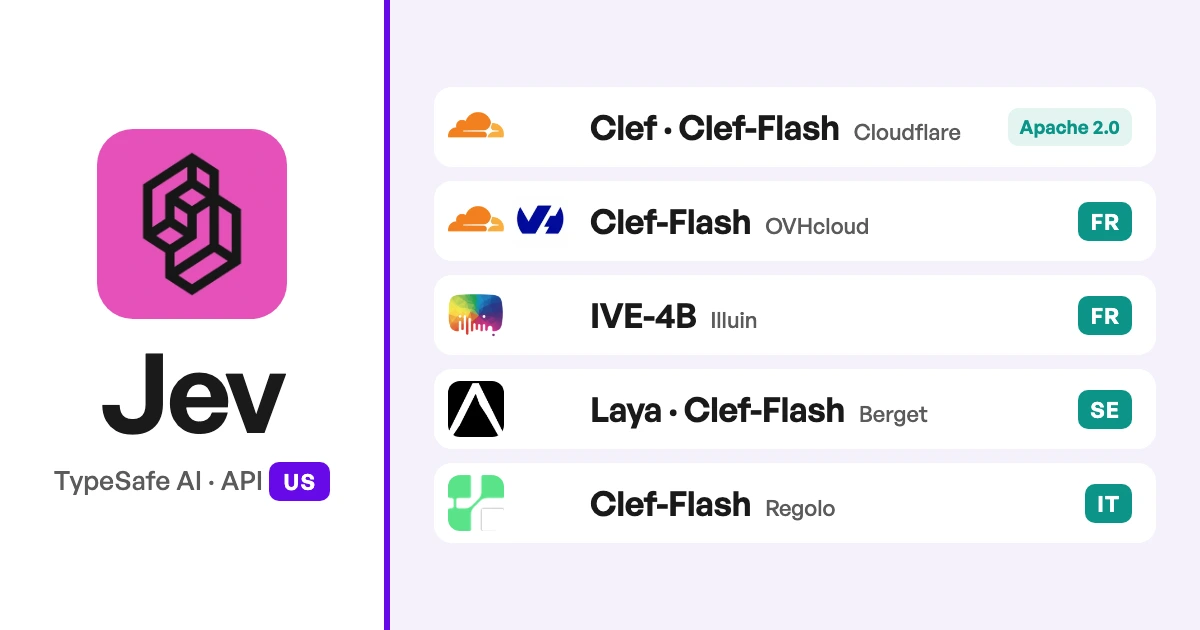
The short answer: Europe hosts these models far more than it builds them. OVHcloud serves Clef-Flash, compatible with Jev's API, from a French data center. Berget in Sweden, Regolo in Italy and two German companies offer others. Only one European publisher releases its own weights: the French company Illuin Technology.
What is a decision model?
A decision model, or "System One" model, reads a state (a text, an email, a JSON document) and answers typed questions without generating sentences. OVHcloud's documentation describes three kinds: a choice among named options (choice), a rating on ordered levels (score), and a yes/no question the model answers with the probability of yes (noul). Every answer comes with the probability of each option.
The appeal lies in what it does not do. No text to parse, no answer that changes shape from one call to the next, and a very low cost per decision. Cloudflare measured the gap on its own workload, classifying websites for its security teams: 2.2 seconds with its decision model, 4.7 seconds with gpt-oss-120b, which also returned only two categories.
At Ask This Guy, Jev has two jobs. It sorts the excerpts of a document search before they reach the LLM, as we described in our report on Jev in production. It also checks every assistant reply with three closed questions: does the reply stop mid-sentence? Does the assistant announce a search or a file without having called the tool? If so, which tool? These are small, frequent decisions, where a general-purpose LLM would be too slow and too expensive. When an algorithm is enough, we use no AI at all; these questions, however, require understanding the text.
What has changed since Jev came out?
On TypeSafe's side, not much. Jev 1.14, released on October 14, brings better multilingual support, images and an optional long context. The price has not moved: $0.042 per million input tokens, with output free. The weights are still closed and the service is still hosted in the United States.
Around it, the category has filled up. The Decision Index page lists hundreds of open reproductions, released within weeks by labs, start-ups and individuals. The big players followed: the independent DecideBench benchmark now evaluates decision models from Google, Microsoft, OpenAI, Perplexity and Liquid AI. In two months, Jev went from pioneer to one player among many.
On October 1, Cloudflare released Clef and Clef-Flash, two "fully Jev-API compatible" models under the Apache 2.0 license. Clef-Flash has 9 billion parameters and derives from Qwen3.5-9B; Clef starts from Qwen3.8-27B. Compatible means here that a program written for Jev works by changing the service address. We checked it with TypeSafe's official SDK: by replacing the base URL and the model name, it queries Clef-Flash at OVHcloud with no other change.
Which open-weight Jev alternatives, from Clef-Flash to IVE-4B?
Almost all of them start from the same place: an open language model, Alibaba's Qwen or Google's Gemma, tuned to answer with probabilities rather than text. The table lists the most cited ones, with their place on the November 21 Decision Index.
| Model | Publisher | Base | License | Decision Index (rank) |
|---|---|---|---|---|
| karpo-decision-31B | MachinePulseAI | Gemma 4 31B | Apache 2.0 | 73.9 (#1) |
| GLiDE 27B | Fastino | Qwen3.8-27B | custom license | 73.4 (#2) |
| Jev 1.14 | TypeSafe AI | closed | proprietary | 60.2 (#79) |
| Kev 27B | Jared Palmer | Qwen3.8-27B | Apache 2.0 | 59.6 (#87) |
| Clef | Cloudflare | Qwen3.8-27B | Apache 2.0 | 54.9 (#121) |
| IVE-4B | Illuin Technology | Qwen3.5-4B | Apache 2.0 | 52.8 (#136) |
| Winnow-12B | EldanRing | Gemma 4 12B | Apache 2.0 | 46.6 (#169) |
| Clef-Flash | Cloudflare | Qwen3.5-9B | Apache 2.0 | 44.4 (#181) |
| Laya | Convai Innovations | ModernBERT | Apache 2.0 | 9.2 (#332) |
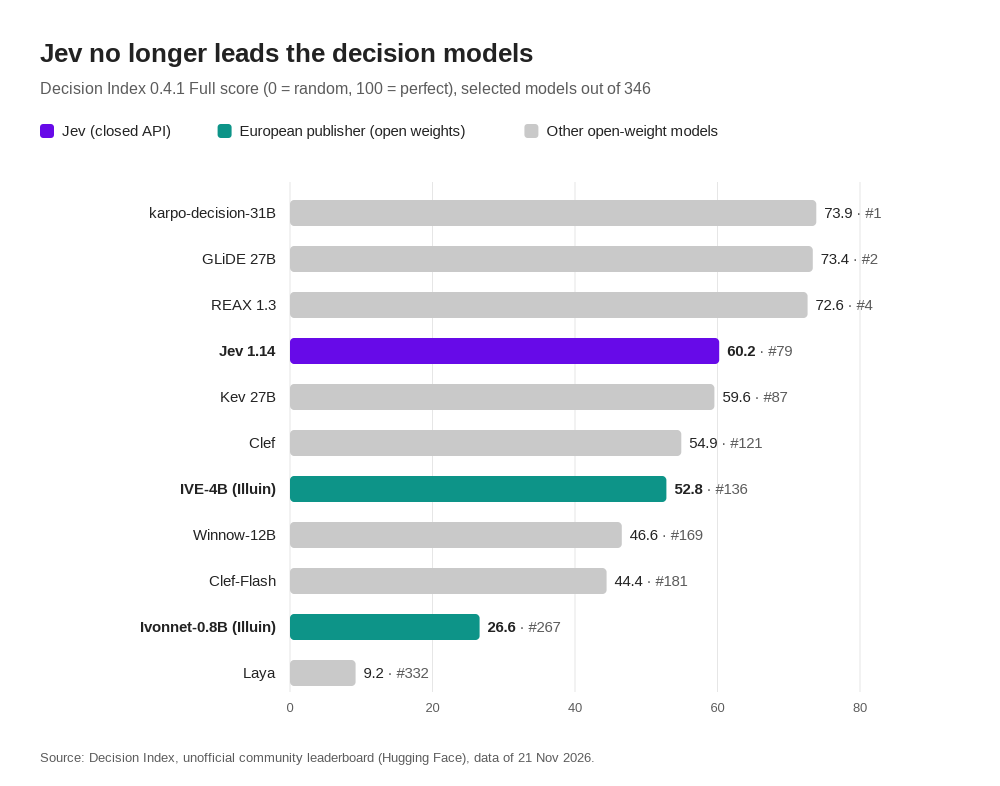 Bar chart of the Decision Index 0.4.1 Full score, data of November 21, 2026: karpo-decision-31B 73.9 (#1), GLiDE 27B 73.4 (#2), REAX 1.3 72.6 (#4), Jev 1.14 60.2 (#79), Kev 27B 59.6 (#87), Clef 54.9 (#121), Illuin's IVE-4B 52.8 (#136), Winnow-12B 46.6 (#169), Clef-Flash 44.4 (#181), Illuin's Ivonnet-0.8B 26.6 (#267), Laya 9.2 (#332)
Scores are chance-corrected: 0 is a random answer, 100 a perfect run. Perplexity has also opened the weights of pplx-decider, built on Qwen3.8-27B, and the REAX 1.3 model, ranked 4th, comes from a decentralized lab where models compete on the Bittensor network.
The leading models weigh 27 to 31 billion parameters: hosting them yourself takes a server-grade GPU, not a laptop. And the smaller ones are not necessarily the least useful: Clef-Flash, low in the overall ranking, is still the only one served by a French host.
What do published benchmarks say about Jev and its alternatives?
No single benchmark is a reference on its own, and they sometimes contradict each other, because they do not measure the same thing.
The Decision Index, a community leaderboard
The Decision Index is run by volunteers and describes itself as "unofficial and community-maintained; not affiliated with TypeSafe AI". Its main score combines 60% private tests of known skills and 40% private tasks from new domains, never published, so that nobody can train on them. A public suite of 37 benchmarks, almost all in English, sets the scale and can be reproduced with an MIT-licensed kit.
This setup reveals a useful gap. Clef-Flash scores 56.2 on the public benchmarks and 44.4 on the private tests: 12 points lost as soon as it does not know the questions. Jev stays stable (60.7 versus 60.2). The leaderboard also measures calibration, that is, how well the stated probability matches the rate of correct answers: the calibration error is 1.6% for IVE-4B and 8% for Jev.
DecideBench, the comparison with a frontier LLM
DecideBench v2 asks 450 questions that a frontier LLM, Claude Opus 4.8, solves at 99.3%, and looks at how much of that accuracy decision models recover for 100 to 1,000 times less. Jev 1.14 scores 88.0%, behind six APIs including Nace.AI's Drex Max (94.4%) and Liquid AI's d1.2-ultra (92.9%). Clef 27B, self-hosted, scores 85.3%; Clef-Flash, 66.9%. The best open model, pplx-decider 27B, reaches 92.2%. It is an individual's work, published in November: a signal, not a standard.
Two academic studies
The study by Deußer, Ramamurthy, Sparrenberg and Sifa ran Jev 1.13 on 37 datasets, 346,009 requests for under 10 dollars. Jev beats Qwen3.8-27B on 27 datasets and Gemma-4-E4B on all 37, with well-calibrated probabilities. The authors also note the limits shared by all three models: low-resource languages, fine-grained or noisy labels, rubric-based ratings. Yes/no thresholds have to be tuned task by task: on a dataset of unfair contract clauses, tuning the threshold raises the F1 score from 0.50 to 0.75.
Dinzinger, Ghosh Dastidar and Granitzer, from the universities of Passau and Linz, tested the use we make of it: sorting excerpts for a RAG. Their conclusion fits in one sentence: "If you need a reranker, fine-tune a reranker." Up to 9 billion parameters, a model trained specifically to rank passages does 5 to 29 points better. Decision models are built to decide, and fine-grained passage ranking remains the domain of rerankers, which we cover in our reranking guide.
Publishers' own numbers
Cloudflare publishes its own evaluations: Clef and Clef-Flash beat Jev on banking intent classification (BANKING77), but Jev stays ahead on passage retrieval (BRIGHT) and on deciding whether to call a tool (When2Call). These are a publisher's numbers on its own models.
Are there European alternatives to Jev?
For us, an offer is European when the company that controls it is headquartered in the European Economic Area or in Switzerland. A European subsidiary or data center of a US group is not enough: it is the logic we apply in our analysis of what "sovereign" really means. With this criterion, the landscape splits in two: hosts, fairly numerous, and a single publisher.
| Company | Country | Role | Models | Price (input) |
|---|---|---|---|---|
| OVHcloud AI Endpoints | France | host | Clef-Flash (data center in France) | $0.04 / M tokens |
| Berget AI | Sweden | host | Laya, Clef-Flash, Qwen3.5-2B | €0.042 / M tokens |
| Regolo (Seeweb) | Italy | host | Clef-Flash | €0.15 excl. VAT / M tokens |
| Decision Models | Germany | host | s1-fast, s1-pro, Clef-Flash | €0.030 / M tokens (s1-fast, EU tier) |
| eu/jev (Bevelites GmbH) | Germany | host | unnamed model | €0.037 / M tokens |
| Illuin Technology | France | publisher | IVE-4B, Ivonnet-0.8B | free weights |
The hosts
OVHcloud has served Clef-Flash since November 17 at $0.04 per million input tokens, about the price of Jev, with a 16,000-token context. Berget AI opened a "System One" category on September 25, on its own hardware in Sweden. Decision Models, a company based in Passau, offers an "EU" tier that keeps requests in Europe, with a data processing agreement, and serves Clef-Flash on GPUs in Poland. eu/jev, run by the Munich company Bevelites GmbH, promises inference in Germany "at Jev's price", without saying which model answers.
Scaleway, Mistral, Infomaniak, Nebius and Verda listed no decision model in their catalogs as of November 26. Mistral has released nothing in this category; the only model built on a Mistral base, Jevstral 8B, is an individual's work.
A single publisher: Illuin Technology
Illuin Technology, based in Puteaux near Paris, released IVE-4B on November 3 and Ivonnet-0.8B on November 18, under the Apache 2.0 license. IVE-4B, tuned from Qwen3.5-4B, also reads documents as images. The publisher says it is first among models under 5 billion parameters on the new-domain tasks of the Decision Index, at about 50 milliseconds per question on one GPU. It answers choices and yes/no questions, not yet ratings on a scale, and no host serves it as an API: you have to install it yourself.
On the research side, a preprint from November 4 describes Zuse, a family of decision models for 27 European languages, whose project page is hosted by Bineric, the Norwegian publisher of the NorskGPT models. It makes an observation that holds for the whole category: until then, no decision model had published results outside English. We did not find its weights.
What the European argument is worth
The weights are American or Chinese; the hosting can be European. Clef-Flash comes from Cloudflare and Qwen; served by OVHcloud, it sends no data out of Europe and no US company controls it. We take the same position on LLMs: the origin of an open model matters less than where it runs, as we explain about open-weight models. Europe has the hosts; it lacks the publishers.
Can you run a decision model locally?
Yes, and it has become simple. Ollama has exposed the decision-model API since version 0.35.0, at the local address http://localhost:11434/v1/systemone. Its library includes Clef-Flash, downloaded more than 100,000 times, Clef, Laya, Kev, Liquid AI's d1 and pplx-decider. A program written for Jev then points to the machine instead of the United States.
The constraint is hardware. A 4 to 9 billion parameter model runs on a workstation GPU; a 27 to 31 billion parameter model, the kind that tops the rankings, needs a server card. REAX 1.3, 4th on the Decision Index, requires a 96 GB RTX PRO 6000. Illuin's IVE-4B installs only with PyTorch and CUDA, so on an NVIDIA card. We cost out an on-site AI server in our article on the local AI server, and its limits in local LLMs and the sovereignty illusion.
What a company can take away
Switching decision models costs little, since Jev's API has become a de facto standard. What takes work is evaluating the model on your own decisions. Public leaderboards are in English, contradict each other, and the Decision Index gives a quarter of its weight to academic knowledge (physics, math, code), far from routing a ticket or validating a reply. A hundred real decisions, reviewed by hand, will say more than a rank on the Decision Index.
Thresholds matter as much as the model. A probability of 0.5 does not mean the same thing from one model to the next, or from one question to the next, as the study on Jev showed. We set ours on reports reviewed excerpt by excerpt before putting Jev into production.
For organizations that require processing in Europe, the most direct option today is Clef-Flash at OVHcloud, with the same code as for Jev. In our own EU-only policy, reply checking is currently handled by a general-purpose LLM hosted in Europe that answers in JSON. Decision models hosted in Europe are the natural candidates to take over, and we will evaluate them on our own decisions before any change.
Frequently asked questions about Jev alternatives
What is a System One model?
It is a decision model: it reads a state (text or JSON) and answers closed questions with probabilities, without generating text. There are three question types: a choice among options, a rating on ordered levels and a yes/no question. TypeSafe AI launched the category with Jev on September 15, 2026.
Is Jev open source?
No. Jev's weights are closed and the model is only available through TypeSafe AI's API, hosted in the United States. Its training method is not published. The open alternatives, such as Cloudflare's Clef-Flash or Illuin's IVE-4B, are under the Apache 2.0 license.
How much does Jev cost?
Jev 1.14 costs $0.042 per million input tokens, and output tokens are free. Clef-Flash at OVHcloud costs $0.04 per million input tokens, Berget AI charges €0.042 for its decision models and eu/jev €0.037.
Is there a Jev alternative hosted in Europe?
Yes. Since November 17, 2026, OVHcloud AI Endpoints has served Clef-Flash, an open Cloudflare model compatible with Jev's API, from a French data center. Other European hosts serve decision models in Sweden, Italy and Germany.
Can you run Jev locally?
Not Jev itself: its weights are not published. Compatible models run locally: Ollama, since version 0.35.0, exposes the same API as Jev and offers Clef-Flash, Clef, Laya and Kev. The best-performing ones need a server-grade GPU.
Is Cloudflare Clef-Flash as good as Jev?
Not on general leaderboards: on the November 21, 2026 Decision Index, Clef-Flash ranks 181st and Jev 79th, and DecideBench gives Clef-Flash 66.9% against 88.0% for Jev. Clef, its 27-billion-parameter sibling, comes closer. Only an evaluation on your own decisions tells whether the gap matters for a given use.
Conclusion
Jev created a category, then watched it slip away: in two months, open models overtook it and European hosts now serve them. The question still open is the publishers'. Illuin shows that a French company can release a competitive 4-billion-parameter decision model; Zuse shows that European languages remain largely untouched ground. The first major European decision model, multilingual and served in Europe, does not exist yet.
If you want to know which of your teams' decisions a model like this could take on, and with what hosting, book a demo. Our forward deployed engineers do this evaluation work directly with your teams.