Olala mini, OVH's first French LLM: what is it really worth?
Olala mini 7A1B, OVH's first LLM, runs without a GPU. What 7A1B means, what the figures leave out, and what this French LLM can do for European businesses.

On November 17, 2026, OVH announced Olala mini 7A1B, its first LLM and the first of a family called Olala. Its weights will be available on Hugging Face from Thursday, November 19, according to the news agency AFP, under the Apache 2.0 license, on the day of OVHcloud's AI Summit in Paris.
The model that Octave Klaba, OVHcloud's founder and CEO, described in October to the French business daily La Tribune as "very far ahead of its time" turns out to be a small one: 7 billion parameters, only one billion of which work on each word it produces. OVH says it can run on a standard processor, without a graphics card. OVH is aiming at simple tasks at very low cost, and leaves the rest to large models.
Nobody knows yet how good it is: OVH has published speeds, not a single quality score. For a company, the appeal lies in what it could do locally, on ordinary machines, and that is what will need measuring as soon as the weights are out.
What is Olala mini, OVH's French LLM?
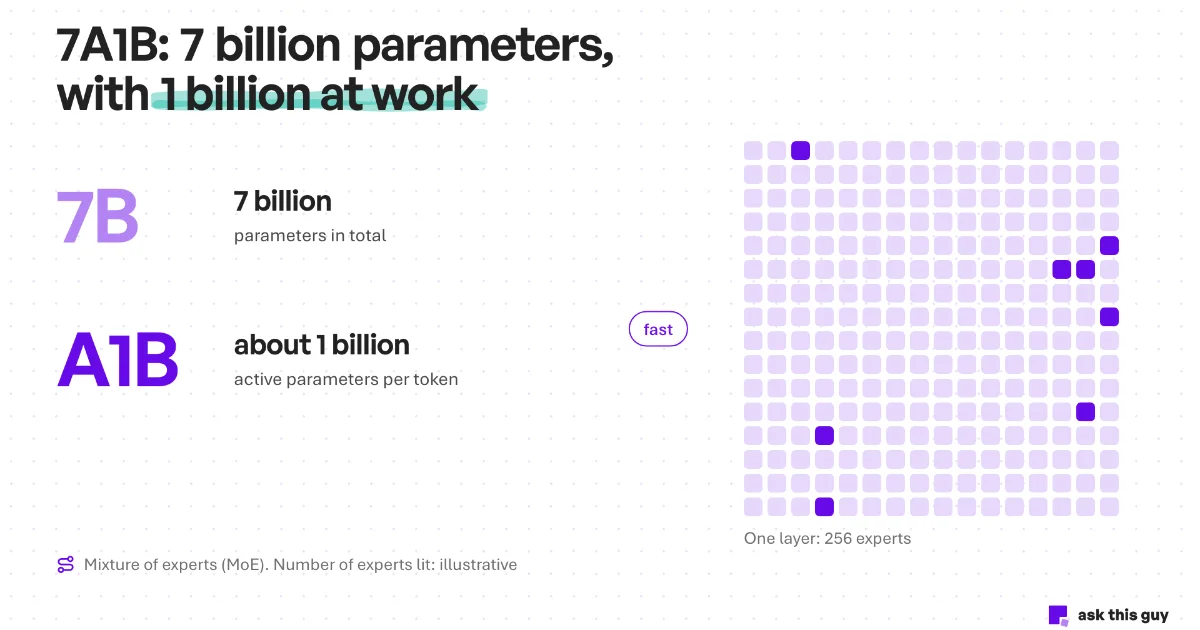
Olala mini 7A1B is a compact open-weight language model, trained from scratch by OVH. The name reads like a spec sheet: 7 billion parameters in total, one billion of them active for each token, that is, each word or piece of a word the model reads or writes.
The gap between total and active comes from the architecture. Olala mini is a mixture of experts (MoE): each layer of the model is split into 256 small sub-networks, the experts, and a router wakes up only a few of them for each token. The model stores 7 billion parameters but computes with only one billion at each token. Our guide to mixture of experts versus dense models explains this trade-off.
The rest of the spec sheet is unusual. OVH describes a hybrid attention combining "Differential-TPA" with Mamba-3 layers. These are three recent research ideas, published by others:
- Microsoft Research's Differential Transformer (2024) computes attention as the difference between two attention maps, to dampen the noise on unimportant words;
- Tensor Product Attention (2025) compresses the keys and values the model keeps in memory while it reads a text;
- Mamba-3 (2026), by Albert Gu, Tri Dao and their co-authors, replaces part of the attention with a state space model, whose cost does not grow with the length of the text.
All three share the same goal: less memory and more speed at answer time. How OVH puts them together is not described; the French tech outlet Next points out that the claim of a "novel" architecture has yet to be backed up. The technical report, announced alongside the weights, should tell.
The press release talks about "open source", but OVH is announcing the weights, the base model, a technical report and AI Act compliance documentation, not the training code or the data. Olala mini is therefore an open-weight model, like Llama or Qwen; the distinction is explained in our article on open weights vs open source. Apache 2.0 is one of the most permissive licenses: commercial use, modification and redistribution with no threshold and no contract.
Why does it run without a graphics card?
Because it computes little. A graphics processor is built to multiply huge matrices very fast; a conventional processor does it slowly. With one billion active parameters per token, Olala mini needs roughly the compute of a model seven times smaller than its total size, which stays within reach of a recent server or workstation processor.
The announced figures point the same way. According to OVH's press release, the model "reaches 160 tokens per second on an RTX A4500", a professional graphics card, and 50 tokens per second "without a GPU, on a standard processor". The context window, the length of text the model can read in one go, is 32,000 tokens, a few dozen pages.
Memory, however, does not add up. OVH says a GPU with as little as 8 GB is enough, yet an MoE has to keep all its experts in memory, even the idle ones: 7 billion parameters in BF16 weigh about 14 GB, at two bytes each. ActuIA flags the gap and sees in it a compressed version or partial loading of the experts, which the press release does not explain. The same outlet notes that the RTX A4500 used for the measurement has 20 GB of memory, not 8, and the processor behind the 50 tokens per second is not named. No test conditions come with these throughputs either, neither text length nor number of concurrent requests, as Next notes.
Nothing disqualifying: compressed to 8 bits, 7 billion parameters weigh about 7 GB, and 3.5 GB at 4 bits, at the cost of a quality loss that will need measuring. But the real configuration will show in the files released on Thursday, not in the press release.
How does Olala mini compare with other small models?
Impossible to say today, and that is the main criticism of this announcement. OVH has published speeds, not a single quality score. On October 20, Octave Klaba nonetheless promised La Tribune that customers would be able to "see its speed, its memory consumption and the quality of its answers". Two out of three, for now.
The competition is well known. In the same class, Mistral releases Ministral 3 in 3, 8 and 14 billion parameters, and Alibaba Qwen 3.5 9B, all under Apache 2.0. OVH even already serves Qwen 3.5 9B on its API service, AI Endpoints, at $0.12 per million input tokens. Olala mini will have to show it does at least as well, in French in particular, to justify switching models.
The only usage report comes from Qwant, the French search engine, which adopted it, according to the press release, for its "flash answer" feature: answers 20% faster and running costs divided by three compared with the previous model, a Mistral model according to Next. The figure comes from OVH, not Qwant, and the customer is not independent: Qwant is controlled by Synfonium, 75% owned by Octave and Miroslaw Klaba, OVH's founders. A first in-house customer is nothing unusual; it does not prove, however, that the model suits anyone else.
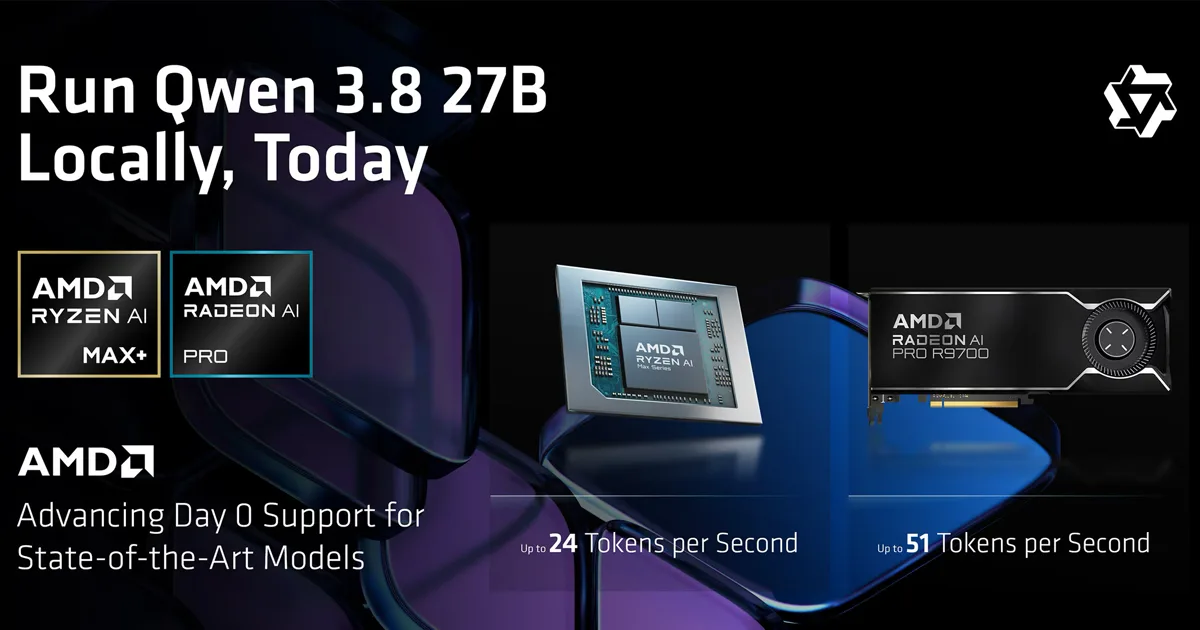
A last limit is context. 32,000 tokens are enough to answer a question or summarize a short document. To query a document base or have an agent work on a long file, it is little: Qwen 3.8 27B, in the same OVH catalog, reads 262,144. OVH announces 128,000 tokens for version 1.1, by the end of the year.
Has OVH changed its bet?
Yes, and that is rather good news. In June 2026, OVHcloud said it wanted to develop frontier AI models, according to Reuters. In October, the ambition narrowed to three areas, cybersecurity, code and business agents, and the first model would "not exactly" cover all three. In November comes a small general-purpose model; the specialized models are pushed back to a version 2.0 that, according to the press release, "will exceed 100 billion parameters", with no date.
The timeline, on the other hand, was kept. Octave Klaba had told La Tribune about a release "at the end of November", while Reuters reported the same day a first model "in early 2027". La Tribune was right. Our article on OVHcloud's AI strategy details what already existed around this model, from GPUs to AI Endpoints.
The resources are modest, and OVH makes a point of it. Training took place on three European public supercomputers, Jupiter in Germany, MeluXina in Luxembourg and Jean Zay, the French national research supercomputer, thanks to public support which, according to OVH, is "equivalent to €7 million in computing hours". That amount is not the cost of the model, which nobody has published. On staffing, Octave Klaba told AFP about "a little under a hundred people" working on AI, spread across three Paris labs, against more than 1,000 employees at Mistral. "We want to show that it is possible to train a model with few resources," he added.
The rationale has not changed, in the press release: "We cannot simply rely on the generosity of certain labs to share their LLMs as open source in the years to come." "Today's open source is Chinese," he summed up before the French National Assembly in September, and publishers are already tightening the licenses of their flagship models. We think this scaled-down bet is the right one. A small model released beats a large model promised: anyone can test it and compare it, and it teaches OVH how to train, something the acquisition of Dragon LLM in March had started. Whether a player of this size can keep pace with the labs on version 2.0, where costs change scale, remains to be seen.
Does OVH outsource inference?
For Olala mini itself, the question does not arise: weights under Apache 2.0 run wherever they are installed. It does arise for the service that will serve it, and OVH has not yet said whether Olala will join AI Endpoints. For that service, our answer is: no, no third party runs the models, with two caveats.
The most often overlooked criterion of AI sovereignty is the operator, the company that actually runs the graphics processors. Mistral signs its contracts through a French company, but its sub-processor list names CoreWeave as its inference provider, and Microsoft and Google as infrastructure. These are American companies, subject to US law even when their servers are in Europe, as we explained in our article on CoreWeave.
At OVH, the group's sub-processor list refers to the terms of each service for the names of third-party companies. The terms for AI Endpoints name none and state that OVH handles maintenance itself, whereas the same document names Aiven for managed databases. The contracting party is OVH SAS, and the capital is nearly 80% controlled by the Klaba family. Contracting party, operator and control are therefore European: AI Endpoints joins Scaleway in the small group of end-to-end European inference services, according to the criteria on our sovereign AI page. They are also the two inference providers ATG uses.
First caveat: the location is not written into the contract. Since November 10, OVH's documentation has described the infrastructure as "hosted in Europe" and no longer names Gravelines. The catalog declares France for each of the 21 models, and the service's address points to an OVH load balancer in Gravelines: these are strong clues, not a commitment. OVH's subsidiaries in Canada and the United Kingdom also appear among the group's sub-processors, for all services outside SecNumCloud (the French state's security certification) and Trusted Cloud.
Second caveat: SambaNova. Part of AI Endpoints runs on machines from this American manufacturer. It is not declared as a sub-processor, so it does not process data in the contractual sense, but nothing says whether it administers its machines remotely. One last detail matters for developers: calling OVH through Hugging Face, for which it has been an inference provider since November 2025, routes requests through an American company.
What can Olala mini be used for in a company?
Small models have their ground: simple tasks repeated by the thousand. Classifying messages, extracting fields from a form, rephrasing, detecting a language, giving a short answer based on a supplied text. On these tasks, a model with one billion active parameters can be enough, and its cost per request becomes negligible.
Olala mini adds two arguments. It runs on ordinary hardware: an existing server, a workstation, perhaps a laptop, with no graphics card to buy. And its Apache 2.0 license lets a company install it wherever it wants, including on machines cut off from the internet, which settles at once the question of who sees the data. Our article on local AI servers prices the hardware needed for a larger model.
Its limits are just as clear. To draft a document, reason over a case file, write code or drive an agent, a model of 27 billion parameters or more remains necessary in our view, and a 32,000-token context rules out long documents. Olala mini is not available in the AI Endpoints catalog as of November 17 either: using it will mean hosting it yourself, at least at first.
What IT leaders can take away
There is no rush, and nothing stops a company from trying it. The right approach, in our view, comes down to four points:
- Waiting for the weights and the technical report on November 19 before drawing any conclusion: actual file size, compressed versions, published scores, languages covered.
- Testing it on the company's own data, on a simple, high-volume task, against the small model already in place (Ministral 3, Qwen 3.5 9B or a small closed model). The announced speed says nothing about quality on a real case.
- Archiving the weights and the license file of the version tested: a version released under Apache 2.0 stays that way, whatever OVH decides later.
- Not making it the only model: an LLM gateway routes simple tasks to a small model and the rest to a larger one, and makes it possible to switch models without rewriting the application.
Frequently asked questions about Olala, OVH's LLM
What is Olala mini 7A1B?
Olala mini 7A1B is OVH's first large language model, announced on November 17, 2026. It is a mixture of experts with 7 billion parameters, about 1 billion of them active for each token, spread across 256 experts per layer. It combines a hybrid attention (Differential-TPA) with Mamba-3 layers, reads a 32,000-token context and will be released under the Apache 2.0 license.
When will Olala be available?
OVH announced Olala mini on November 17, 2026. Its weights, the base model, a technical report and AI Act compliance documentation are expected on Hugging Face on Thursday, November 19, the day of the OVHcloud AI Summit in Paris. A version 1.1 with a 128,000-token context is planned by the end of 2026, and a version 2.0 of more than 100 billion parameters with no date.
Is Olala open source?
Not in the strict sense. OVH releases the model weights under the Apache 2.0 license, which allows commercial use, modification and redistribution. But neither the training code nor the training data has been announced, according to Next: Olala mini is an open-weight model, like Llama, Qwen or Ministral.
Can Olala run without a graphics card?
According to OVH, yes: the model reaches 50 tokens per second on a standard processor, and 160 tokens per second on an RTX A4500 card. These throughputs come from the press release, with no test conditions. The 7 billion parameters weigh about 14 GB in BF16: the announced 8 GB of memory implies a compressed version, to be checked in the released files.
Is Olala available on OVHcloud AI Endpoints?
Not as of November 17, 2026. The model appears neither in the AI Endpoints catalog nor in the list of models served by its API, and OVH has announced no usage price. At least at first, it will have to be self-hosted from the weights published on Hugging Face.
Does OVH outsource AI Endpoints inference?
No, according to its contractual documents. The AI Endpoints terms name no third-party sub-processor, while OVH's sub-processor list refers to those terms for companies outside the group, and OVH maintains the service itself. Two caveats: the hosting location is not guaranteed by contract (the documentation says "Europe", the catalog declares France for every model), and the role of SambaNova, whose machines run part of the service, is not documented.
Is Olala a competitor to Mistral?
On small models, yes, and already at a customer: Qwant replaced a Mistral model with Olala mini for its "flash answer", according to Next. At 7 billion parameters, Olala mini goes up against Mistral's Ministral 3 (3, 8 and 14 billion), all under Apache 2.0, with no quality comparison published so far. Elsewhere, the two are not playing the same game: Mistral also sells large models and supports the companies that deploy them, with more than 1,000 employees according to AFP, while OVH has a little under a hundred people working on AI. Olala version 2.0, beyond 100 billion parameters, would bring the two closer on large models, but it has no date.
For now, Olala mini proves that OVH can train and release a model; its quality remains to be shown. The interesting question arrives on Thursday, with the weights: can a compact European LLM, with no license restrictions, hold its own against Qwen and Ministral on the simple tasks of a European company? The scores in the technical report will give a first indication, and tests on real cases will show whether it deserves a place in the information system.