DeepSeek V4.1 Pro vs DeepSeek V4 Pro: What to Expect
DeepSeek V4.1 Pro is not out as of November 16. What is confirmed, what the leaks are worth, and DeepSeek V4 Pro today: pricing, MIT license, data location.

As of November 16, 2026, DeepSeek V4.1 Pro does not exist. DeepSeek's API change log says nothing about it, and DeepSeek's Hugging Face organization has no repository by that name. The Chinese lab has written the name exactly once, on September 10, in the V4.1 Flash announcement: requests sent to V4 Pro would be routed to the new Flash model, and “This will continue until V4.1-Pro launches”. The Pro model you can use today is DeepSeek V4 Pro, in its V4-Pro-0813 version, released on August 13.
So the name is official, and nothing else is: no date, no size, no price, no benchmark. Even that single mention was walked back the next day. On September 11, DeepSeek dropped the routing plan “in response to user demand” and kept V4 Pro running. Since then, 67 days have gone by without V4.1 Pro, against 13 days between the final releases of V4 Flash and V4 Pro last summer.
For a business, we do not think it is worth waiting for. The small model of the new generation already beats the old big one: DeepSeek says V4.1 Flash is “ahead of V4-Pro on performance, cost, speed & total runtime”, and Artificial Analysis scores it at 32.6 against 23.1 for V4 Pro. It costs less, and Scaleway already serves it from France, which no European host does for any version of V4 Pro.
For context, DeepSeek is a Chinese AI lab founded in 2023 in Hangzhou and funded by the High-Flyer hedge fund. It releases its models as open weights: the weights, the files that hold the trained model, can be downloaded, and V4 Pro's are under the MIT license, one of the most permissive there is. At DeepSeek, "Pro" is the large model and "Flash" the fast, cheap one.
Is DeepSeek V4.1 Pro out? What is confirmed
No. Here is where things stand on November 16, 2026, separating what is established from what is rumor.
| Information | Status |
|---|---|
| The name "V4.1 Pro" | Written once by DeepSeek, on September 10, with no date or specification |
| Routing V4 Pro to V4.1 Flash "until V4.1 Pro launches" | Announced on September 10, canceled on the 11th before it took effect; the announcement page was never corrected |
| Weights on Hugging Face | No V4.1 Pro repository, from DeepSeek or third parties; DeepSeek's latest repository is V4.1 Flash 1017, from October 17 |
| API model ID, pricing | None: DeepSeek's price page lists only deepseek-flash and deepseek-v4-pro |
| Size, architecture, license, benchmarks | Unknown |
| The November 11 leak | Unit-test data in a Vercel Labs coding agent, not an announcement |
| DeepSeek's latest announcement | November 13: search, OCR and speech APIs, for the Flash model only |
Rumors and leaks: what they are worth
The most widely shared one dates from November 11. A deepseek/deepseek-v4.1-pro identifier showed up in the model picker of an open-source coding agent. The agent is fx, from Vercel Labs, and the string sits in a unit test in this commit, next to other models ranked by a hand-written sort key. The test needed a Pro model newer than the Flash one. As OrcaRouter put it, “the fixture is not a schedule”.
On October 31, a lab at Renmin University had already written --model deepseek-v4.1-pro in the quick-start example of its FlashRSI tool, then removed it. Dozens of GitHub repositories contain the same string, often mapped to deepseek-v4-pro: these are developers getting ahead of a release, not leaks.
On X, predictions have followed one another since September: a release "within the next two weeks", hidden early access, or a window from "the second half of October to the first half of November". kie.ai has collected them, and every one of those dates has passed without a release. None of the figures going around, such as "at least 2.6T parameters", cites a source.
DeepSeek V4.1 Pro release date: what precedent suggests
Nobody knows, and the precedent is not encouraging. For V4, DeepSeek released Flash and Pro on the same day, April 24, then their final versions 13 days apart: Flash 0731 on July 31, with the note “The official release of DeepSeek-V4-Pro will follow soon”, then Pro 0813 on August 13. For V4.1, Flash came out on September 10, its update V4.1 Flash 1017 on October 17, and the Pro model has been missing for 67 days.
On Polymarket, a prediction market, bettors gave a 10% chance of a new DeepSeek Pro model by November 30 on November 16, and 17% by year-end. They expect a new Flash rather than a Pro, and DeepSeek did ship a Flash update in October, not the Pro. Odds are not information, but they do suggest nothing credible points to an imminent release.
DeepSeek V4 Pro today: what the available model is worth
A 1.6-trillion-parameter MoE under the MIT license
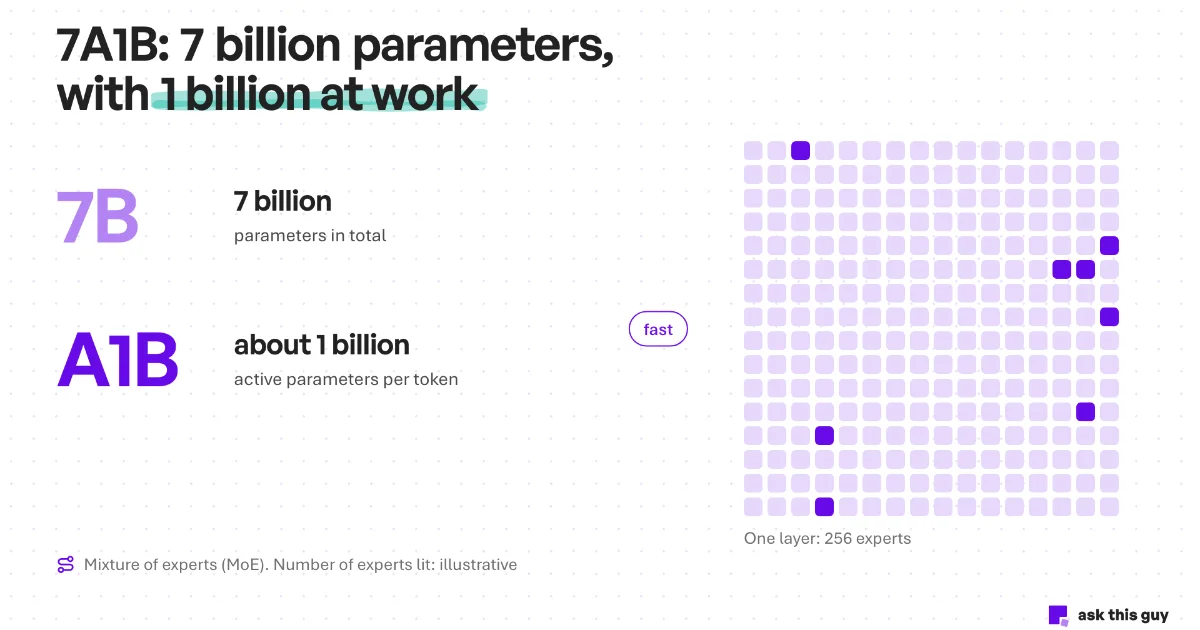
DeepSeek V4 Pro is a mixture of experts (MoE): the model is split into "experts", and only a few of them work on each token, the chunk of a word the model reads or writes. According to DeepSeek, it has 1.6 trillion parameters, 49 billion of them active per token, and reads up to one million tokens of context. Version 0813, released on August 13, replaces the April preview, adds three reasoning effort levels (low, high, max) and stays under the MIT license: commercial use, modification and resale as a service are all allowed.
Size is the first hurdle. V4-Pro-0813's files weigh 892.7 GB on Hugging Face, even though the experts are stored in FP4, a 4-bit format. The vLLM recipe, from the reference inference engine, starts from an eight-H200 server and caps the context at 800,000 tokens to leave room for working memory. Eight 80 GB H100s, 640 GB in total, cannot even load the weights. V4 Pro is a data-center model, not one for a local AI server.
What DeepSeek claims, what others measure
DeepSeek's numbers look good. On the V4-Pro-0813 model card, the model scores 87.9 on Terminal Bench 2.1 against 85.0 for Claude Opus 4.8, and 62.7 on DeepSWE against 58.0. These scores are picked by the vendor, measured with its own agent harness, DeepSeek Harness, and compared with models that have since been replaced. The benchmarks also change from one card to the next: SWE-bench, published for the preview, is gone from version 0813.
Independent measurements are more modest. In the Artificial Analysis Intelligence Index (version 5.0.1, November 16), V4 Pro 0813 scores 23.1 at maximum effort, the median for its category. That puts it below Mistral Large 4, at 26.1, and far behind Kimi K3.1 Pro, the top open-weights model on the leaderboard at 46.5. In May, CAISI, the evaluation center at the US NIST, judged that the preview lagged “behind the frontier by about 8 months”, while finding it more cost-efficient than models of similar capability.
V4.1 Flash already beats V4 Pro
DeepSeek says so itself. On September 10, it described V4.1 Flash as “ahead of V4-Pro on performance, cost, speed & total runtime”, and announced: “We're phasing out V4-Pro”. On the V4.1 Flash model card, the new model goes from 62.7 to 74.2 on DeepSWE and from 12.4 to 31.2 on Terminal-Bench 4.0 compared with V4 Pro 0813. Its October update, V4.1 Flash 1017, climbs further, to 77.0 and 42.3.
Artificial Analysis confirms the order, with smaller gaps. V4.1 Flash 1017 scores 32.6, the second-best open-weights model on the leaderboard, against 23.1 for V4 Pro. It generates 173 tokens per second, against 93, and costs $0.60 per index task, against $1.77 for V4 Pro. On Terminal-Bench 4.0, Artificial Analysis measures 33.8% where DeepSeek reports 42.3: the score depends on the agent harness.
The counterpoint is knowledge. According to DeepSeek's own tables, V4 Pro's base model keeps the edge on factual questions (55.2 against 42.3 on SimpleQA-Verified) and long documents (51.5 against 45.2 on LongBench-V2). That makes sense: knowledge lives in the total parameter count, and V4 Pro has three times as many. V4.1 Flash is also verbose, producing 174 million tokens for the index against a median of 104 million. Knowledge and long documents are where a V4.1 Pro would have the most to add.
DeepSeek V4 Pro API pricing: peak hours fall on European mornings
DeepSeek's price page has peak and off-peak hours, with off-peak at half price. In dollars per million tokens, as of November 16:
| Model | Input (cache miss), off-peak / peak | Output, off-peak / peak |
|---|---|---|
deepseek-v4-pro (V4 Pro 0813) | 0.66 / 1.32 | 1.98 / 3.96 |
deepseek-flash (V4.1 Flash 1017) | 0.15 / 0.30 | 0.60 / 1.20 |
Peak hours run from 01:00 to 04:00 and from 06:00 to 10:00 UTC, Monday to Friday, except Chinese public holidays: 9 a.m. to noon and 2 to 6 p.m. in Beijing. In Paris, that means 7 to 11 a.m. in winter (6 to 10 a.m. in London), plus a night slot: the European working morning pays full price.
The price has moved a lot in seven months. At launch, V4 Pro cost $1.74 for input and $3.48 for output. A 75% discount was made permanent on May 22, bringing it to $0.435 and $0.87. On August 12, DeepSeek announced “a significant increase”, which took effect on August 16. Compared with the June price, input at peak costs three times as much, and output 4.6 times as much, higher even than the launch price.
Flash went the other way. On September 10, DeepSeek cut its price with the release of V4.1 Flash: “We're passing the savings on to you”. At peak hours, V4 Pro costs 4.4 times as much as V4.1 Flash for input and 3.3 times as much for output, for a lower score. No wonder DeepSeek wanted to move traffic from one to the other. Its customers still got to keep V4 Pro, a sign that the big model remains useful for some workloads.
What to expect from DeepSeek V4.1 Pro
Nothing has been published about its performance. As for its shape, the V4.1 Flash announcement offers clues. DeepSeek presents Flash as “the smallest model in our new architecture family”, designed for “scaling to larger models”. V4.1 Pro would be the large model of that same family.
That family breaks with V4. According to the V4.1 Flash model card, it uses a "Causal Encoder-Decoder" architecture. The 552-billion-parameter model activates only 8 billion to read the prompt and 16 billion to write the answer. Its working memory per token, the KV cache, drops to 890 bytes, about a quarter of V4 Flash's: the same GPU can hold more long conversations at once.
The headline size is misleading, though. On top of its 552 billion parameters, Flash adds a 196-billion-parameter conditional memory called Engram, and its files weigh 510 GB. A V4.1 Pro larger than Flash will likely weigh more than 510 GB: at least one high-end eight-GPU server, possibly more. That is an inference, not information: DeepSeek has published no size.
As for the license, DeepSeek has released the weights of every V4 and V4.1 version under MIT so far, as its Hugging Face organization shows. Nothing guarantees V4.1 Pro will follow: no statement covers it. On release day, we will check six things:
- whether the weights are published, and under which license;
- their real size on disk, Engram memory included, and the minimum hardware given by DeepSeek or vLLM;
- the API price, at peak and off-peak hours;
- the Artificial Analysis score, against V4.1 Flash (32.6) and Kimi K3.1 Pro (46.5);
- results on knowledge and long documents, where V4 Pro keeps its edge;
- when a European host will offer it.
DeepSeek for business: the API no, the weights yes?
The name "DeepSeek" covers two things that an IT department should keep apart: DeepSeek's service, and the weights of its models.
The API and the app send data to China
DeepSeek's privacy policy, updated in February 2026, is explicit: “we directly collect, process and store your Personal Data in People's Republic of China”. Inputs may be used to train its models, with an opt-out by email. Two European authorities have already acted. Italy's data protection authority, the Garante, ordered on January 30, 2025 an emergency limitation on the processing of Italian users' data. In June 2025, Berlin's data protection commissioner reported the app to Apple and Google as illegal content. In the United States, a notice published in the Federal Register on October 20, 2026 excludes DeepSeek products from federal civilian agencies.
Our sovereignty test is simple: a provider whose parent company sits outside the European Economic Area fails, wherever its servers are. DeepSeek's API fails that first check, and a European company that sends personal data to it sets up a transfer to China that it will have to justify under the GDPR.
MIT weights hosted in Europe send nothing to DeepSeek
An open-weights model does not “phone home” to its publisher. Once downloaded, the weights are files running on servers you choose. Hosted by a European operator, a DeepSeek model sends nothing to Hangzhou. Sovereignty depends on who runs the compute, not on the nationality of the weights. We made the same case for Qwen, Alibaba's model.
In practice, that applies to V4.1 Flash, not V4 Pro. Scaleway serves V4.1 Flash 1017 serverless, with context limited to 256,000 tokens during the preview, or on a dedicated eight-H100 server. Umans, a French inference provider and an Ask This Guy partner, also offers V4.1 Flash, at $0.15 for input and $0.60 for output. For V4 Pro, we found no sovereign European host as of November 16, and OVHcloud's catalog has no DeepSeek model. You would have to run it yourself, on an eight-H200 server.
Two questions remain open, and they apply to American models too: biases inherited from training, which have to be tested on your own use cases, and dependence on a vendor whose roadmap changes from one day to the next. Our page on sovereign AI details these criteria, and our article on open model licenses compares MIT with Mistral's and Qwen's licenses.
What an IT department should take away
Waiting for V4.1 Pro before starting a project makes no sense: nothing points to a release, and the model that already beats V4 Pro is available. If a DeepSeek model fits the use case, we would start from V4.1 Flash 1017, served by a European host, rather than V4 Pro through DeepSeek's API. V4 Pro costs more, scores lower and, through the API, sends data to China.
V4 Pro still has a case for pure knowledge tasks and very long documents, where it keeps the edge. You still need to host it: 893 GB of weights means an eight-H200 server, an investment that only makes sense for sustained volume and data that cannot leave the company.
Switching models is something to plan from day one. European hosts expose an OpenAI-compatible API, and an LLM gateway lets you change models through configuration, without touching the code. With a set of 100 to 300 real questions and their expected answers, like the one in our RAG audit guide, a team can evaluate V4.1 Pro in half a day on release day, and switch if the gain is real.
Frequently asked questions about DeepSeek V4.1 Pro and V4 Pro
Is DeepSeek V4.1 Pro out?
No. As of November 16, 2026, DeepSeek has published no weights, API model ID, pricing or benchmarks for V4.1 Pro. The only Pro model available is DeepSeek V4 Pro, in version 0813, released on August 13, 2026. The name V4.1 Pro appears only in the V4.1 Flash announcement of September 10.
When will DeepSeek V4.1 Pro be released?
There is no official date. DeepSeek has given no timeline, and every date floated on social media since September has passed without a release. For V4, the final Pro model followed the Flash one by 13 days; for V4.1, Flash came out on September 10 and the Pro model is still missing 67 days later. On November 16, Polymarket bettors gave a new Pro model a 10% chance by November 30.
What is the difference between DeepSeek V4 Pro and V4.1 Flash?
V4 Pro is the large model of the V4 generation: 1.6 trillion parameters, 49 billion active per token, 893 GB of weights. V4.1 Flash, released on September 10, is the smallest model of a new architecture: 552 billion parameters, 8 to 16 billion active, 510 GB of weights. According to DeepSeek and to Artificial Analysis, V4.1 Flash does better on coding and agents and costs less; V4 Pro keeps the edge on factual knowledge and long documents.
How much does the DeepSeek V4 Pro API cost?
As of November 16, 2026, $0.66 per million input tokens and $1.98 per million output tokens off-peak, twice that at peak. Peak hours run from 01:00 to 04:00 and 06:00 to 10:00 UTC on weekdays, which is 7 to 11 a.m. in Paris in winter. The peak output price, $3.96, is 4.6 times the June 2026 price, before the August 16 increase.
Is DeepSeek V4 Pro open source?
DeepSeek V4 Pro is an open-weights model: its weights can be downloaded from Hugging Face under the MIT license, which allows commercial use, modification and resale as a service. Its training data and code are not published, which sets it apart from open-source software in the strict sense.
What hardware do you need to run DeepSeek V4 Pro locally?
V4 Pro 0813's weights weigh 892.7 GB. The vLLM recipe starts from an eight-H200 server, with context capped at 800,000 tokens; DeepSeek also gives an example on a four-GB300 node. Eight 80 GB H100s cannot load the weights. It is not a model for a workstation or a small server.
Can a company use DeepSeek and comply with the GDPR?
Through DeepSeek's API or app, it is hard: according to its privacy policy, DeepSeek stores data in China, and two European authorities, in Italy and Berlin, have challenged those transfers. With the MIT weights hosted by a European operator, no data goes back to DeepSeek. Scaleway serves V4.1 Flash from France; no European host served V4 Pro as of November 16, 2026.
DeepSeek tried to retire its big model in favor of the small one, and its customers stopped it. Meanwhile, the previous generation's flagship costs more than a newer model that scores higher. When V4.1 Pro comes out, its score against Kimi K3.1 Pro will make the headlines. For a European company, the useful question will be elsewhere: who will run it in Europe, on what hardware, and at what price?