Qwen 4 27B vs Qwen 3.8 27B: What to Expect from Qwen 4
This article reviews what is confirmed about Qwen 4 27B, Qwen's upcoming model, and how Qwen 3.8 27B, a dense model on one GPU, compares with Mistral models.

"Qwen4 next week." That is what Alibaba Cloud CTO Feifei Li reportedly said on October 29 in Amsterdam, according to one attendee. Twelve days later, no Qwen 4 model has been published on Hugging Face, and Alibaba's only written statement is still its September 22 press release: Qwen 4 is "currently in training". Everything points to an imminent release, though: the official Qwen account posted a teaser on November 6. The model you can actually download today is Qwen 3.8 27B, released on August 14 under the Apache 2.0 license. Its results are exceptional for its size, which is why we use it a lot at Ask This Guy.
Some context: Qwen (short for Tongyi Qianwen) is the AI model family of Alibaba, the Chinese e-commerce giant (Taobao, Tmall, AliExpress), which is also China's largest high-end cloud provider. Launched in April 2023, Qwen has released most of its models as open weights since August 2023: anyone can download them and run them on their own machines. The range goes from under one billion parameters to 2,400 billion. The "27B" in Qwen 3.8 27B means 27 billion parameters, the internal settings whose number gives a rough idea of a model's size.
Qwen 3.8 27B is a dense model, at a time when almost every large open model, Mistral's included, has moved to mixture of experts (MoE). It fits on a single GPU. In the November 10 Artificial Analysis leaderboard, it scores 20 points, five times as much as Gemma 4 31B or gpt-oss-120b, and four times as much as Mistral Medium 3.5, a 128-billion-parameter dense model.
What should you expect from Qwen 4 27B? On performance, nothing has been published. On its shape, the name gives a clue: at Qwen, the names of MoE models include two numbers ("35B-A3B"), dense models a single one. A "Qwen4-27B" would therefore be dense, if Alibaba keeps its convention. But the preview of the Qwen 4 architecture, released in August, adds embedding tables of 51 billion parameters that do not appear in its name: the real memory footprint of a future "27B" could exceed what its name suggests. Two other signals call for caution. That preview is released under a custom license, not Apache 2.0: under such terms, Qwen 4 27B could require a contract for some commercial uses, such as reselling it as a service. And the 3.7 generation never had an open-weight release: nothing obliges Alibaba to publish a downloadable Qwen 4 27B.
Qwen 4 27B: what is actually confirmed?
Very little. The name "Qwen4-27B" has been circulating since Alibaba's Apsara conference, but it comes from keynote slides and write-ups, not from the official press release, which does not mention any 27-billion-parameter model. Where things stand on November 10, 2026:
| Information | Status |
|---|---|
| Qwen 4 is in training | Confirmed by Alibaba on September 22, with a roadmap to Qwen 4.5 and Qwen 5 |
| A Max, Plus, Flash and 27B lineup | Names seen in the keynote, absent from the press release |
| "Qwen4 next week" | Attributed to the CTO on October 29 by a single attendee, unconfirmed; the week passed with no release |
| "The becoming begins" teaser | Posted on November 6 by the official Qwen account, with no model name, date or size |
| Weights on Hugging Face | No Qwen 4 repository in the Qwen organization |
| License, actual size, architecture | Unknown |
Precedent gives a rough idea of the timing. Qwen 3.8 Max came out on August 3, and Qwen 3.8 27B followed about ten days later. If Alibaba repeats the pattern, the 27B will land after the Qwen 4 flagship, which has not shipped either. On Manifold, a play-money prediction market, forecasters gave a 61% chance of Qwen 4 weights on Hugging Face by November 25, as of November 10. A bet is not an announcement.
The Qwen 27B family: three versions in six months
Qwen 27B is the mid-sized model of Alibaba's Qwen family: a dense 27-billion-parameter language model, multimodal (text, image, video), released as open weights under the Apache 2.0 license. It went through three versions in 2026, all built on the same architecture:
| Version | Release | License | Cumulative Hugging Face downloads as of Nov 10 |
|---|---|---|---|
| Qwen 3.5 27B | February 2026 | Apache 2.0 | 22.4 million |
| Qwen 3.6 27B | April 22, 2026 | Apache 2.0 | 30.9 million |
| Qwen 3.8 27B | August 14, 2026 | Apache 2.0 | 22.0 million, 7.5 million in the last 30 days |
There was no Qwen 3.7 27B. The 3.7 generation, Qwen 3.7 Max in May and Qwen 3.7 Plus on June 1, shipped as API-only models, with no published weights: no Qwen 3.7 repository exists on Hugging Face. Trackers expected open 27B and 35B versions, which never came. The open 27B went straight from version 3.6 to 3.8. The previous dense model of this size from Qwen was Qwen 3 32B, released in April 2025 with a conventional architecture.
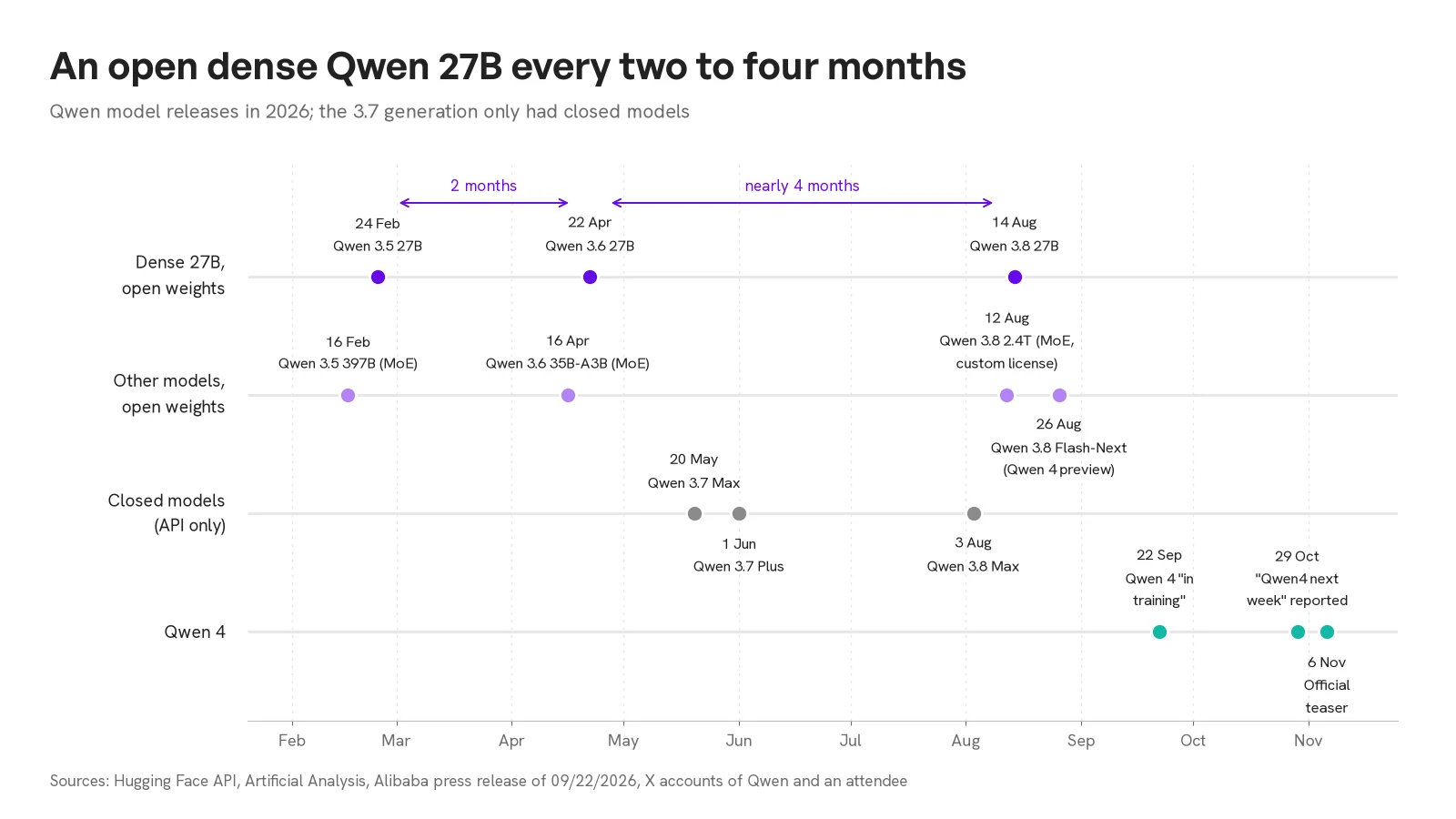 Timeline of Qwen releases in 2026, on four rows. Dense 27B with open weights: Qwen 3.5 27B on February 24, Qwen 3.6 27B on April 22 (two months later), Qwen 3.8 27B on August 14 (nearly four months later). Other open models: Qwen 3.5 397B on February 16, Qwen 3.6 35B-A3B on April 16, Qwen 3.8 2.4T under a custom license on August 12, Qwen 3.8 Flash-Next, a Qwen 4 preview, on August 26. Closed models: Qwen 3.7 Max on May 20, Qwen 3.7 Plus on June 1, Qwen 3.8 Max on August 3. Qwen 4: announced as in training on September 22, "Qwen4 next week" reported on October 29, official teaser on November 6
Dates: Hugging Face, Artificial Analysis and Alibaba.
Since Qwen 3.5, these models have been hybrid: of the network's 64 layers, three out of four use so-called linear attention (Gated DeltaNet), which is lighter on memory, and one in four uses full attention. The Qwen 3.8 27B model card lists a 262,144-token context window, extendable to one million, and a thinking mode with four settings, from off to xhigh. Qwen describes it as a "compact, deployment-friendly dense model".
What Qwen claims
From one version to the next, Qwen keeps the architecture and changes the training, and the announced gains are large. A selection of the scores published by Qwen:
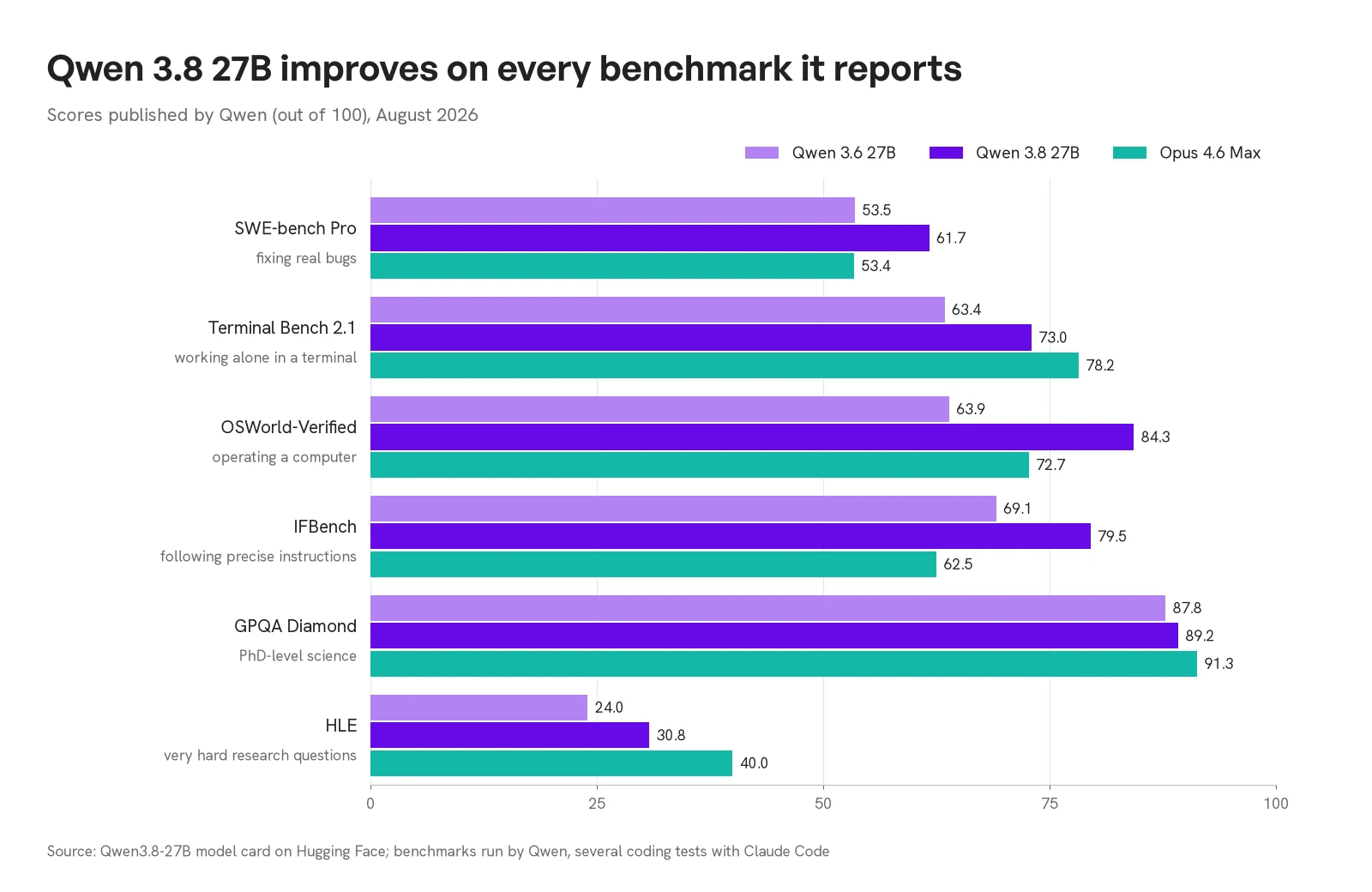 Bar chart of scores published by Qwen, out of 100, for Qwen 3.6 27B, Qwen 3.8 27B and Opus 4.6 Max: SWE-bench Pro 53.5, 61.7 and 53.4; Terminal Bench 2.1 63.4, 73.0 and 78.2; OSWorld-Verified 63.9, 84.3 and 72.7; IFBench 69.1, 79.5 and 62.5; GPQA Diamond 87.8, 89.2 and 91.3; HLE 24.0, 30.8 and 40.0
These are the vendor's own numbers, measured with its own settings, and several coding benchmarks were run with Claude Code as the harness. The "Qwen 3.8 27B beats Opus" headlines on YouTube overstate it: it beats Opus on SWE-bench Pro in this table, not on Terminal Bench or HLE.
The most interesting number is in the previous table, the one for Qwen 3.6 27B. Qwen compares its dense model with its own MoE from the previous generation, Qwen 3.5 397B, fifteen times heavier. On SWE-bench Verified, the dense model scores 77.2 against 76.2; on Terminal-Bench 2.0, 59.3 against 52.5. On agentic coding, a dense 27B matched a 397-billion-parameter MoE. The big model keeps the edge on knowledge (MMLU-Pro, GPQA, HLE), which makes sense: knowledge is stored in parameters, and it has fifteen times more of them.
What independent benchmarks show
Artificial Analysis runs the same battery of tests on every model. On version 4.3.2 of its index, recorded on October 21, Qwen 3.8 27B scored 34 points, against 21 for Qwen 3.6 27B, 18 for Qwen 3.5 397B, 15 for Google's Gemma 4 31B and 12 for OpenAI's gpt-oss-120b. The site has since moved to version 5.0.1, on a harsher scale: Qwen 3.8 27B now sits at 20 points, while the median for comparable models is 8. In the November 10 leaderboard, that is five times the score of Gemma 4 31B or gpt-oss-120b, at about 4 points each.
The same page shows the downside. To complete the index, Qwen 3.8 27B produced 128 million tokens, against a median of 77.7 million, and took 39.9 minutes per task against 13.9. The model thinks at length before it answers. At 46 tokens per second on Alibaba's API, you pay for that in waiting time, and in money when you are billed per output token.
What we see at ATG
At ATG, Qwen 3.8 27B is the model that writes the answers to users' messages. It is the model used, for example, in our FinanceBench benchmark, where our search agent correctly answers 92% of analyst questions asked over 368 financial reports. When we swapped it for Gemini 3.8 Flash, we saw no significant difference in score, and none either when we raised its thinking budget. In a RAG system, retrieval drives the result. A well-equipped 27-billion-parameter model is enough to read documents and write a sourced answer.
We have also seen its limits. Pushed to a temperature of 1.5 (a setting that makes answers more random), it no longer returns a valid answer in 15 to 27% of cases: its reasoning runs away and hits the maximum length. At the settings Qwen recommends, we have not seen this problem.
Qwen 27B vs Mistral, the European reference
For a French company, Mistral remains the reference for open weights, as it is for many European buyers. The comparison is useful, as long as each model is put in its proper place, because the two lineups do not cover the same tiers.
| Model | Architecture | Parameters (total / active) | License | Artificial Analysis index v5.0.1 | Cumulative downloads |
|---|---|---|---|---|---|
| Qwen 3.8 27B | hybrid dense | 27B | Apache 2.0 | 20 | 22.0 million |
| Mistral Small 3.2 (June 2025) | dense | 24B | Apache 2.0 | not measured | 5.6 million |
| Mistral Small 4 (March 2026) | MoE | 119B / 6.5B | Apache 2.0 | 4 | 0.7 million |
| Mistral Medium 3.5 (April 2026) | dense | 128B | Modified MIT, with a revenue cap | 5 | 1.1 million |
| Mistral Large 3 (December 2025) | MoE | 675B / 41B | Apache 2.0 | not measured | 17,500 |
| Mistral Large 4 (October 2026) | MoE | about 1,000B / 52B | Mistral Ecosystem Open-Weight License | 26 | 12,000 |
| Qwen 3.8 2.4T-A95B (August 2026) | MoE | 2,400B / 95B | Qwen3.8-Max License | not scored (API version, Qwen 3.8 Max: 34) | 117,500 |
Download counts come from the Hugging Face API as of November 10, 2026.
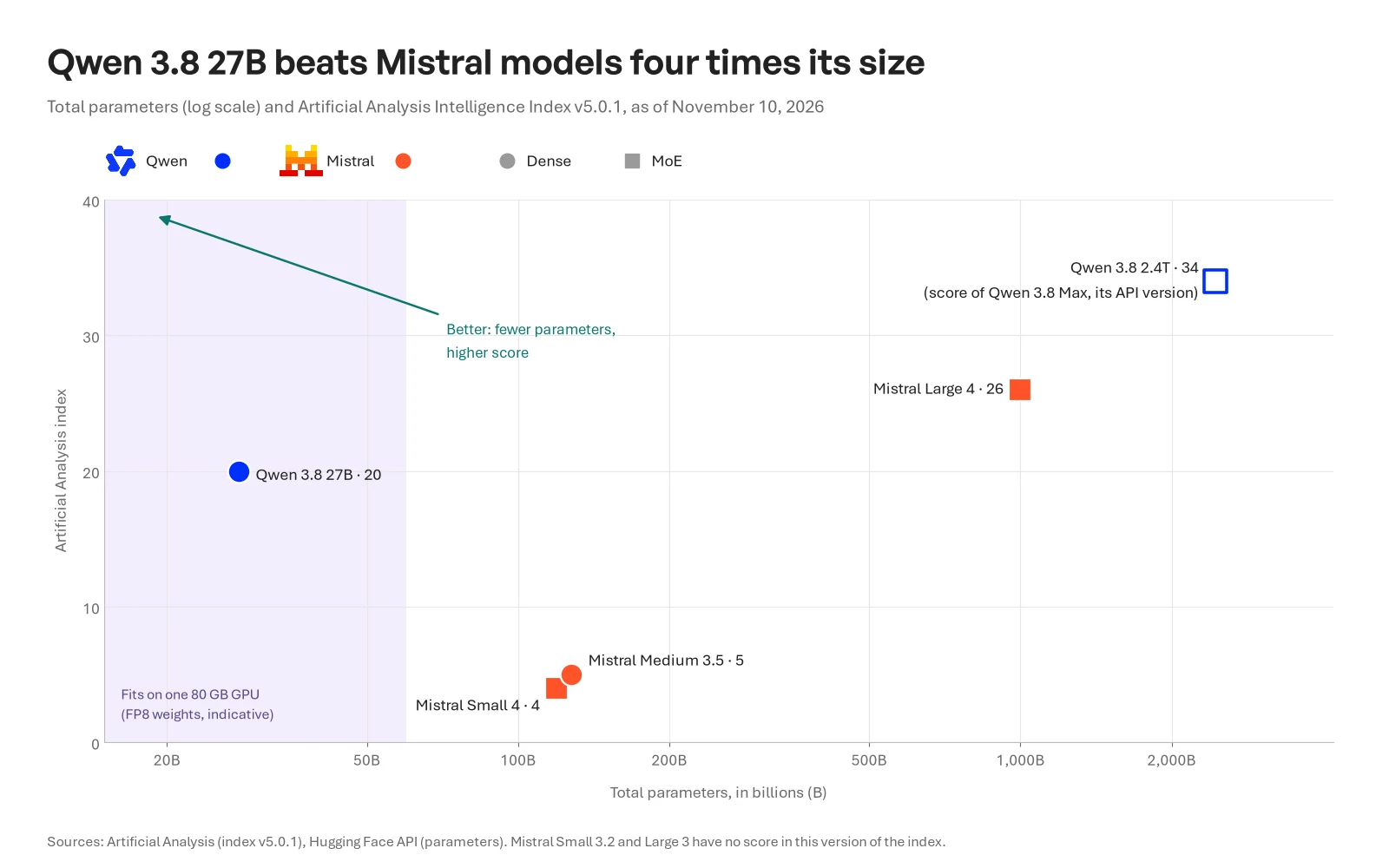 Scatter plot of total parameters on a log scale against the Artificial Analysis index v5.0.1. Qwen 3.8 27B, dense, 27 billion parameters, score 20, the only model in the zone that fits on one 80 GB GPU. Mistral Small 4, 119-billion-parameter MoE, score 4. Mistral Medium 3.5, 128-billion-parameter dense model, score 5. Mistral Large 4, MoE of about 1,000 billion parameters, score 26. Qwen 3.8 2.4T, 2,400-billion-parameter MoE, placed at 34, the score of its API version Qwen 3.8 Max. An arrow shows that the top left is better: fewer parameters, higher score
At the single-GPU tier, Mistral has no recent answer. Its latest general-purpose models under 30 billion parameters, Ministral 3 and Devstral Small 2 for code, date from late 2025. Mistral Small 3.2, the dense 24-billion-parameter model downloaded 5.6 million times, dates from June 2025. In 2026, Mistral has released large models and specialized ones (voice, time series, mathematical proofs), but no successor to Small 3.2. The Qwen 27B line went through three versions over the same period.
Mistral Medium 3.5 is the other dense model in the lineup, but it has 128 billion parameters, and its deployment examples use eight GPUs. Mistral reports 77.6 on SWE-bench Verified, on par with the 77.2 Qwen reports for its 27B, with protocols that may not be comparable. More importantly, its license excludes companies whose consolidated monthly revenue exceeds $20 million: above that, you must ask Mistral for a commercial license, granted "at its sole discretion", or use its hosted services. A large mid-sized company or a corporate group cannot run Medium 3.5 on its own servers without a contract.
Mistral Small 4 is an MoE with 119 billion parameters, 6.5 billion of them active, under Apache 2.0, and Mistral's deployment example uses two GPUs. It is fast (145 tokens per second on Mistral's API, per Artificial Analysis) and frugal: Mistral states on its model card that Qwen models need three to four times more output for comparable results, which matches the verbosity of Qwen 3.8 27B measured above. On the index, it lags far behind.
At the top end, it is the other way around. Mistral Large 4, released in late October, scores 26 points on the Artificial Analysis index, above Qwen 3.8 27B's 20, and Mistral presents it as the best Western open-weight model on that index. But it has about a trillion parameters, its deployment examples use eight GPUs, and its license requires a contract for anyone who wants to resell it as an inference service: a different project, with a different budget.
Alibaba has its own equivalent, even larger: Qwen 3.8 2.4T-A95B, the open-weight version of its flagship, has 2,400 billion parameters, 95 billion of them active, and weighs 4.9 TB on Hugging Face. Artificial Analysis does not score it, as this version has no public API, but Qwen 3.8 Max, the commercial version built on it, scores 34 points, above Mistral Large 4's 26. Its license is not the Apache 2.0 of the 27B: the "Qwen3.8-Max License" requires displaying the model name above 100 million monthly users or $20 million in monthly revenue, and a contract to resell it as a service above $50 million in revenue. At Qwen as at Mistral, the very large open model comes with a custom license. Closer to Mistral Large 3 in size, Qwen 3.5 397B remains under Apache 2.0, but has no score in the current version of the index.
Our take: between Qwen and Mistral, we would decide based on the GPU budget and the license. For a model that fits on one card, Qwen 3.8 27B has no recent equivalent at Mistral. For the best open quality, Mistral Large 4 and Qwen 3.8 2.4T both require a multi-GPU server and a custom license; Mistral has the advantage of being a European vendor. Sovereignty is settled elsewhere, as we discuss below.
Dense vs MoE: why a dense 27B when everyone is moving to MoE?
A dense model uses all its parameters for every token it produces. A mixture-of-experts model (MoE) is split into sub-networks, the experts, and a router activates only a few of them for each token. Our guide to mixture of experts explains the difference step by step. Its size is written with two numbers: Qwen 3.6 35B-A3B has 35 billion parameters, 3 billion of which are active for each token.
MoE has become the norm for large open models. Alibaba's flagship, Qwen 3.8 Max, has 2,400 billion parameters, 95 billion of them active. Mistral Small 4 and Large 4, DeepSeek V4 and gpt-oss are MoE models too. Recent dense models are few: Qwen 27B, Google's Gemma 4 31B, Mistral Medium 3.5.
An MoE must keep everything in memory
An MoE computes little, but it has to keep all its experts loaded, because the router may call any of them for the next token. As Hugging Face puts it, "all parameters need to be loaded in RAM, so memory requirements are high". For the size of the weights published in BF16, the reference format, the Hugging Face API gives:
| Model | Architecture | BF16 weights |
|---|---|---|
| Qwen 3.8 27B | dense, 27B | 55.6 GB (30.9 GB in FP8) |
| Qwen 3.6 35B-A3B | MoE, 3B active | 71.9 GB |
| Qwen 3.5 397B-A17B | MoE, 17B active | 806.8 GB |
In FP8, Qwen 3.8 27B fits on an 80 GB GPU with room left for conversations. At 4 bits, it weighs about 17 to 18 GB according to Runpod, which fits on a 24 GB card such as an RTX 4090. For comparable coding quality, it needs fifteen times less memory than the 397-billion-parameter MoE.
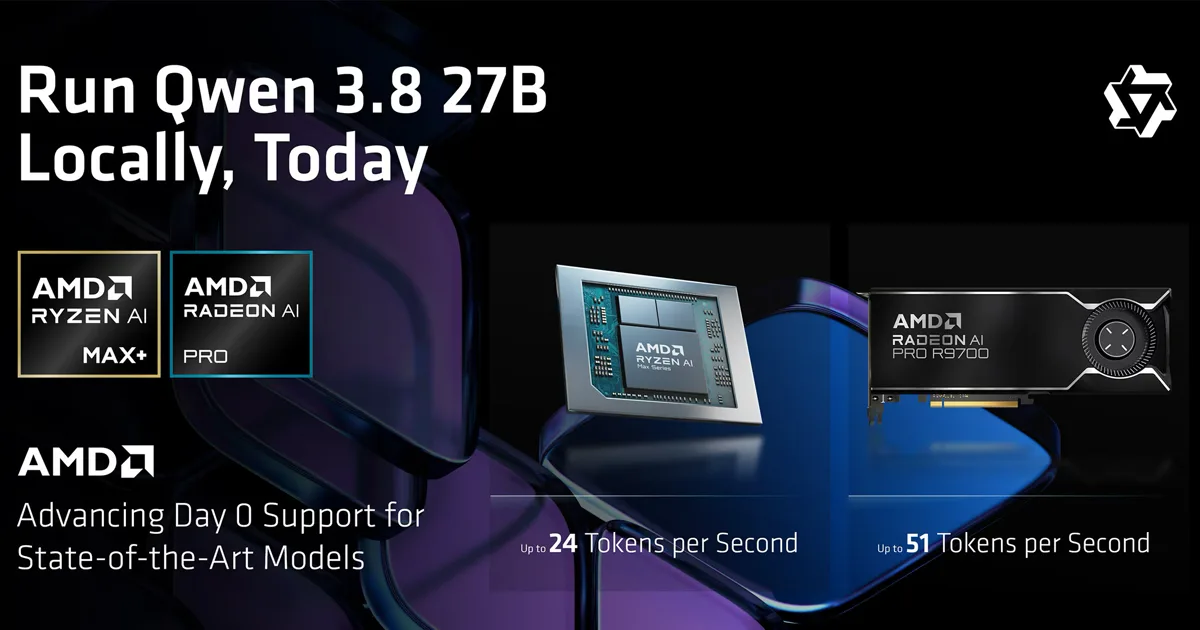
AMD measured it on release day on two desktop machines: up to 24.5 tokens per second on a mini PC with a Ryzen AI Max+ 395 processor and 128 GB of memory, and up to 51.8 on a single 32 GB Radeon AI PRO R9700 card, using llama.cpp with speculative decoding enabled. These are preliminary figures, measured by the vendor for a single user. AMD itself points out that, as a dense model, Qwen 3.8 27B "places substantial demands on memory capacity and compute", and it needs about 24 GB of graphics memory to run comfortably. A workstation is enough for a developer or a pilot, not to serve a whole company. The visual at the top of this article comes from AMD's post.
MoE is faster, dense answers better
The trade-off is speed. For each token, an MoE reads only its active parameters, while a dense model reads all of them. On the same consumer graphics card, one developer measured 31 tokens per second for Qwen 3.6 27B and 98 for Qwen 3.6 35B-A3B, with slightly different quantizations. On Alibaba's API, Artificial Analysis measures 55 tokens per second for the dense model and 107 for the MoE.
The same developer notes that the dense model "scores higher on every coding benchmark". Qwen's numbers point the same way: 77.2 on SWE-bench Verified for the dense 27B, 73.4 for the 35B-A3B. The MoE answers two to three times faster; the dense model answers better. For a coding assistant a developer uses all day, speed may win. For an agent that chains steps with no human waiting, accuracy matters more.
A KV cache four times smaller
The KV cache is a model's working memory for each conversation: it keeps track of every token already read, and grows with context length and the number of concurrent users. On a shared server, it is often the KV cache, more than the weights, that caps the number of users.
The hybrid architecture of Qwen 27B cuts this cost sharply: only 16 of its 64 layers keep a KV cache, and the other 48 hold a small fixed-size state. Based on the published configuration files of Qwen 3.8 27B and Qwen 3 32B, our calculation gives 64 KiB per token for Qwen 3.8 27B, against 256 KiB for Qwen 3 32B, a conventional dense model of similar size. A 32,000-token conversation, common in RAG, takes 2.1 GB instead of 8.4 GB. Runpod reaches the same conclusion: each conversation costs "roughly a quarter" of what it would on a conventional 27B.
In practice, on a single 80 GB H100, with FP8 weights and a safety margin, our calculation gives about 18 concurrent 32,000-token conversations, and about 35 with an FP8 KV cache. To size a server beyond this example, our article on on-premise LLMs walks through the method.
Easier to customize
A dense model is also easier to customize. Hugging Face notes that MoE models have long struggled to generalize after fine-tuning, with a risk of overfitting. A dense 27-billion-parameter model can be adapted with a LoRA adapter on a single card. As of November 10, Hugging Face lists 862 fine-tuned versions of Qwen 3.8 27B and more than 1,000 quantized ones, against 442 fine-tunes for the Qwen 3.6 35B-A3B MoE. On November 7, Nous Research released Arete-27B, a post-trained version of Qwen 3.8 27B.
When to prefer an MoE
MoE remains the right choice in three cases: when the speed each user feels comes first, when the task needs a lot of general knowledge, and when you want the best open quality, which today only exists as MoE models with hundreds of billions of parameters. A dense 27-billion-parameter model has its limits too: it knows less, and it reasons at length to make up for it, which burns tokens.
What to expect from Qwen 4 27B?
A more capable model, if the pace of the line is any guide, but nobody knows its shape yet. First signal, the 3.7 generation: Alibaba showed it could ship a whole Qwen version with no open model. Second signal: Qwen 3.8 Flash-Next, released in late August and described by Qwen as an "experimental preview of the architecture that will underpin Qwen4". It is an MoE with 125 billion parameters, 6 billion of them active, plus 51 billion parameters of "n-gram embedding", lookup tables that do not count toward the advertised size. Its license is "qwen-community-1.0", not the Apache 2.0 of the 27B line.
The fact that the preview is an MoE says little about the 27B: at Qwen, the large models have been MoE since Qwen 3, while the 27B stayed dense. The name matters more. The names of Qwen's MoE models include two numbers ("35B-A3B": 35 billion parameters, 3 billion of them active), those of its dense models only one. A model released as "Qwen4-27B" would therefore be dense, if the convention holds; that name, however, comes from slides, not from a press release. The real unknown is memory: if Qwen 4 adopts those embedding tables, a "27B" could weigh more than its name suggests. Then there is the license, which could be more restrictive than Apache 2.0. On release day, check four things before switching:
- The license: Apache 2.0 or a custom license, with any restrictions on commercial use.
- The architecture: dense or MoE, total and active parameters.
- Memory: weight size in FP8 and at 4 bits, and KV cache per token, which you can compute from the configuration file.
- Independent measurements: the Artificial Analysis index or your own tests; vendor benchmarks are not enough.
We will update this article when Qwen 4 27B ships, with a side-by-side comparison.
Can a Chinese model be sovereign?
An open-weight model does not "phone home" to its vendor: once downloaded, the weights are files running on servers you choose. Hosted in France by a European provider, Qwen 3.8 27B sends nothing to Alibaba. OVHcloud has served it since August 24, in FP8, from a French data center, at €0.40 per million input tokens and €2.70 per million output tokens. Scaleway offers it at €0.60 and €3.30 (prices recorded on October 21).
Sovereignty depends on the host and the compute operator; the nationality of the weights does not change it. Two questions remain, and they apply to American models too: biases inherited from training, which you should test on your own use cases, and dependence on one vendor for future versions, which Qwen 4's still unknown license illustrates well. This is where Mistral has its own argument: a European vendor you can contract with under European law. Our page on sovereign AI and our article on open-weight licenses cover these criteria in detail.
What an IT department should take away
If a model that fits on a single GPU is enough for your use case, start with Qwen 3.8 27B, either through the OVHcloud or Scaleway API or on your own card. Waiting for Qwen 4 only makes sense for a project that will not start for several weeks.
Plan for the model switch from day one. OVHcloud and Scaleway expose an OpenAI-compatible API: the model name belongs in configuration, where you can change it without touching the code. Build a set of 100 to 300 real questions with their expected answers, as described in our RAG audit guide. The day Qwen 4 27B ships, you measure it on your questions in half a day, and switch if the gain is real.
Set the thinking effort per task. Qwen 3.8 27B thinks at the maximum level by default; to classify an email or extract a field, low or thinking turned off is enough, and the model produces fewer tokens. And for tasks an algorithm can do (calculation, sorting, business rules), do not use AI at all: it is more reliable, cheaper and leaner.
Frequently asked questions about Qwen 4 and Qwen 3.8 27B
When will Qwen 4 27B be released?
There is no official date as of November 10, 2026. Alibaba has only written, on September 22, that Qwen 4 is in training. A remark attributed to its CTO pointed to an early November release, which did not happen. For Qwen 3.8, the 27-billion-parameter model arrived about ten days after the flagship.
Is Qwen 3.8 27B open source?
Qwen 3.8 27B is an open-weight model: its weights can be downloaded freely under the Apache 2.0 license, which allows commercial use, modification and redistribution. Its training data and training code are not published, which sets it apart from open-source software in the strict sense.
What GPU do you need to run Qwen 3.8 27B?
At 4 bits, Qwen 3.8 27B weighs about 17 to 18 GB according to Runpod and fits on a 24 GB card such as an RTX 4090, for a single user. AMD reports up to 51.8 tokens per second on a 32 GB Radeon AI PRO R9700 card. In FP8, its weights take 30.9 GB: an 80 GB H100 can then serve about 18 concurrent 32,000-token conversations. In BF16, the weights alone take 55.6 GB.
Qwen 3.8 27B or Mistral: which should you choose?
It depends on your infrastructure. For a model that fits on a single GPU, Qwen 3.8 27B has no recent equivalent at Mistral, whose dense 24-billion-parameter model, Mistral Small 3.2, dates from June 2025. For the best open quality from a European vendor, Mistral Large 4 beats Qwen 3.8 27B on the Artificial Analysis index, but Mistral's examples deploy it on eight GPUs, and reselling it as a service requires a commercial license.
Why is there no Qwen 3.7 27B?
The Qwen 3.7 generation shipped only as API models: Qwen 3.7 Max in May 2026 and Qwen 3.7 Plus on June 1, 2026, with no weights on Hugging Face. The open 27B and 35B versions the community expected never arrived. The open 27-billion-parameter model went from Qwen 3.6 27B, in April, to Qwen 3.8 27B, in August.
Is Qwen 3.8 27B better than Qwen 3.6 27B?
Yes, according to both Qwen and Artificial Analysis. With the same architecture, Qwen 3.8 27B goes from 53.5 to 61.7 on SWE-bench Pro and from 63.9 to 84.3 on OSWorld-Verified according to the vendor, and from 21 to 34 points on version 4.3.2 of the Artificial Analysis index. It is also more verbose: expect more thinking tokens.
In February 2026, it took a 397-billion-parameter MoE to do what a 27-billion-parameter model was doing on code by April. If that pace holds, the model that covers most business use cases will soon fit on a workstation graphics card. The advantage will go to teams that can switch models in a day: every new version benefits them with no migration project, while the others stay on whatever they installed.