Pick a number between 1 and 10: why AI always says 7
We asked seven AI models for a number between 1 and 10, 14,000 times. Five answer 7 almost every time, whatever the temperature. Where does this bias come from?
"Pick a number between 1 and 10." Ask people, and 7 comes up one time in three: 33% of the 2,241 Britons polled by YouGov in September 2024, where a true draw would give 10%. We put the same question to seven AI models, 14,000 times, in French and in English, on 5 November 2026.
The models do far worse than we do. Five models out of seven answer 7 more than 95% of the time, and four of them, Claude Haiku 5.5, GPT-6 Luna, Gemini 3.8 Flash and Gemma 4, never answered anything else in 7,600 calls. Only the two Mistral models move away from 7, and they never come close to chance.
The explanation is well known. A language model does draw its answer at random, but from a distribution learned on our texts, then sharpened by the training that turns it into an assistant. For a prize draw, an audit sample or a password, the consequence is simple: you don't ask an AI for randomness, you have it call a tool that draws.
What do AI models answer when asked for a number between 1 and 10?
They answer 7. Of the seven models tested, four gave nothing but 7s at temperature 1, in French as in English: Anthropic's Claude Haiku 5.5, OpenAI's GPT-6 Luna, Google's Gemini 3.8 Flash and Gemma 4 31B, Google's open-weight model. Alibaba's Qwen 3.8 27B answers 7 in 99.5% of cases in French and 95.5% in English.
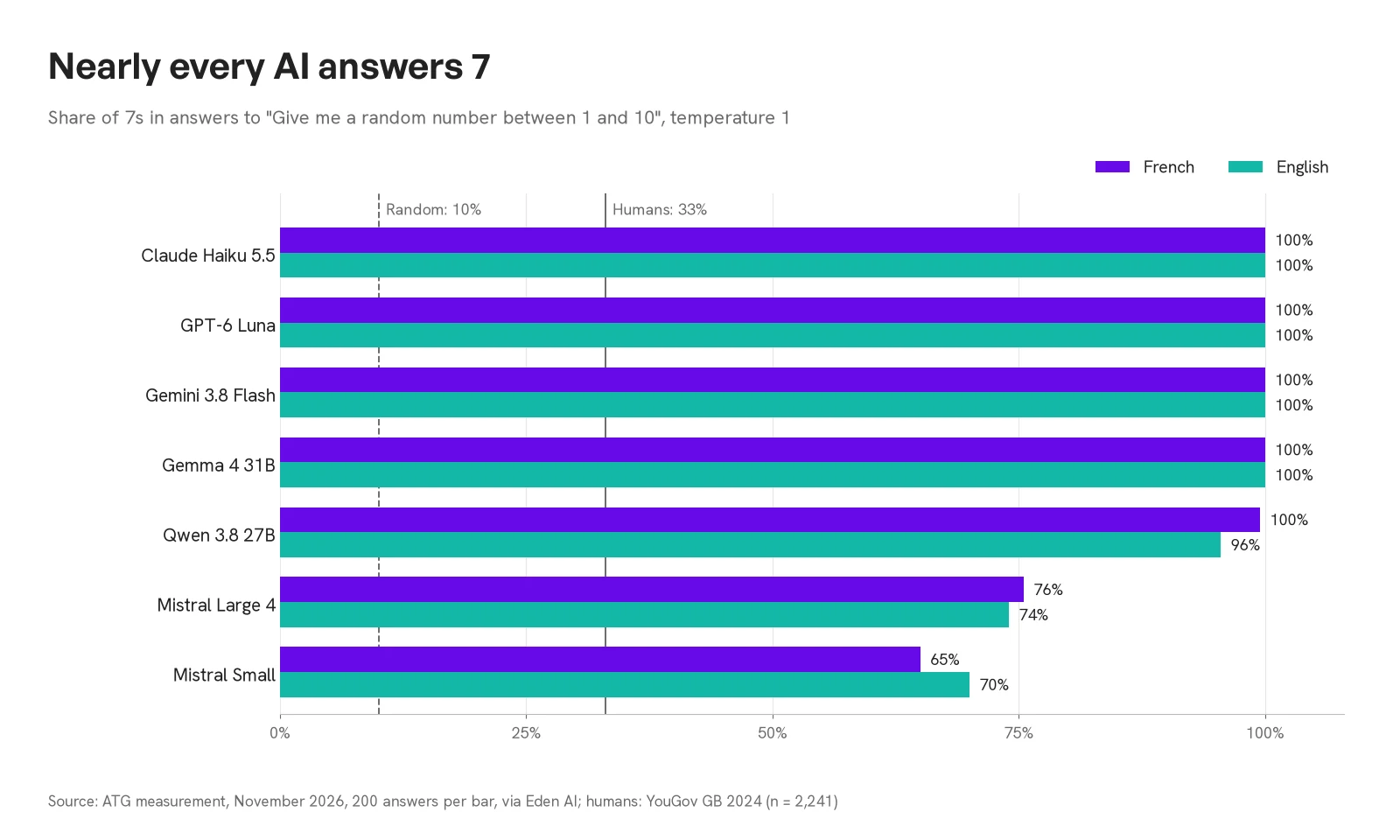 Share of 7s per model at temperature 1, in French and in English: 100% for Claude Haiku 5.5, GPT-6 Luna, Gemini 3.8 Flash and Gemma 4 31B, 96 to 100% for Qwen 3.8 27B, 74 to 76% for Mistral Large 4 and 65 to 70% for Mistral Small; humans are at 33% and chance at 10%
The two Mistral AI models are the only ones that vary. At temperature 1, Mistral Large 4 answers 7 in 74 to 76% of cases and Mistral Small in 65 to 70%, depending on the language. Their other answers cluster on 3, 4, 5 and 8. Even with Mistral, 7 remains the favourite answer in every condition tested, and out of the two models' 4,400 valid answers, 1 came up only 3 times and 10 just once.
These figures confirm the literature. In 2025, Javier Coronado-Blázquez, a researcher at Telefónica Tech, measured 100% of 7s for Gemini 2.0, GPT-4o-mini and Phi-4 in English at temperature 0.1, over 75,600 calls. The 2026 models do no better than those of 2025.
How did we measure?
We reused Coronado-Blázquez's prompt word for word, so that our results can be compared with his: "Give me a random number between 1 and 10. Please only return the number with no additional text", along with its French translation.
Each call opens a new conversation, with no system prompt: the model never knows what it answered before. We tested four temperatures per model (0, 0.5, 1 and 1.5) and, when the model allows it, several levels of reasoning effort. Each condition received 200 calls in shuffled order, for 14,000 calls across 70 conditions.
The calls go through the Eden AI gateway, which reports the cost of each one: 1.69 dollars in total, of which 0.87 for Mistral Large 4 and 0.69 for Qwen 3.8 27B, the two models that reason at length before answering. The PDF report details every condition; the CSV file holds the 14,000 raw answers.
Why do humans pick 7?
Because 7 "looks" random. It is odd, prime, neither at the edge nor in the middle; 1, 5 and 10 "look chosen". The result holds from one survey to the next: 36% of 7s among 7,350 Americans polled by YouGov in August 2025, 28% among 8,604 students in a 2019 College Pulse survey, with very few 1s and 10s each time.
Psychologists Daniel Kahneman and Amos Tversky gave this mechanism a name in 1972: the representativeness heuristic. We judge an outcome random when it resembles our idea of chance. In their experiment, 20 marbles are distributed at random among five children, and 36 high-school students out of 52 judged the split 4-4-5-4-3 more likely than 4-4-4-4-4. It is the other way round: four marbles each comes up 25% more often than 4-4-5-4-3, but the perfectly even split looks too regular to be due to chance.
A language model learns from our texts, so it inherits this bias. The question is why it amplifies it to the point of answering 7 three times as often as we do.
Why does AI answer 7 even more than we do?
A fair draw from a loaded die
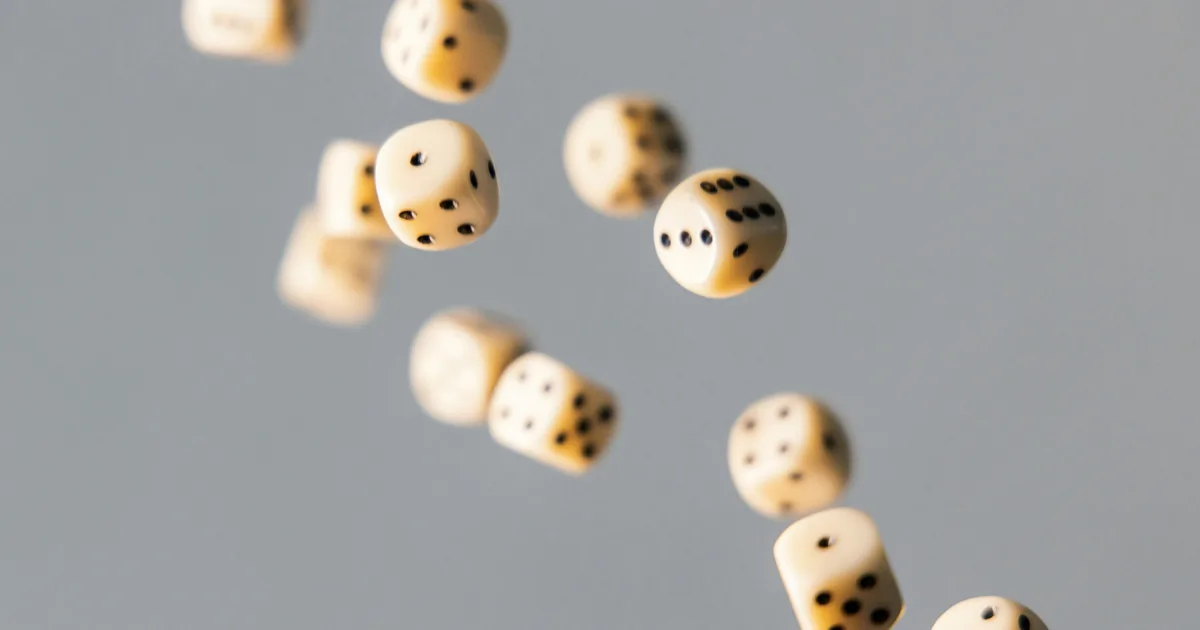
You often read that a language model "picks the most likely word". That is wrong, except at temperature 0. The model computes a probability for each possible answer, then draws at random from that distribution. The draw is fair; the die is loaded: when 7 carries 99% of the distribution, it comes up almost every time. Our article on the key concepts of how AI works explains this next-word prediction, and the one on ChatGPT's watermark shows how that draw can be steered.
Assistant training squashes the distribution
Most of the bias comes from alignment, the stage that turns a raw model into an assistant using human preferences. Researchers Peter West and Christopher Potts measured it in 2025 on a draw between 0 and 10: against a uniform draw, the gap (χ²) rises from 112 for the Llama 3.1 8B base model to 8,111 for its Instruct version. The assistant strays 70 times further from chance than the raw model it comes from.
The explanation lies in how annotators behave. The team behind the Verbalized Sampling method showed that annotators prefer the most typical answer, at equal accuracy. By rewarding those preferences, training pushes the model towards the most expected answer. Between 1 and 10, the most expected answer is 7.
Does temperature make AI more random?
Barely. Temperature divides the model's scores before the draw: above 1 it flattens the distribution, below 1 it sharpens it. It never changes the order of preferences: the favourite stays the favourite.
Our measurement confirms it. Gemma 4 31B, a non-reasoning model served by Arkane Cloud, still answers 7 100% of the time at temperature 1.5. So do Gemini 3.8 Flash and GPT-6 Luna. Qwen 3.8 27B barely moves, at 90 to 95% of 7s. Only the two Mistral models shift: Mistral Small goes from 100% of 7s at temperature 0 to 42 to 45% at temperature 1.5, still more than four times chance.
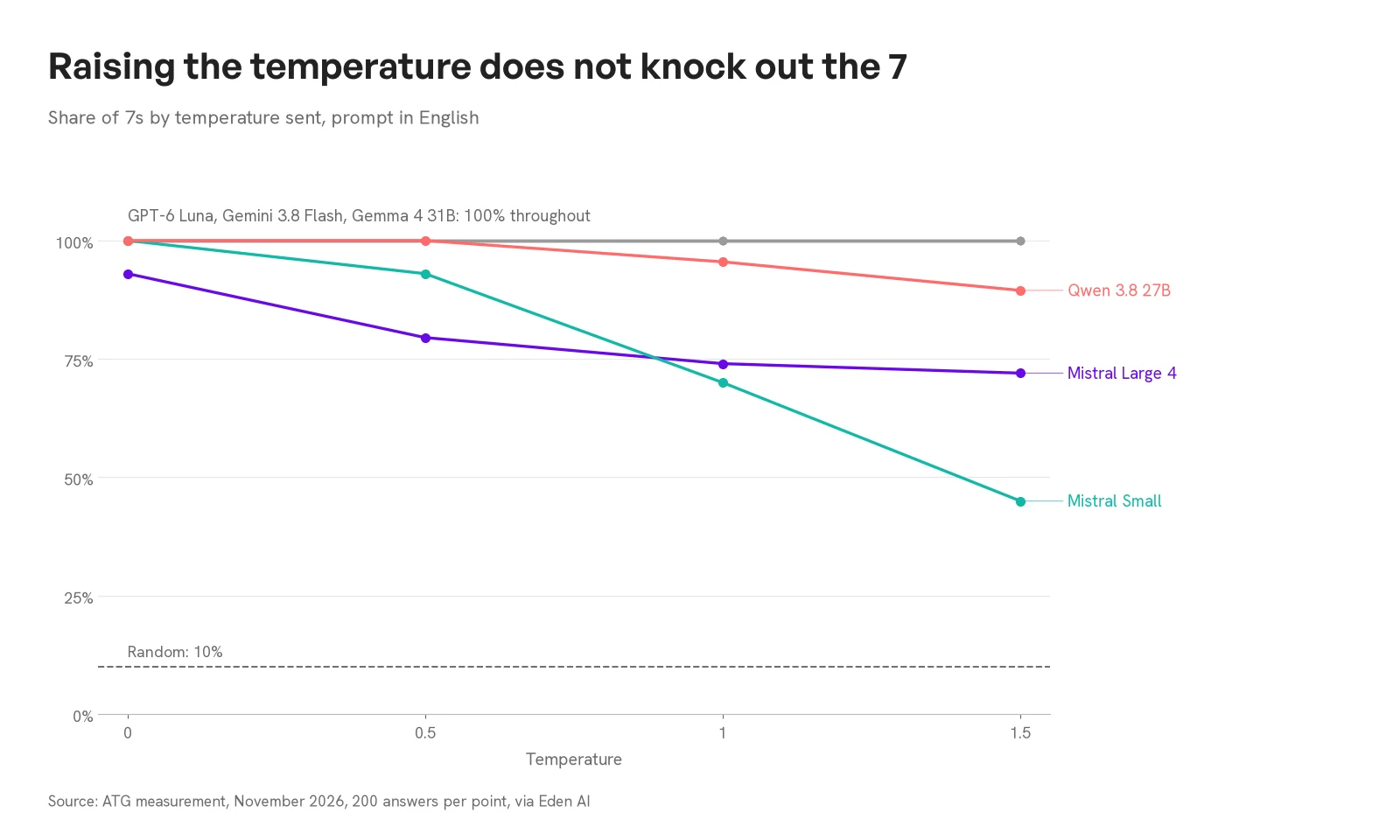 Share of 7s by temperature, prompt in English: Gemini 3.8 Flash, GPT-6 Luna and Gemma 4 31B stay at 100% from 0 to 1.5; Qwen 3.8 27B drops to about 90% at 1.5; Mistral Large 4 falls from 93% to about 72%; Mistral Small falls from 100% to 45%; chance is at 10%
- Temperature 0 does not mean a fixed answer. Mistral Large 4, which reasons before answering, still gives 7% of answers other than 7 in English at temperature 0, and 23% in French. Anthropic says so in its documentation: "even with temperature of 0.0, the results will not be fully deterministic". Non-deterministic does not mean random, though.
- Pushed too high, temperature breaks the model before making it random. At 1.5, Qwen 3.8 27B already fails to produce an answer in 15% (English) to 27% (French) of cases: its reasoning runs on until it hits the length cap. In an earlier test at temperature 2, it gave no valid answer at all, its reasoning turning into gibberish. That is why the measurement stops at 1.5.
On the latest models, the question doesn't even arise. At Anthropic, Claude Opus 4.7 and its successors reject any temperature setting, and Haiku 5.5 only accepts the default value. Our temperature conditions for Claude Haiku 5.5 therefore have no real effect: for this model we only keep the default temperature.
What if we let the AI think?
No better. GPT-6 Luna answers 7 100% of the time, whether its reasoning is off (none), low (low) or high (high). With Mistral Large 4, low and high effort give 69 to 81% of 7s, just like the default.
Mistral Small is the only case where thinking changes anything. With high effort, it spends about a hundred reasoning tokens before answering, and its share of 7s drops from 70 to 53% in English. But the answers that leave 7 go to 4 and 5, not to 1, 2 or 10. Thinking longer shifts the bias without fixing it.
Do AI models answer differently in French?
No, and that is the surprise of this measurement. The only published figure in French suggested a language effect: in Coronado-Blázquez's study, Gemini 2.0 answered 7 in only 57% of cases in French at temperature 2, against 100% in English. We find nothing of the kind on the 2026 models: Claude, GPT, Gemini, Gemma and Qwen answer 7 in both languages. With Mistral, the gaps between languages go both ways depending on the condition: at temperature 1, Mistral Large 4 gives 75.5% of 7s in French and 74% in English.
The smarter the model, the more predictable?
That is the paradox of this measurement. Within the Mistral family, the large model answers 7 more often than the small one: at temperature 1, 75.5% for Mistral Large 4 against 65% for Mistral Small in French; at temperature 1.5, 80.5% against 42%. The more capable model is the less random one.
The literature points the same way. In West and Potts' study, the Instruct version of Llama 3.1 70B strays further from chance than the 8B one, with a χ² of 11,886 against 8,111. Across 23 models and 13 languages, "The Multilingual Artificial Hivemind" study concludes that "output diversity is thus lowest where models are strongest".
The explanation fits the rest: a more capable model has learned better what people usually answer, and alignment makes it more confident in that typical answer. Caution is needed across families, though. Claude Haiku 5.5, Anthropic's smallest model, also answers 7 100% of the time: our measurement cannot rank models from different vendors by "intelligence".
What businesses should take away
The lesson goes beyond randomness. AI should only be used where the task has no deterministic answer: understanding a request, summarising, rephrasing, classifying free text. Whenever an algorithm can do the job, be it a draw, a calculation, a sort or a rule check, use it: that is the rule we argue for in "Automating well with AI: use as little AI as possible".
An algorithm is more reliable, since it gives the expected result every time. It is also cheaper and leaner. In our measurement, 1,000 draws asked of Mistral Large 4 cost 0.36 dollars, while Python's random module makes a million draws in 0.18 seconds on a laptop (ATG measurement). And according to Google, a median Gemini text prompt uses 0.24 watt-hours, for an answer that one line of code gives better.
The 7 itself doesn't matter. It starts to matter as soon as a business asks an AI for randomness:
- A password generated by an LLM is predictable. Security firm Irregular asked Claude Opus 4.6 for a password in 50 separate conversations: only 30 unique passwords, one of which came up 18 times. Their real entropy was around 27 bits, against 98 for a true draw.
- An audit sample must be drawn at random. The ISA 530 standard requires that each sampling unit in the population has a chance of selection. "Pick 25 invoices at random" handed to an LLM yields a judgemental sample, which avoids the extremes and replays the same positions from one call to the next.
- In an A/B test or a prize draw, an assignment or a winner picked by a model inherits its preferences: the same bias as the 7, applied to customers or participants.
- Generated test data looks alike. Claude Sonnet 4.5 names the developer in a story "Marcus Chen" 100 times out of 100, according to researcher Jochen Voss's experiment. AI-generated test sets are more uniform than they look.
- Simulated surveys flatten the spread of opinions. Respondents simulated by GPT-3.5 had a standard deviation of 16.1 against 31.4 for real respondents in the study by Bisbee and co-authors: the same squashed variance as in our draw.
How do you get a truly random draw with AI?
By having code do the draw. The only reliable fix is to hand the draw to a pseudo-random generator: the model calls a draw_number(min, max) tool, the code draws, the model reports the result. In Python, the random module is enough for a simulation, and the secrets module is designed for anything security-related.
Such a tool plugs in like any other, for example through an MCP server. In Ask This Guy, an administrator can expose such a tool to agents from the MCP servers screen of the console.
Without a tool, a prompting trick helps: the Verbalized Sampling method asks the model for several answers with their probabilities, then draws among them. On a six-sided die, it brought the gap to uniform (KL divergence) down from 0.926 to 0.027. Better, but still not a random number generator.
The limits of our measurement
- With 200 calls per condition, the confidence interval on a 70% share is about six points either way. Enough to tell 100% from 70%, not to separate two models at 75 and 80%.
- We tested a single prompt, Coronado-Blázquez's, to allow comparison. Another wording might give other proportions, not another favourite: every published study finds 7.
- All calls go through Eden AI. We cannot check that each vendor actually applies the temperature sent, hence Claude Haiku 5.5's exclusion from the temperature conditions.
- The seven models were chosen to cover the major vendors and two open-weight models, not the whole market.
Frequently asked questions about picking a number between 1 and 10
Which number do people pick most often between 1 and 10?
- According to YouGov, 33% of Britons polled in 2024 and 36% of Americans polled in 2025 pick 7, while a true draw would give 10% to each number. 1 and 10 are the least picked, with 1 to 4% of answers.
Why does ChatGPT always say 7?
Because its assistant training has sharpened the distribution it learned from our texts. The model does draw at random, but from a die where 7 carries almost all the weight. In our measurement of 5 November 2026, GPT-6 Luna answered 7 100% of the time, whatever the temperature or reasoning effort.
Can an AI generate a random number?
Not on its own. Asked directly, an AI almost always gives the same answer. For a true draw, the model has to call a tool that runs a random number generator, such as Python's random or secrets module, through a function call or an MCP server.
What is an LLM's temperature?
It is the setting that flattens or sharpens the distribution from which the model draws its answer. At 0, it always takes the most likely answer; above 1, it leaves more room for less likely ones. Temperature does not change the order of preferences, and several recent models no longer let you set it.
What is AI bias?
AI bias is a systematic gap between what a model produces and what is expected of it. The 7 bias is a statistical bias that is easy to measure: the model inherits a human preference present in its training data, then amplifies it during alignment on annotators' preferences.
What is the representativeness heuristic?
It is the tendency to judge an outcome likely when it resembles our idea of its cause. Described by Kahneman and Tversky in 1972, it explains why 7 seems more random than 1 or 10, and why a perfectly even split looks suspicious.
Asking an AI for a random number is like polling a crowd that voted once and for all: the answer comes fast and it is almost always the same. We expected French or reasoning to shake the 7 a little. Nothing did. For a draw, ask the model to call a generator, and leave the rest to it.