OVHcloud's AI strategy: what Octave Klaba's plan is worth
OVHcloud is announcing its own LLM and wants the whole AI stack. What already exists (GPUs, AI Endpoints), what is still unproven, what IT leaders can learn.
On October 20, 2026, the day OVHcloud released its annual results, Octave Klaba told the French business daily La Tribune that the company is finishing training its first LLM: « Nous pensons le publier en open source fin novembre » ("we plan to release it as open source at the end of November"). The same day, Reuters quoted him saying the first model would launch "in early 2027". The model is only one piece: in AI, OVHcloud wants to own the whole chain, from the graphics processor to the end use.
A good part of that chain already exists. OVHcloud rents out GPUs, orchestrates training and sells tokens, meaning access to AI models billed by the volume of text processed, through its AI Endpoints service. On gpt-oss-120b, it is cheaper than Scaleway and IONOS, its two main European rivals. But it is slow to serve the most recent open models, and it lags on speed.
Klaba's central argument, the fear of depending on a model provider, applies to every company.
What does OVHcloud want to do in AI?
OVHcloud's AI strategy is to sell AI end to end from its own data centers, without depending on any intermediary. Octave Klaba, who returned as CEO on October 20, 2025, described it to La Tribune as five layers:
- GPUs, installed in its data centers;
- their orchestration, for training and inference;
- "tokens as a service", with "the question of their price and their quality";
- tools to host applications built with AI;
- end uses, with OVHai workspace, an email, storage and video-conferencing suite driven by AI.
The starting advantage is physical. OVHcloud has 250 MW of connected power capacity, 140 MW of it in operation, in buildings it owns, and builds its servers in its own factories. In his October 20 letter to shareholders, Klaba goes further: "for the first time, some of our new products will no longer be intended for humans, but for AI agents".
The day's results support him. Revenue for fiscal 2026, which ended August 31, reached €1,145.1 million, up 7.2% like for like, and the public cloud business, which houses the AI offering, grew 18.9%. Free cash flow turned positive for the first time since the 2021 IPO. The stock gained nearly 10% in the morning.
What does OVHcloud already offer?
GPUs and orchestration
OVHcloud rents Nvidia GPUs by the hour: an H100 costs €2.80 excluding VAT per hour, an eight-H200 instance €42 per hour. Its AI Training, AI Notebooks and AI Deploy services train or deploy a model on those GPUs, billed by the minute. Two caveats: eight-H200 instances are only available in Paris (AI Training, AI Notebooks and AI Deploy offer them in bundles of four in Gravelines), and Nvidia's Blackwell generation is not yet in the catalog. In June, OVHcloud said on its public roadmap that its H200s were "fully allocated due to high demand".
Tokens: AI Endpoints
AI Endpoints is OVHcloud's inference offering: an OpenAI-compatible API giving access to open-weight models hosted in Gravelines, in northern France. The service launched in April 2025. It is the layer where OVHcloud competes head-on with Scaleway, IONOS and the APIs of the big labs. We come back to it in detail below.
End uses: OVHai workspace
OVHai workspace was previewed at VivaTech on June 17, 2026: email, storage, video conferencing and search handled by agents, with optional end-to-end encryption. A beta was announced for OVHcloud's November event. The company says it is first using the suite internally to boost productivity.
AI Endpoints: how good are OVHcloud's tokens today?
Cheaper than Scaleway and IONOS on several models
On the models its European competitors also serve, OVHcloud's prices are low, often the lowest. Prices as of October 20, 2026, from the OVHcloud, Scaleway and IONOS price lists:
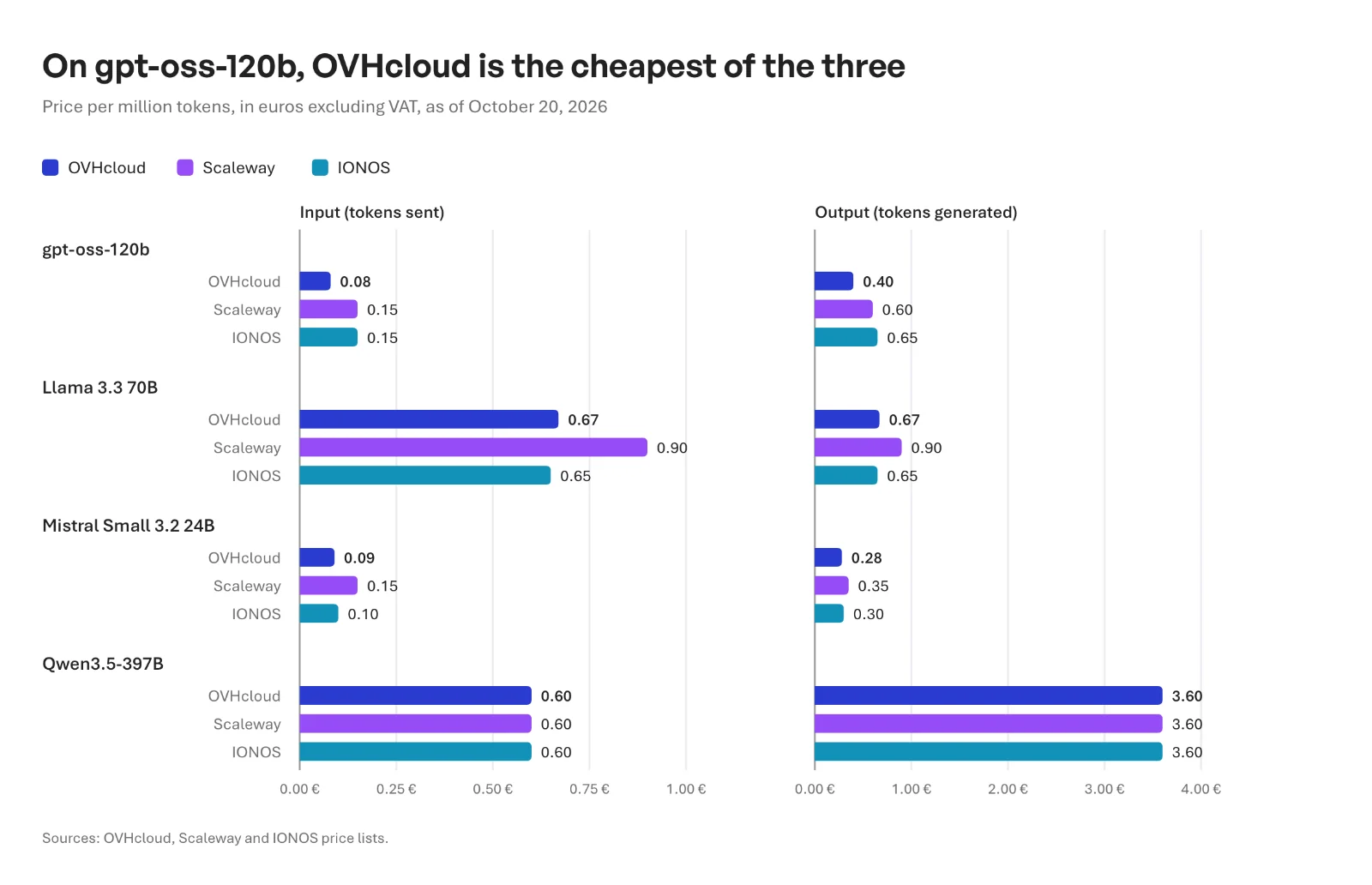 Price per million tokens in euros excluding VAT as of October 20, 2026, input then output. gpt-oss-120b: OVHcloud 0.08 and 0.40, Scaleway 0.15 and 0.60, IONOS 0.15 and 0.65. Llama 3.3 70B: OVHcloud 0.67 and 0.67, Scaleway 0.90 and 0.90, IONOS 0.65 and 0.65. Mistral Small 3.2 24B: OVHcloud 0.09 and 0.28, Scaleway 0.15 and 0.35, IONOS 0.10 and 0.30. Qwen3.5-397B: 0.60 and 3.60 at all three
A batch API, in beta since June, halves the bill again for jobs that can wait a day or more. On sovereignty, AI Endpoints meets the four criteria we apply to a provider: a French legal entity, which operates the service itself, with capital nearly 80% controlled by the Klaba family, and hosting in France. Our sovereign AI page explains this grid.
A leaner catalog, like everyone else's
The AI Endpoints catalog shows 20 models, eight of them LLMs: OpenAI's gpt-oss, Meta's Llama and several of Alibaba's Qwen models. At the 2025 launch, OVHcloud advertised more than 40. The last two Mistral models, Mistral Small 3.2 and Mistral Nemo, have already left the catalog: they remain reachable through the API until their retirement on November 4, 2026.
That slimming follows a market-wide trend in inference. Most models served are general-purpose: a customer can swap a Qwen for a DeepSeek without rewriting their application. Providers therefore keep the models that deliver the most intelligence for their size, and quickly drop the rest. Scaleway writes it into its policy: a model is deprecated "when a newer, more efficient version is available". Groq retired Llama 3.3 70B from its free and developer tiers on August 16, 2026, recommending gpt-oss-120b or Qwen3.6-27B, a model 2.6 times smaller. Together AI removed dozens of models from its serverless offering in 2026. Fewer models, better served: that is how the business works.
What matters, then, is how fresh those few models are. OVHcloud added Qwen3.8-27B at the end of August, but not yet the latest DeepSeek, GLM or Kimi models: on its public roadmap, DeepSeek 3.2 and Kimi K2.5 were closed as "not planned" in August, while GLM-5.3 and DeepSeek-V4-Flash remain user requests. AI Endpoints offers no context caching either, a feature that sharply cuts the cost of agents that reread the same documents over and over: the request has been open since September.
Umans: the newest models on release day
Umans, a French company founded in 2025, takes this logic all the way: six models, all built for code and agents, and, by its own account, the best open coding models served on release day.
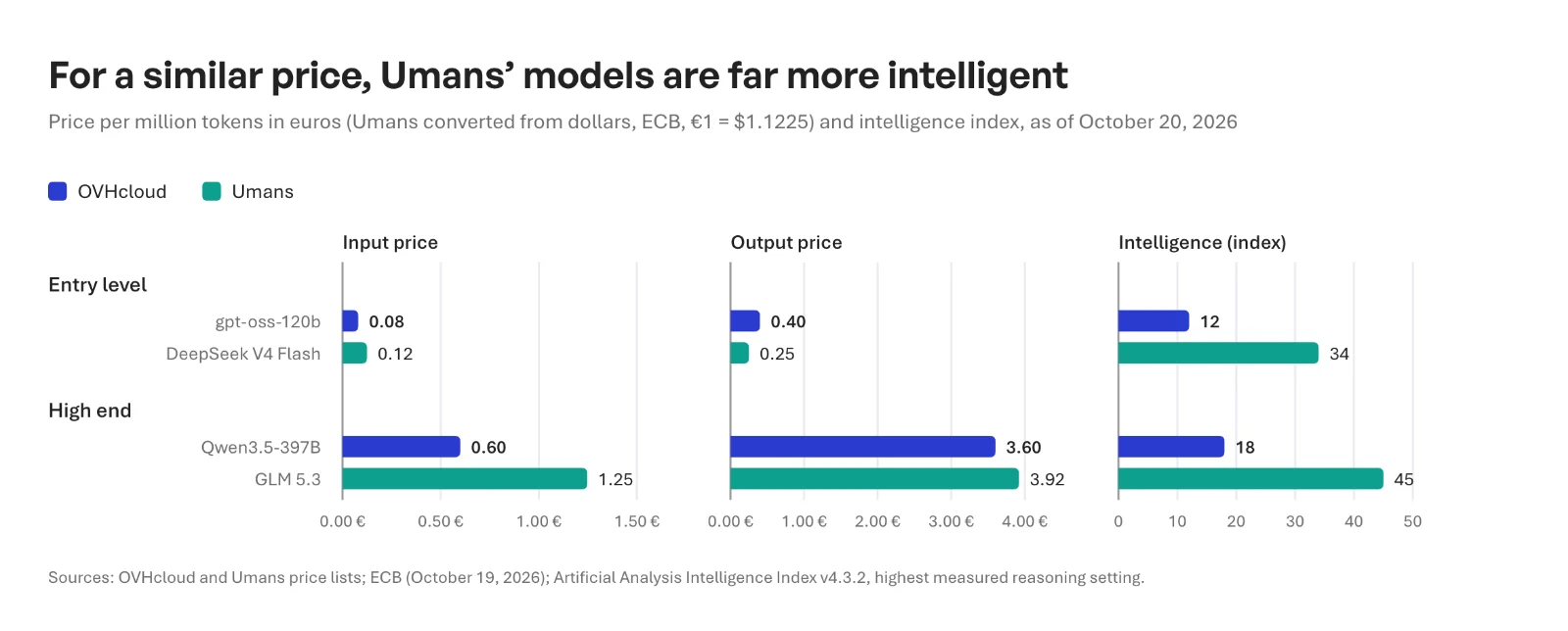 OVHcloud versus Umans as of October 20, 2026, price per million tokens in euros and Artificial Analysis intelligence index. Entry level: gpt-oss-120b at OVHcloud, €0.08 input, €0.40 output, index 12; DeepSeek V4 Flash at Umans, €0.12, €0.25, index 34. High end: Qwen3.5-397B at OVHcloud, €0.60, €3.60, index 18; GLM 5.3 at Umans, €1.25, €3.92, index 45. Umans prices converted from dollars at the ECB rate of October 19, 2026
Prices come from the OVHcloud and Umans price lists, converted from dollars at the ECB rate of October 19, 2026 (€1 = $1.1225). On intelligence, the Artificial Analysis index (version 4.3.2) gives 12 to gpt-oss-120b against 34 for DeepSeek V4 Flash, and 18 to Qwen3.5-397B against 45 for GLM 5.3, at their highest reasoning setting. The rest of the offering:
| OVHcloud AI Endpoints | Umans | |
|---|---|---|
| Most recent models | Qwen3.8-27B, added late August 2026 | DeepSeek V4.1 Flash, GLM 5.3, Kimi K3 |
| Context caching | no | yes |
| Use cases | text, embeddings, transcription, vision, images | code and agents |
| Inference in the EU | yes, in Gravelines | on request |
At the entry level, the two providers' prices are close, but Umans' models are far more intelligent: their scores are 2.5 to nearly 3 times those of OVHcloud's models. Umans has a significant edge on model freshness, and its caching noticeably cuts the bill of a coding agent. By its own measurements, it serves DeepSeek V4 Flash at more than 360 tokens per second. The two offerings complement each other: a general-purpose catalog hosted in France on one side, the best open coding models on release day on the other.
Behind on speed for the most popular models
Hugging Face routes requests to several inference providers, OVHcloud among them, and publishes their throughput. On the morning of October 20, on gpt-oss-120b, OVHcloud was the slowest of the ten providers measured: 35 tokens per second, against 161 at Scaleway and 227 at Baseten. Same rank on Llama 3.3 70B, among four providers. On the other hand, it was the fastest on Qwen3.5-397B, at 105 tokens per second against 62 at Scaleway. These figures are a snapshot, and Hugging Face does not document its method.
OVHcloud does not hide it. To a customer who measured 13 tokens per second in April, the company replied that the shared service's performance "can occasionally vary", and advised deploying a dedicated model with AI Deploy. In August, a tech lead wrote that a rollout had been paused because of that inconsistent latency. Our own tests of AI Endpoints, run before the strategic shift led by Octave Klaba, had disappointed us. For now, AI Endpoints is therefore not one of Ask This Guy's inference providers. One to watch: we will test it again with the in-house model and the new offerings.
SambaNova: the promise of fast endpoints, not yet visible
This is where SambaNova was supposed to come in. On November 20, 2025, OVHcloud picked the American inference-chip maker for "real-time endpoints with guaranteed performance", with a 99.8% uptime commitment and availability in France announced "by end of year". SambaNova's chips, called RDUs, are designed to serve models much faster than a standard GPU: on its own platform, SambaNova serves gpt-oss-120b at 708 tokens per second, according to Artificial Analysis.
SambaNova describes OVHcloud's Premium offering as "available now". On OVHcloud's side, however, we found no product page, no price and no model in the catalog on October 20. Its labs page still lists the fast tier as "Coming soon", with a minimum monthly commitment. Eleven months after the announcement, a customer looking for fast tokens at OVHcloud cannot buy them self-service. Neither SambaNova nor AI Endpoints appears in the results press release, which defers the AI strategy to the November 19 event.
Why is OVHcloud training its own LLM?
The fear of being cut off
Klaba's explanation fits in one sentence. If OVHcloud does not control its own model, "someone could one day tell us: 'You are my competitor, I am cutting your access to my model.'" He adds: "We will have handed over our data, they will do our job, and all we will have left is our eyes to cry with." In his view, nothing stops the big labs from building a CRM or an ERP to rival SAP tomorrow.
For a European company, the scenario is far from theoretical; we described it in "What if the United States Turned Off Your Digital Tap?". What is new is a cloud provider applying it to itself. Klaba says the models are built "first for us, with our data, not our customers'", to boost productivity, before possibly being offered to customers.
A specialized first model, an unclear timeline
OVHcloud has picked three areas, which the first model "will not exactly cover" in full: "offensive and defensive" cybersecurity, code, and agents for finance, HR, legal and supply chain. Klaba promises an architecture "very far ahead of its time", without giving a size or a score. Reuters adds that it will be a mixture-of-experts model, which activates only part of its parameters, its "experts", for each token processed.
The ambition has narrowed. In June, at VivaTech, Klaba wanted to train frontier models from scratch, mentioned a first pre-training run on Jupiter, the European supercomputer, and put the cost of such a project at €150 to €200 million. In October, he stressed three trades OVHcloud knows, and a method: "The idea is not to put billions on the table today, but to check whether we can innovate in this business […]." The open-source release remains conditional: "If it works for us".
The timeline is unclear. "End of November" in La Tribune, "early 2027" at Reuters: the two could be reconciled, with the weights published first and a commercial launch later, but OVHcloud has not said so.
The Mistral question
Klaba does not mince his words. Asked about an alliance with Mistral, he replied that Mistral is closer, in its business, to "an AI IT services firm, because it mainly does integration", and questioned its valuation: "Is it worth that money? I have no idea." French broadcaster BFM read it as a jab at Mistral's billions. The label largely holds. Mistral is first and foremost a provider of AI services to businesses: it claims more than 125 enterprise customers, sends researchers embedded with its customers to build custom models, and the French state, according to ActuIA, buys skills from it more than licenses. To serve those customers, it develops its own technology: models, an inference service and, with Mistral Compute, computing capacity rented out to other companies. That last piece, funded in part by its €3 billion round in September 2026, is where it meets OVHcloud, which explains Klaba's "Mistral has declared itself a competitor to OVHcloud". We covered Mistral's infrastructure in our article on CoreWeave.
Which pieces did OVHcloud buy in 2026?
Unable to build everything, OVHcloud is buying. Three acquisitions since January:
- Seald, in January: end-to-end encryption, with a development kit certified by ANSSI, the French cybersecurity agency;
- Dragon LLM, formerly Lingua Custodia, in March: specialized models for regulated industries, and the starting point of OVHcloud's AI lab, tasked with training and fine-tuning LLMs;
- Gladia, closed at the end of July: speech-to-text in more than 100 languages, paid for in new shares.
The results presentation maps each acquisition to a layer: Dragon LLM to training, Gladia to tokens, Seald to the platform, OVHai workspace to end uses. To fund what comes next, Klaba rules out, for now, any capital increase: "I want to invest the money we earn."
What are the limits of this strategy?
Budget
OVHcloud generated €24.7 million of free cash flow in fiscal 2026. Mistral raised €3 billion in a single round. Quoted by Le Monde Informatique in June, Counterpoint analyst Neil Shah noted that a model depreciates "if it is not trained regularly". An LLM is paid for every year, not once.
Precedents
The founder of Germany's Aleph Alpha put it bluntly in 2024, as the company changed its business model: "Just having an European LLM is not sufficient as a business model". Alibaba shows the opposite case, using its Qwen models, downloaded more than 3 billion times, to bring customers to its cloud. OVHcloud has what Aleph Alpha lacked, 1.7 million customers, but not yet the model that would make them want it.
The quality of open models
Klaba says the quality of tokens from open-source models "does not necessarily meet our needs". Yet the best open models now lag closed frontier models by four months on average, according to Epoch AI. Part of the quality gap at AI Endpoints comes from its own catalog, which lacks recent models other European providers already serve.
Hardware dependence
The GPUs come from Nvidia, the chips for the fast tier from SambaNova, and a first pre-training run took place on Jupiter, a supercomputer built on Nvidia chips. The contract and the data stay under French law, which matters for legal sovereignty. As Greyhound's Sanchit Vir Gogia, quoted by Le Monde Informatique, put it, sovereignty "simply changes the hand" on the kill switch.
Cybersecurity, the model's first focus
The day before the announcement, several versions of OVHcloud's official command-line tool were found to contain spyware, slipped in by an attacker through a contributor's GitHub account. The incident says nothing about the future model. It is a reminder that software supply-chain security also has to be proven at home.
What IT leaders can take away
- Test AI Endpoints on your own workload. For batch processing, extraction or classification, the price-to-quality ratio on gpt-oss is very good and the service is sovereign. For an agent or an interactive assistant, measure latency at peak hours before committing.
- Do not pick a provider for a model that does not exist yet. OVHcloud's LLM will be judged on evidence, once its weights and scores are published. See you on November 19, then at release.
- Plan for model replacement. At every provider, models are retired as better ones arrive: three months' notice at OVHcloud and Scaleway, two to three weeks at Together AI. A production use case needs a planned, tested replacement.
- Apply Klaba's reasoning to yourself. A company that builds its processes on a single model is exposed to a cutoff, a price increase or a provider turned competitor. An LLM gateway lets you switch providers without rewriting your applications, and an open-weight model can serve as a fallback.
- Separate legal sovereignty from technical independence. OVHcloud delivers the first: French law, French ownership, data in France. The second, chips and models included, does not exist anywhere in Europe today. Our comparison of ways to run a model in the enterprise helps pick the right trade-off.
In the interest of transparency: Ask This Guy hosts its servers at OVHcloud in Gravelines, Umans is one of our partners, and we use several European inference providers, as we explain in our overview of French AI vendors.
Frequently asked questions about OVHcloud's AI strategy
What is OVHcloud AI Endpoints?
AI Endpoints is OVHcloud's inference service, launched in April 2025. Through an OpenAI-compatible API, it gives access to about twenty open-weight models (gpt-oss, Llama, Qwen, Whisper) hosted in Gravelines, France. Billing is per million tokens, and a batch API costs half as much for non-urgent jobs.
When will OVHcloud's LLM be released?
Octave Klaba told La Tribune on October 20, 2026, that training of the first version was ending and that he planned to release it as open source at the end of November. The same day, Reuters reported a launch in early 2027. OVHcloud is due to detail its AI strategy at its AI Summit in Paris on November 19, 2026.
Is OVHcloud AI Endpoints sovereign?
Yes, in the legal sense. The service is provided by OVH SAS, a French company nearly 80% controlled by the Klaba family, and the models run in the Gravelines data center. No American parent company is involved, so the service is not exposed to the US CLOUD Act through that route. The GPUs and chips, however, come from American suppliers, Nvidia and SambaNova.
What is the partnership between OVHcloud and SambaNova?
In November 2025, OVHcloud chose SambaNova, an American maker of inference chips, to offer fast endpoints with guaranteed performance, 99.8% uptime and a usage commitment. SambaNova describes the offering as available, but OVHcloud had published neither a product page nor a price as of October 20, 2026.
What is the difference between OVHcloud AI Endpoints and Umans?
The two offerings are complementary. OVHcloud AI Endpoints serves about twenty general-purpose models (text, embeddings, transcription, vision) from Gravelines, at some of the lowest prices in Europe. Umans, a French company founded in 2025, serves six of the most recent coding and agent models (DeepSeek V4.1 Flash, GLM 5.3, Kimi K3), with context caching and inference within the European Union on request. At the entry level, their prices are close, but Umans' models are far more intelligent: 34 against 12 on the Artificial Analysis index for DeepSeek V4 Flash versus gpt-oss-120b.
Is Mistral an IT services firm?
Partly. On October 20, 2026, OVHcloud CEO Octave Klaba said Mistral is closer, in its business, to "an AI IT services firm, because it mainly does integration". Mistral is first and foremost a provider of AI services to businesses: it claims more than 125 enterprise customers and embeds researchers with some of them to build custom models. Unlike a traditional IT services firm, it develops its own technology, including models, an inference service and, with Mistral Compute, computing capacity rented out to other companies.
To succeed in AI, OVHcloud would almost only need to serve up-to-date models quickly: it already has the infrastructure and the prices. The first LLM, expected in late 2026 or early 2027, will show whether the company can do research. The following months will show whether it can sell what it announced in November 2025.
For any company, Klaba's lesson is more useful than his model: never depend on a single provider for a building block your business relies on.