The AI inflation illusion, explained by the Jevons paradox
AI looks more expensive every month. For the same service, its price is collapsing faster than that of any other technology in history.
In 2025, electricity prices in France fell by about 15%. According to the Banque de France, fewer than 5% of households noticed. We remember price rises, not price cuts. AI suffers from the same bias: people talk about "AI inflation", yet for the same service its price is collapsing. The Jevons paradox, first described in 1865 about coal, explains why the bill keeps going up anyway.
The signs of rising prices are real. Microsoft 365 Personal went from $6.99 to $9.99 a month when Copilot was added, and the Microsoft 365 E3 business plan goes from $36 to $39 on July 1, 2026, an increase Microsoft partly attributes to AI. But for the same performance, the price of a language model is divided by ten every year according to the venture firm a16z, and by forty at GPT-4 level according to Epoch AI. Electricity took almost half a century to divide its price by fifteen.
The misunderstanding is costly for businesses: they judge AI by its most visible subscription, overestimate what heavy use really costs, and fail to measure what they are buying. The right unit is the cost of a completed task, rather than the price of a subscription or a token.
Why perceived inflation exceeds measured inflation
Perceived inflation is how households feel prices are changing; measured inflation is what statistics offices compute with the consumer price index. In France, the first durably exceeds the second. In a 2012 study, the French statistics office INSEE found that perceived inflation had run about six points above measured inflation on average since 2004, with answers above 20% a year "not uncommon".
Households are not wrong about individual prices: their perception of specific products matches INSEE's own price data. The error comes from the weighting. The index weights each product by its share of the budget; households weight products by how often they buy them, and count rises more than cuts. According to INSEE, giving twice the weight to products whose prices go up is enough to reproduce the whole gap. This is the loss aversion described by Tversky and Kahneman.
The gap has widened since the 2022 inflation wave. According to a Banque de France survey published in July 2026, average perceived inflation was 4 points above measured inflation in 2022 and more than 8 points above in 2025, even though prices rose only 0.8% in 2025. The asymmetry is striking. In 2023, when fruit and vegetable prices rose 17%, almost 95% of households noticed. In 2025, when electricity fell by about 15%, fewer than 5% did. The French Treasury adds that households form their perception over a horizon longer than a year.
Google searches show the same asymmetry. A 2024 analysis on the French blog Data Dingo matches, week by week from January 2022 to February 2024, pump price changes with searches for "prix carburant" (fuel price). By our calculation on that data, in the 17 weeks when prices rose by at least 3%, the Google Trends index gained 7.5 points on average; in the 19 weeks when prices fell by at least 3%, it stayed flat (-0.3 points). The index peaked with the 16% price jump of early March 2022.
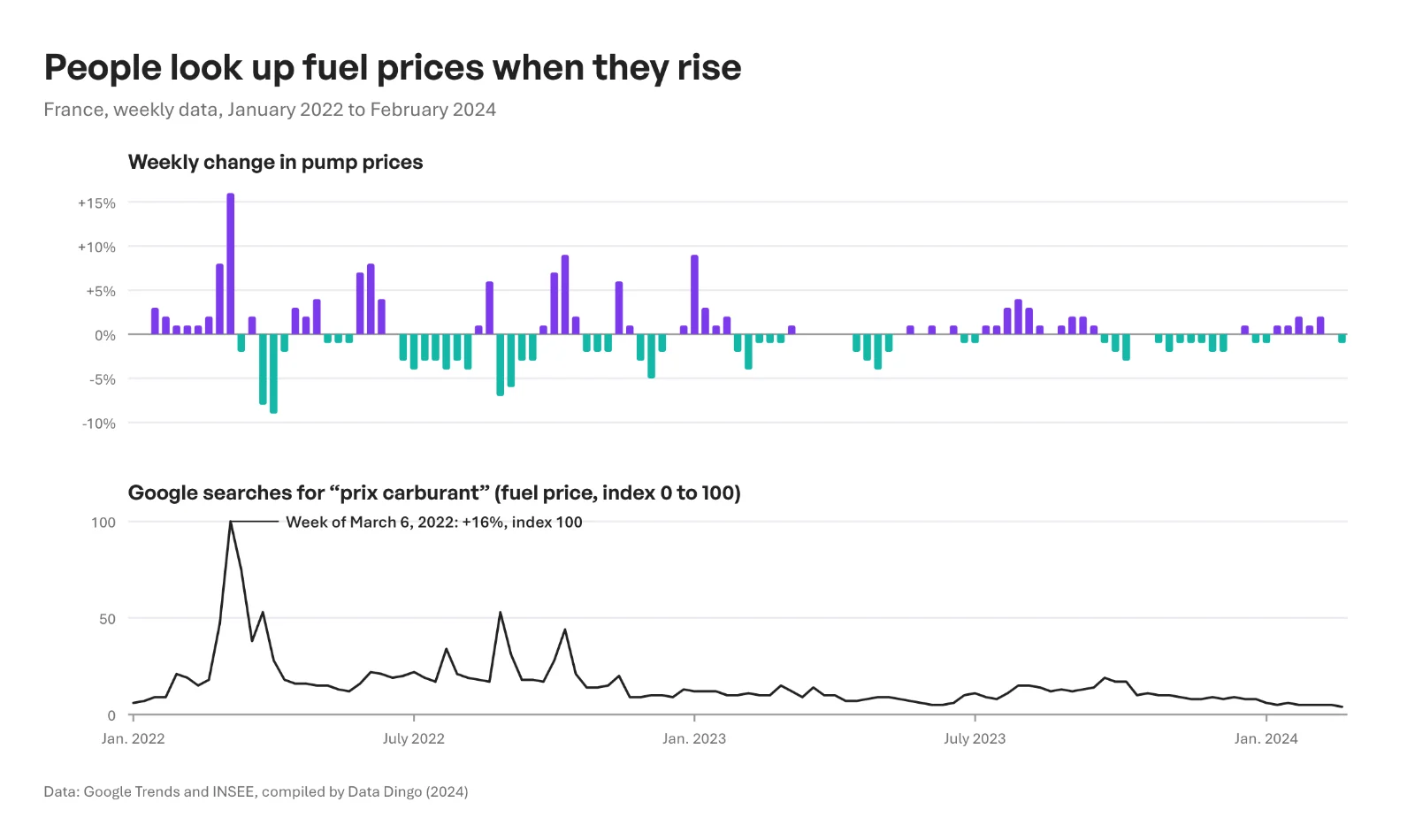 Two panels over the same period, January 2022 to February 2024: at the top, the weekly change in French pump prices, with purple bars for rises and teal bars for falls; at the bottom, Google searches for "prix carburant", which peak at index 100 in the week of March 6, 2022, when prices rose 16%
Research confirms the mechanism. A study published in the Journal of Political Economy in 2021 shows that inflation expectations follow the prices of the groceries each household buys, weighted by purchase frequency rather than spending. There is also a blind spot that official indexes correct and households ignore: quality. Statistics offices measure prices at constant quality. In the United States, the Boskin Commission estimated in 1996 that the CPI overstated inflation by about 1.1 points a year, partly because it missed product improvements.
Is AI getting more expensive?
From the bill's point of view, yes. Since January 2025, Microsoft has charged $3 more a month for Microsoft 365 Personal with Copilot included, $9.99 instead of $6.99. For businesses, Microsoft 365 E3 goes from $36 to $39 on July 1, 2026, an increase Microsoft attributes in part to Copilot Chat.
These prices behave exactly like INSEE's frequent purchases: a subscription is paid every month, its amount shows up on a bank statement, and its increases are announced by email. What the subscription contains, on the other hand, shows up nowhere.
Google Workspace makes the point. In January 2025, Google added Gemini to all its business plans and raised their prices "by a couple of dollars". But the Gemini add-on used to cost $20 per user per month. In Google's own example, a customer who paid $32 for Workspace plus Gemini now pays $14. Reported as a price rise, it is a 56% cut for anyone who already used the AI.
For the same service, the price of AI is collapsing
To compare AI prices from one year to the next, you have to hold the service constant: the same score on the same benchmark, then find the cheapest model that reaches it at each date. It is the equivalent of the statistician's constant-quality price.
Measured this way, prices fall at an unprecedented speed. In November 2021, GPT-3 was the only model scoring 42 on the MMLU benchmark, at $60 per million tokens; three years later, a small Llama model did as well for $0.06. a16z concludes that the cost falls by a factor of 10 every year for equivalent performance, 1,000 over three years. Epoch AI finds that the price of reaching GPT-4's level on PhD-level science questions fell by 40 times a year, with rates from 9 to 900 depending on the level. Stanford's AI Index reports that the cost of a GPT-3.5-level system dropped more than 280-fold between November 2022 and October 2024.
Price lists follow. On Anthropic's pricing page, the flagship Opus model went from $15 per million input tokens (Opus 4, 2025) to $5 (Opus 4.5), then to $4 (Opus 5.5), each version more capable than the last. The small Haiku model went from $1 (Haiku 4.5) to $0.10 (Haiku 5.5). OpenAI's CEO Sam Altman says it himself: "The cost to use a given level of AI falls about 10x every 12 months".
Faster than electricity
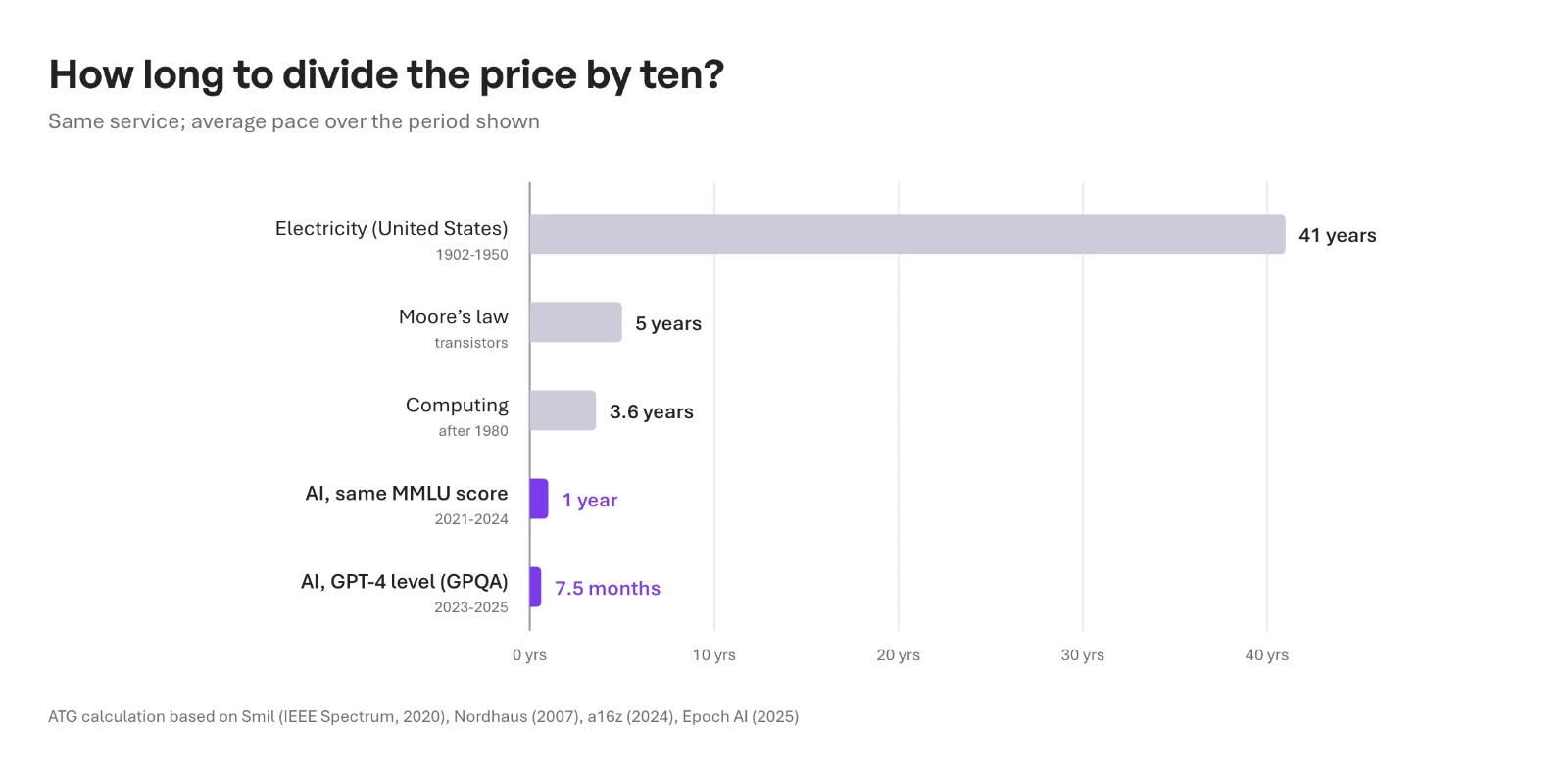 How long it takes to divide the price by ten for the same service: about 41 years for US electricity between 1902 and 1950, 5 years for Moore's law, 3.6 years for computing after 1980, 1 year for AI at equal performance, 7.5 months for AI at GPT-4 level
Electricity is the textbook general-purpose technology. In the United States, its average price in constant 2019 dollars went, according to Vaclav Smil, from $4.79 per kilowatt-hour in 1902 to 32 cents in 1950: divided by 15 in 48 years, or about forty years to divide the price by ten. Computing did much better: according to the economist William Nordhaus, the cost per computation fell by 64% a year after 1980 (as a logarithmic rate), dividing by ten in a little over three and a half years. AI does it in one year, and in seven and a half months at GPT-4 level.
The comparison flatters AI: it sets three years of a young technology against decades of mature ones, and Epoch AI notes that the fastest drops happened in the most recent year. Nothing guarantees the pace will hold. But even five times slower, it would still match the best pace computing ever achieved.
What price indexes cannot see
In 1996, William Nordhaus reconstructed two centuries of lighting prices, from wood fires to compact fluorescent bulbs. His conclusion: traditional price indexes overstated the price of light by a factor of 900 to 1,600 since 1800, because they tracked the price of candles and lamps rather than the service delivered. In the early nineteenth century, the light of a bulb burning three hours a night for a year required 17,000 candles and almost 1,000 hours of work; by the end of the twentieth, about ten minutes.
AI raises the same problem at scale. A $20 subscription whose model improves every quarter keeps the same price on the bill, and a free service has no price at all. Yet Stanford's 2026 AI Index puts the value of generative AI tools to US consumers at $172 billion a year, for tools often used for free. No price index captures it.
"I paid $200 and got $26,000 of usage"
Testimonials keep circulating online. Paweł Huryn, author of the Product Compass newsletter, calculated, with a screenshot of his dashboard, that a month of Claude Code amounted to $1,588 of tokens at API prices, "covered by a $200 subscription". The developer Michael Lip measured $26,187 of usage at list prices over one month on a Max plan, 131 times his subscription. Anthropic itself mentioned in July 2025 a user who consumed "tens of thousands in model usage on a $200 plan". The conclusion seems obvious: vendors subsidize their subscribers, and AI "really" costs far more.
List price is not cost
These calculations value usage at the API list price, which includes a margin. Michael Lip's measurement shows it: 96.4% of his input tokens are cache reads, context already processed that the model re-reads from one request to the next. Anthropic charges them a tenth of the normal input price, and they are cheap to serve. The 131x multiple mostly measures the price list.
The available figures point the same way, with a caveat: they are unaudited and mostly come from leaks. OpenAI reportedly keeps, according to internal data obtained by The Information, about 70% of its revenue after paying for the compute that serves its paying customers (October 2025). Sam Altman said in August 2025 "We're profitable on inference". DeepSeek published in March 2025 a theoretical cost-profit ratio of 545% for its models, if all usage were billed. Anthropic, with a negative gross margin in 2024, was projecting about 40% for 2025, and told investors in mid-October 2026 that it had an adjusted profit and positive cash flow in the third quarter, on $16.8 billion of revenue. Hosts of open-weight models such as Together AI or Fireworks reportedly run gross margins of 45% to 50% according to Sacra: an ordinary hosting business, neither ruinous nor exceptional.
A positive gross margin does not mean a profitable company. Anthropic lost more than $8 billion at the operating level in 2025, according to its draft prospectus as reported by Reuters, because of model training, research and salaries, not the cost of serving customers. And Anthropic cut its 2025 margin forecast because inference cost more than expected, then capped in 2025 the fewer than 5% of subscribers who ran Claude Code around the clock. Extreme cases exist. They do not make the average.
Where the subsidy is real
The largest subsidy is also the most visible: free tiers. ChatGPT reports 900 million weekly users for 50 million paying subscribers: about 94% of its users pay nothing. It is a deliberate acquisition cost, like free search engines, funded by subscribers, the API, fundraising and, since February 2026, advertising in the free tiers.
The other subsidy sits with resellers. The code editor Cursor, which buys Anthropic's models at list price, had a negative gross margin in 2025, because of its heaviest individual subscribers. The same tokens, profitable for the model maker, lose money for whoever resells them at a flat rate.
The Jevons paradox: why the bill rises when the price falls
The Jevons paradox is the observation that an efficiency gain in the use of a resource increases its total consumption instead of reducing it. The British economist William Stanley Jevons described it in 1865, in The Coal Question: "It is wholly a confusion of ideas to suppose that the economical use of fuel is equivalent to a diminished consumption. The very contrary is the truth." More efficient steam engines made coal profitable for new uses, and total consumption grew. In energy policy, this is called the rebound effect.
AI is a textbook case. Sam Altman completes his own sentence on falling costs: "and lower prices lead to much more use". Three mechanisms push the bill up:
- Demand goes to the best model. Each new frontier model launches at roughly the same price as the previous one; the price drop benefits yesterday's performance levels, which few users pick.
- Tasks get longer. According to the analyst Ethan Ding, the length of tasks AI can complete doubles every six months: an answer that used 1,000 tokens can now use 100,000, with reasoning, research and agents.
- Uses multiply. A coding agent can run nonstop: according to Ethan Ding, some Claude Code subscribers were using up to 10 billion tokens a month before Anthropic capped its plans.
A rising bill mostly signals that we are buying far more of a service that has become far cheaper, exactly what Jevons saw with coal.
What AI really makes more expensive
AI does push some prices up: those of its inputs. According to TrendForce, contract prices for DRAM memory rose 93% to 98% in a single quarter in early 2026, and were expected to rise another 58% to 63% the next quarter, with supply going to AI servers first. The memory shortage is feeding into the prices of computers and smartphones. In the United States, data center demand is also weighing on the cost of electricity capacity on the PJM grid, the country's largest.
This is the Jevons paradox applied to physical resources: the more efficient AI becomes, the more of it we use, and the more chips, memory and electricity it needs. AI therefore lowers the price of the services it delivers and raises the price of what it consumes. Its net effect on overall inflation has not been measured yet; it will depend on how large these services become in the economy.
Will AI cost businesses more and more?
Yes, and that is a sign it pays. The Jevons paradox applies inside companies too: the cheaper a task is to hand to AI, the more tasks get handed over. According to the venture firm Menlo Ventures, US enterprise spending on generative AI went from $11.5 billion in 2024 to $37 billion in 2025. In France, a Banque de France survey of some 7,000 companies shows that among generative AI users, increases in AI investment outnumber cuts by 15 points, and a third of companies plan to invest more.
The spending is justified because the gains per task are real. In the study by Brynjolfsson, Li and Raymond, customer support agents equipped with an AI assistant resolved 14% more issues per hour. According to a study published in Science, professionals write 40% faster with ChatGPT, with output rated higher in quality.
But time saved is not money saved. An hour saved is worth nothing until it changes either costs or revenue. In France, only 31% of companies using generative AI see productivity gains, according to the Banque de France. In the United States, the United Kingdom, Germany and Australia, nine executives in ten report no impact of AI on employment or productivity over the past three years. The Banque de France draws a hypothesis from this: the cost savings AI allows "could, at first, be offset by the spending needed to adopt it".
The point is unpopular, but the arithmetic is simple. A productivity gain only becomes real in two ways: producing as much with fewer people, or producing more with the same number. The first route means fewer hires or fewer jobs. Some companies say so openly: Salesforce cut its customer support staff from 9,000 to about 5,000 in 2025, and Block went from more than 10,000 to fewer than 6,000 employees in February 2026, with no financial trouble according to its CEO Jack Dorsey. At Shopify, any hiring request must first show why AI cannot do the work. Most often the adjustment happens through hiring: according to Stanford University, employment of 22 to 25 year olds in the occupations most exposed to AI has fallen 19% relative to the least exposed, mainly because fewer of them are hired. The second route, growth, takes more customers, not just freed-up hours.
Either way, someone has to decide. Citing the economist Paul David's work on factory electrification, the Banque de France points out that the gains from a new technology "often depend less on its adoption than on the complementary investments and reorganizations it brings about". Companies that turn time saved into savings or revenue will win with AI; the others will pay the bill without the gain.
What a business should take away
The bias behind perceived inflation is corrected by changing the unit of measurement. For AI, that means five habits.
- Think in cost per task. The right metric is the cost of an invoice processed, a ticket resolved or a contract reviewed, not the price of the subscription or the token. It is the only one that reflects both falling prices and rising volumes.
- Pick the model tier for the task. At Anthropic, the small model costs 40 times less per input token than the flagship. A gateway that routes each request to the right model, like the ones we compare in our article on LLM gateways, often does more for the bill than any negotiation. And many tasks need no language model at all.
- Do not judge AI on list prices. Heavy usage valued at public API rates overstates its real cost, especially when cache reads make up most of the volume. For in-house deployments, compare the different ways to run a model instead.
- Decide what happens to the time saved. Before deploying, set what the gain must produce: fewer hires, shorter lead times, more cases handled per person, a new offering. Without that decision, AI adds a spending line and removes nothing.
- Read flat plans like insurance contracts. "Unlimited" offers get capped as soon as a few users actually use them. Measure your own consumption before setting a budget, and check what office suites now include before contesting a price increase.
Frequently asked questions about AI inflation
What is the Jevons paradox?
It is the observation, made by the economist William Stanley Jevons in 1865 about coal, that an efficiency gain in the use of a resource increases its total consumption instead of reducing it. A resource that becomes cheaper to use finds new uses. Applied to AI, it explains why total spending rises while the price of each token falls.
Is AI getting more expensive?
Not for the same service. The price of a given level of performance is divided by 10 every year according to a16z, and by 40 at GPT-4 level according to Epoch AI. What goes up are some subscriptions, which include more features, and bills, because usage is exploding.
Why is perceived inflation higher than measured inflation?
Because households weight prices by how often they buy things rather than by their budget, and remember rises more than cuts. According to INSEE, counting rises twice is enough to explain the average gap of about six points observed in France since 2004.
Are AI subscriptions subsidized?
Rarely for paying customers. Testimonials such as "$200 paid, $26,000 used" value usage at the public API price, which carries a large gross margin for model makers. The real subsidy sits in free consumer tiers and with resellers who buy models at full price and resell them at a flat rate.
How fast is the price of AI falling?
According to published measurements, by a factor of 10 a year at equal performance (a16z, 2024), and from 9 to 900 depending on the level targeted, with 40 at GPT-4 level (Epoch AI, 2025). That is faster than computing after 1980, which roughly halved its cost every year.
Why is AI not paying off yet for most companies?
Because time saved only becomes money saved if the company does something with it: fewer hires, fewer jobs or more sales. According to the Banque de France, only 31% of French companies using generative AI see productivity gains, and adoption costs can at first offset the savings.
Does AI push inflation up?
It raises the price of some inputs, such as memory chips, whose contract prices almost doubled in one quarter in early 2026, and it weighs on electricity in the United States. It lowers the price of the services it delivers. Its net effect on overall inflation has not been measured yet.
We have never paid so little for the same AI service, and never spent so much. Both are true at once, as with Jevons's coal or Nordhaus's light. For a business, the useful question is the cost of each task AI performs, compared with what that task cost before, and what it does with the time saved.