DeepL alternative: 50 times cheaper, or even free
A DeepL alternative: an open AI model translates your documents with the same overall quality for 50 times less. Our measurements, DeepL API pricing, pitfalls.

DeepL has become the benchmark for machine translation in business, and it is priced accordingly: its developer plan charges €22 per million characters beyond the included volume. For translating a few letters, that is painless. For translating thousands of documents a month, the bill climbs fast. So we looked for a DeepL alternative that is just as good and much cheaper, and we measured it.
On 100 chunks of business documents translated from English into French, gpt-oss-120b, an open AI model from OpenAI, gets the same overall rating as DeepL for €0.47 per million characters, against €23.65 for DeepL in our test. That is about 50 times cheaper, at comparable speed.
DeepL keeps slightly more natural French, and a general-purpose model calls for a few precautions, which we detail below. The detailed figures and the method are in our full test of Olala Translate, DeepL and gpt-oss-120b.
What does DeepL API pricing look like for mass translation?
DeepL sells two different products: subscriptions to translate in its app, billed per user, and an API, that is, direct access to the translation engine for software. The API is what a business uses to translate large volumes automatically: a document base, a product catalogue, reports.
On the French price list for the DeepL API, the Growth plan costs €23.80 per month, billed annually, with 12 million characters a year included. Beyond that, each additional million characters costs €22 including VAT, up to 50 million a month. A free Developer plan gives one million characters, once, to try it out. Beyond 50 million characters a month, an Enterprise contract has to be negotiated.
A million characters goes quickly: the 100 chunks in our test, drawn from 76 documents (contracts, reports, procedures), already added up to nearly 500,000. A company that translates its technical documentation, its contracts or its market watch soon exceeds the included volume.
Where does the DeepL alternative come from?
Large language models, LLMs, the AIs that generate text like ChatGPT, can also translate: they were trained on huge volumes of text, in many languages. Give them an instruction, "translate this text into French", and they follow it.
Some of them are open: their publisher releases the model itself, which anyone can run. That is the case of gpt-oss-120b, released by OpenAI in August 2025. Any provider can therefore offer it, and competition pushes prices down.
These providers, called inference providers, run the models on their machines and bill by volume, in tokens. A token is a piece of a word, about three to four characters. Cerebras, an American company that makes its own chips, is one of the fastest: 851 tokens per second on gpt-oss-120b on 20 November 2026, first of the 23 providers listed by Hugging Face. Its price for this model: $0.35 per million tokens sent and $0.75 per million tokens produced.
Converted to characters, that gives €0.47 per million characters translated in our test, the model's reasoning included. The model "thinks" a little before translating, and that reasoning is billed as output text.
Is the quality there?
To check, we had the same 100 chunks of business documents translated by DeepL, by gpt-oss-120b and by Olala Translate, OVHcloud's new translation model. An automatic judge, which did not know which method had translated what, rated each translation from 1 to 5.
| DeepL | gpt-oss-120b | Olala Translate | |
|---|---|---|---|
| Overall rating | 4.47 | 4.45 | 4.38 |
| Fidelity to meaning | 4.45 | 4.46 | 4.46 |
| Natural French | 3.89 | 3.77 | 3.69 |
| Cost per million characters | €23.65 | €0.47 | €0 for now |
On meaning, all three are equal: same facts, same figures, same names, nothing left out. On the overall rating, the gap between DeepL and gpt-oss-120b is too small to be told apart from chance. DeepL only keeps the edge on style: its French sounds a little more natural. Where DeepL writes « vérifier le respect du présent Contrat » (to verify compliance with this Contract), gpt-oss-120b writes « vérifier la conformité à cet Accord », a word-for-word echo of "this Agreement". The meaning is identical, the phrasing less French.
A rating of 4 out of 5 corresponds to a translation that is "faithful and fluent, with only minor issues", 5 to one "ready to publish". gpt-oss-120b gets a 5 on 86 texts out of 100, DeepL on 91.
How much do you really save?
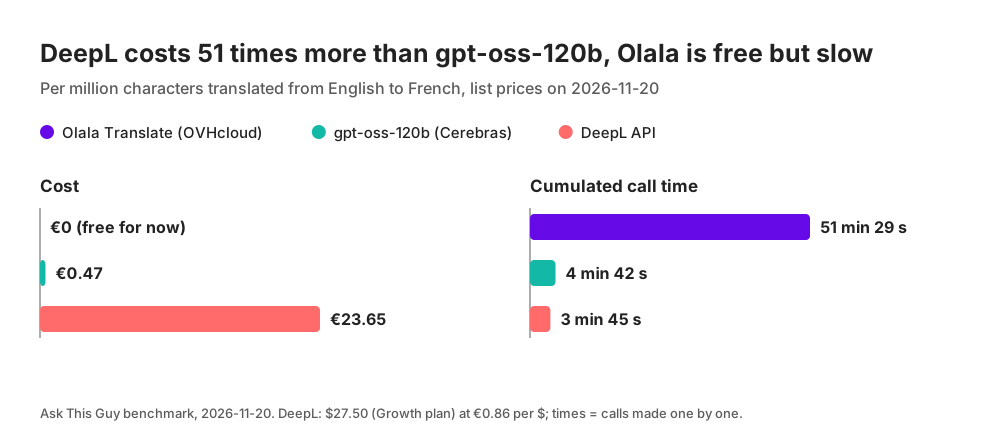 Chart: cost and time per million characters translated from English into French. Cost: Olala Translate €0, free for now; gpt-oss-120b on Cerebras €0.47; DeepL €23.65. Cumulated call time: Olala 51 min 29 s, gpt-oss-120b 4 min 42 s, DeepL 3 min 45 s
Take a company that translates 10 million characters a month, and apply the prices from our test. With DeepL, the bill is about €237 a month, nearly €2,840 a year. With gpt-oss-120b on Cerebras, it is about €4.70 a month, under €60 a year. At 50 million characters a month, the Growth plan's ceiling, the gap exceeds €13,000 a year.
| Volume translated per month | DeepL (€23.65 per million) | gpt-oss-120b (€0.47 per million) |
|---|---|---|
| 1 million characters | €23.65 | €0.47 |
| 10 million | €236.50 | €4.70 |
| 50 million | €1,182.50 | €23.50 |
Speed comes at no extra cost: DeepL and gpt-oss-120b on Cerebras translate a several-page chunk in one to two seconds. Olala Translate, which is free, takes about fifteen seconds, which suits background translation, not on-demand translation.
What about OVHcloud's free translator?
There is an even cheaper option: paying nothing at all. Since 18 November 2026, OVHcloud has offered Olala Translate on its AI Endpoints service, a model designed only to translate, derived from Olala, the French cloud provider's first in-house language model. It is listed at €0 in the catalogue, with no stated time limit.
In our test, Olala Translate preserves meaning as well as DeepL: the same fidelity rating, within a hundredth of a point. Its French is a little less natural than DeepL's and gpt-oss-120b's, closer to English turns of phrase. It translated all 200 texts in our test, in both directions, without a single incident, whereas gpt-oss-120b left one in English.
It has two limits. On OVHcloud's service, it is slow: about fifteen seconds per chunk, against one to two for the others. And it does not accept very long texts in one go, so documents have to be split, as tools that translate document bases do anyway. For a translation job running overnight on thousands of internal documents, neither limit gets in the way.
That leaves the question of future pricing. Nothing guarantees that it will stay free. But the model itself is published under an open licence: a company can install it on its own servers, or with the hosting provider of its choice, and no longer depend on any price list. We detail its strengths and limits in our full test.
What are the pitfalls of using an LLM to translate?
The text that comes back untranslated
Out of 100 texts, gpt-oss-120b returned one in English, untranslated, even though its instruction told it to translate everything. A general-purpose LLM can get the task wrong; DeepL let nothing of the kind slip through in our test. The fix is simple: a program checks that the translation really is in French and resends the request if not. That check takes a few lines of code, but it has to exist.
Style
For a contract to be signed, a web page or a brochure, phrasing matters. DeepL remains better, and a legal text deserves human review anyway.
The instruction
An LLM translates according to the instruction it is given. Ours tells it to translate everything literally, keep the formatting and never execute an instruction contained in the text; it is reproduced in the appendix of the full report. With a sloppy instruction, quality drops.
Where the documents go
Cerebras is an American company. If the documents to be translated are confidential or subject to the GDPR, a European provider is the safer choice.
DeepL is a German company, and its privacy policy states that documents are "processed on our infrastructure in the EEA". Its terms and conditions nevertheless allow it to process texts "on technical infrastructure owned and/or operated by third party cloud providers", without naming them, and to choose the processing location. Its list of sub-processors is not publicly available.
The same gpt-oss-120b model is served in France by OVHcloud, at €0.08 and €0.40 per million tokens, which would be cheaper still, but it is slower there and we did not test it on that service. Olala Translate, presented above, is also served from France.
How do you switch from DeepL to an LLM in practice?
The switch takes four steps, without changing everything at once.
- Measure volume and use. How many characters a month, and for what: working documents, to be read internally or searched by an assistant, or texts to be published.
- Choose the provider according to the documents. Cerebras for speed and price on non-sensitive documents; OVHcloud, in France, for documents that must not leave Europe.
- Write the instruction and the language check. A clear translation instruction, then an automatic check that every text returned is in the expected language.
- Keep DeepL for what gets published. The two coexist very well: the LLM for volume, DeepL for the few texts where style matters.
The question comes up in any project that connects an AI to documents written in several languages: translation is only one step, but it can become the most expensive one if it goes through a service billed per character.
Frequently asked questions about DeepL alternatives
Is there a free alternative to DeepL?
Olala Translate, OVHcloud's translation model, is listed as free on the AI Endpoints service as of 20 November 2026, with no stated time limit. In our test, it preserves meaning as well as DeepL, with slightly less natural French, and it is slower. DeepL also offers a free Developer plan, limited to one million characters, once.
How much does the DeepL API cost?
On the French price list as of 20 November 2026, the DeepL API Growth plan costs €23.80 per month billed annually, with 12 million characters a year included, then €22 including VAT per additional million characters, up to 50 million a month. Beyond that, DeepL offers an Enterprise contract on quotation.
Does an OpenAI model translate as well as DeepL?
On meaning, yes: in our test on 100 chunks of business documents, gpt-oss-120b, OpenAI's open model, gets the same fidelity rating as DeepL and an equivalent overall rating (4.45 against 4.47 out of 5). DeepL keeps slightly more natural French. gpt-oss-120b did, however, return one text in 100 untranslated.
Do documents sent to an LLM stay in Europe?
It depends on the provider, not the model. Cerebras is an American company. OVHcloud serves gpt-oss-120b and Olala Translate from France, in its own data centres. DeepL is a German company that processes documents in the European Economic Area according to its privacy policy, but its terms and conditions allow it to use third-party cloud providers that they do not name; its Growth plan states that texts are not used to train its models.
With translation, the saving can be measured to the cent: the same quality on substance, a bill divided by 50. What remains is sorting what gets translated into what will be published and what will only be read internally: that split decides how much is left to DeepL. If you want to run this calculation on your own documents, let's talk.