LLM translation: OVHcloud's Olala tested against DeepL
LLM translation tested: OVHcloud's Olala Translate against DeepL and gpt-oss-120b on 100 business document chunks. Fidelity, fluency, cost and speed compared.

On 18 November 2026, OVHcloud put Olala Translate, an LLM built for translation, on its AI Endpoints service. It is derived from Olala mini, the French cloud provider's first in-house model, and it is listed at €0 in the catalogue, for input and output alike. OVH compares it with small open models such as Gemma and Qwen, but not with DeepL, the benchmark businesses actually pay for today. So we ran that test: 100 chunks of business documents translated from English into French by Olala Translate, by DeepL and by gpt-oss-120b, OpenAI's open-weight model used as a translator.
The result reflects well on OVHcloud. Olala preserves meaning as faithfully as DeepL: on fidelity, our automatic judge sees no difference between the three methods. DeepL keeps the edge on style, with more natural French, and Olala, as served by OVHcloud's AI Endpoints, is much slower, though nothing prevents deploying it on faster infrastructure. Above all, it costs nothing for now, while DeepL charges over €20 per million characters.
For a business, then, everything depends on the use case. Translating working documents, to index them, search them or have an assistant read them, first of all requires losing none of the meaning: Olala does that well, in France, for free, starting today. Publishing a text as is requires polished French: DeepL stays ahead. For mass translation at very high speed, where sovereignty is not a concern, specialised inference providers such as Cerebras remain attractive.
What is Olala Translate, OVHcloud's translation LLM?
A translation LLM is a language model trained for a single task: take a text, a source language and a target language, and return the translation. It does not chat and does not follow instructions. It is the third way between machine translation services such as DeepL and large general-purpose models that are asked to translate through a prompt.
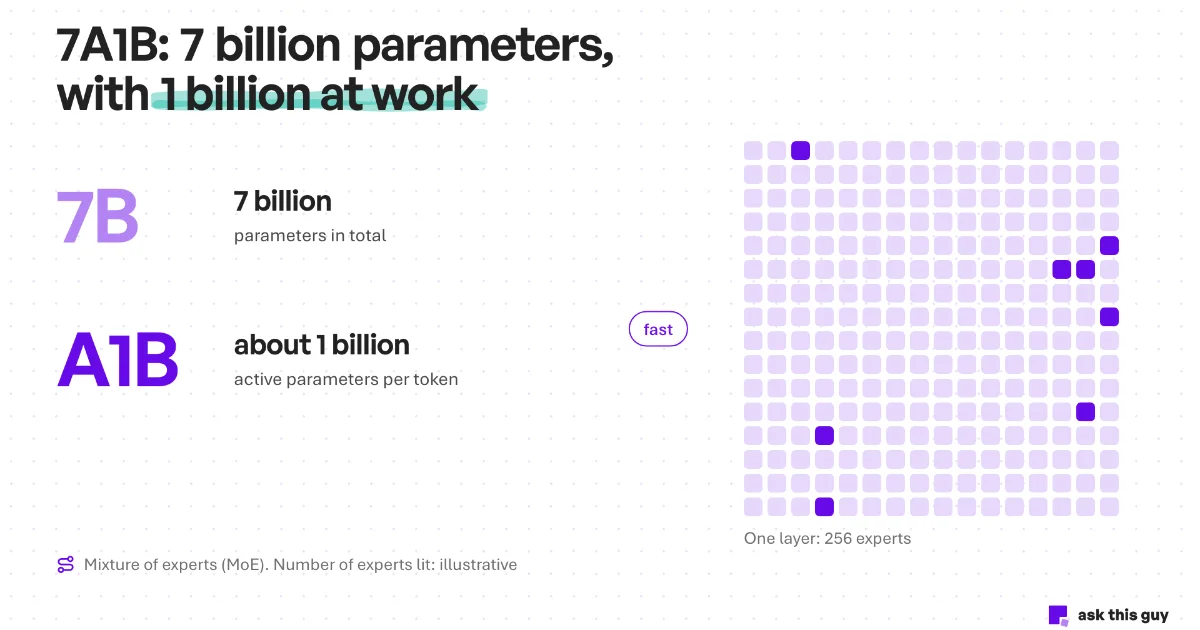
Olala Translate is a fine-tune of Olala mini 7A1B, the small model OVH published on 19 November and that we covered in detail. It has 6.8 billion parameters, of which only about one billion work on each word produced, which makes it light to run. The model card describes it as specialized for financial documents and covers 18 languages, from the major European languages to Chinese, Japanese and Arabic. The weights are under the Apache 2.0 licence: a company can install it in-house, adapt it and use it commercially.
Two options stand out. Users can specify a domain ("Annual Report IFRS", "Prospectus KIIDs", "Regulatory"…) and provide a glossary, a list of terms the translation must use. We did not use them: our test measures the model in its simplest configuration, with the two languages as the only parameters.
On AI Endpoints, the API accepts an 8,000-token context, input and output included: a long document has to be split, which the model card recommends anyway. The model is served from a data centre in France, like the rest of the catalogue.
The results published by OVH are good, but against models of its own size. On COMET-22, which covers news and nine financial domains, Olala comes first with 88.0, ahead of Tower+ and Gemma 4. On DOLFIN, a set of financial documents translated from English into French, it scores 62.6 BLEU, "8.6 points ahead of the next model we compared". No comparison with DeepL or Google has been published: that is the gap this test fills.
How did we compare Olala, DeepL and gpt-oss-120b?
We took one representative of each family:
- the specialised model: Olala Translate, called on AI Endpoints;
- the commercial service: DeepL's API, in its "quality_optimized" mode;
- the general-purpose LLM: gpt-oss-120b, OpenAI's open-weight model, served by Cerebras and guided by a "translation engine" prompt.
Cerebras was picked for its speed: 851 tokens per second on this model on the Hugging Face router on 20 November, the fastest of the 23 providers listed.
The material is business documents as a document pipeline produces them, not clean sentences. We used Veracier Industries, a set of 1,004 PDFs from fictional companies published by LightOn under the Apache 2.0 licence: contracts, test reports, policies, financial documents, letters. Each PDF is converted to Markdown, then split into chunks of at most 8,000 characters, as in a document search engine. After filtering out chunks that were too short or not English enough, we randomly drew 100 chunks from 76 documents, close to 500,000 characters.
Each method translated each chunk into French, then translated its own French back into English. Quality was rated by Jev, TypeSafe's model, which we already use to rerank search results: it answers closed questions with a probability for each answer. It gave three ratings from 1 to 5, without knowing which method had translated: an overall rating and a fidelity rating, from the English text and its translation, and a fluency rating, from the French alone, as a reader would discover it.
Everything is published: the full report (method, prompts, statistics, French version) and the workbook, with every translation and every rating, chunk by chunk.
Does Olala Translate translate as faithfully as DeepL?
Yes. On fidelity to meaning (same facts, same figures, same names, nothing omitted or added), the three methods are tied: 4.46 for Olala, 4.45 for DeepL, 4.46 for gpt-oss-120b. The differences are too small to be told apart from chance. On the overall rating, DeepL leads Olala by 0.09 points, the only significant gap; gpt-oss-120b sits in between, with no significant difference from either.
| Method | Overall rating | Fidelity | French fluency |
|---|---|---|---|
| Olala Translate (OVHcloud) | 4.38 | 4.46 | 3.69 |
| gpt-oss-120b (Cerebras) | 4.45 | 4.46 | 3.77 |
| DeepL API | 4.47 | 4.45 | 3.89 |
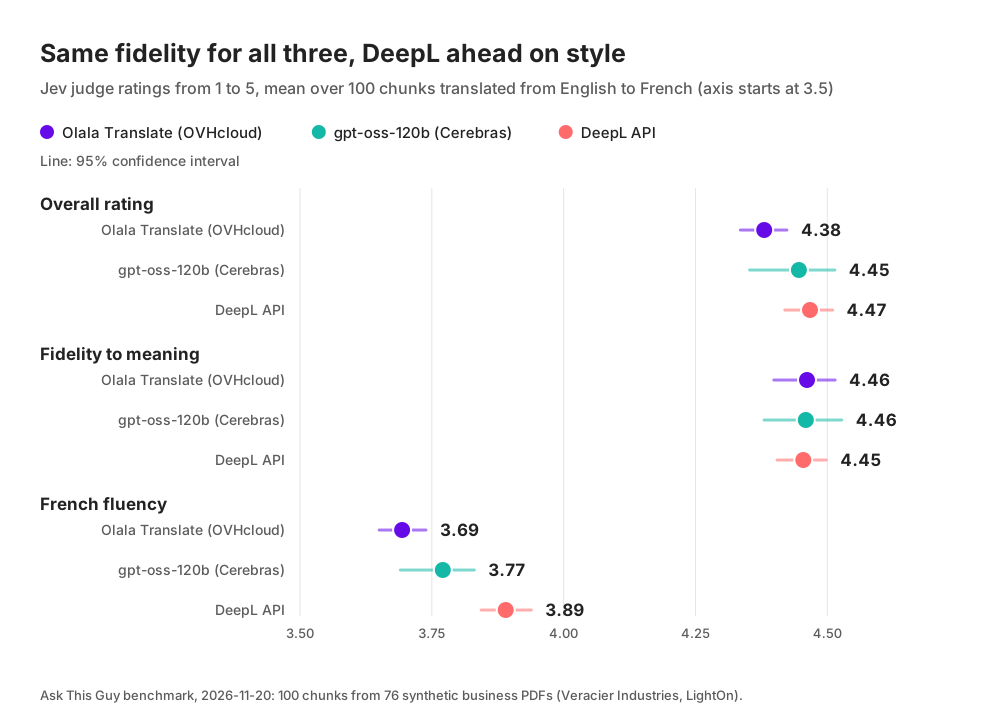 Chart: Jev judge ratings from 1 to 5, mean over 100 chunks translated from English into French. Overall rating: Olala Translate 4.38, gpt-oss-120b 4.45, DeepL 4.47. Fidelity to meaning: Olala 4.46, gpt-oss-120b 4.46, DeepL 4.45. French fluency: Olala 3.69, gpt-oss-120b 3.77, DeepL 3.89. The 95% confidence intervals overlap on fidelity
The gaps remain small, on a scale where 4 means "faithful and fluent, with only minor issues" and 5 "ready to publish". For 72 of the 100 chunks translated by Olala, the most likely overall rating is 5; it is for 91 chunks with DeepL. Olala's other 28 translations get a 4, and none goes lower. Head to head, chunk by chunk, Olala ties with DeepL 73 times, beats it 6 times and loses 21 times.
Where DeepL makes the difference: the French
The gap lies in fluency. DeepL scores 3.89, gpt-oss-120b 3.77 and Olala 3.69. All three gaps are significant. Olala translates accurately, but closer to the English. A contract clause shows it well:
Source: "The Customer reserves the right to audit the Supplier's facilities […] upon fifteen (15) business days' prior written notice, to verify compliance with this Agreement."
Olala: « Le Client se réserve le droit d'auditer les installations […] sur préavis écrit de quinze (15) jours ouvrables, afin de vérifier la conformité avec le présent Accord. »
DeepL: « Le Client se réserve le droit de procéder à un audit des installations […], moyennant un préavis écrit de quinze (15) jours ouvrés, afin de vérifier le respect du présent Contrat. »
The meaning is the same. But a French lawyer would write « Contrat » rather than « Accord », the literal echo of "Agreement", and an engineer « essai de fatigue » rather than « test de fatigue » for the "fatigue test" found further on in the same chunk. DeepL picks those words; Olala, like gpt-oss-120b, keeps the English ones. The judge takes this into account without treating it as an error: on this chunk, its overall rating is actually lower for DeepL (4.22) than for Olala (4.38) and gpt-oss-120b (4.59).
Olala has its good moments too. Some documents in the corpus mix English with French typed without accents, like many real business documents. On a corrective action report of that kind, Olala restores the accents in the French passages (« Vérification de l'efficacité prévue ») and scores 4.50, against 3.47 for DeepL: its widest margin in its favour.
What the round trip and the structure say
Translating the French back into English and comparing it with the original confirms the picture. Measured with chrF++, a character-by-character similarity score from 0 to 100, the version coming back from Olala is the closest to the original (81.8), ahead of gpt-oss-120b (81.6) and DeepL (76.8). This metric favours literal translations: it does not say Olala translates better, but that it rephrases the least. DeepL, which rewrites more, loses more of the original words on the round trip.
Formatting survives well everywhere. Markdown headings, tables, lists and links are kept at 98% by Olala, at 100% by DeepL and by gpt-oss-120b.
How much does each method cost, and how long does it take?
This is where the three methods diverge most. For one million characters translated from English into French:
| Method | Cost | Cumulated call time | Median latency per chunk |
|---|---|---|---|
| Olala Translate (OVHcloud) | €0 (free as of 20 Nov 2026) | 51 min 29 s | 16.0 s |
| gpt-oss-120b (Cerebras) | €0.47 | 4 min 42 s | 1.3 s |
| DeepL API | €23.65 | 3 min 45 s | 1.1 s |
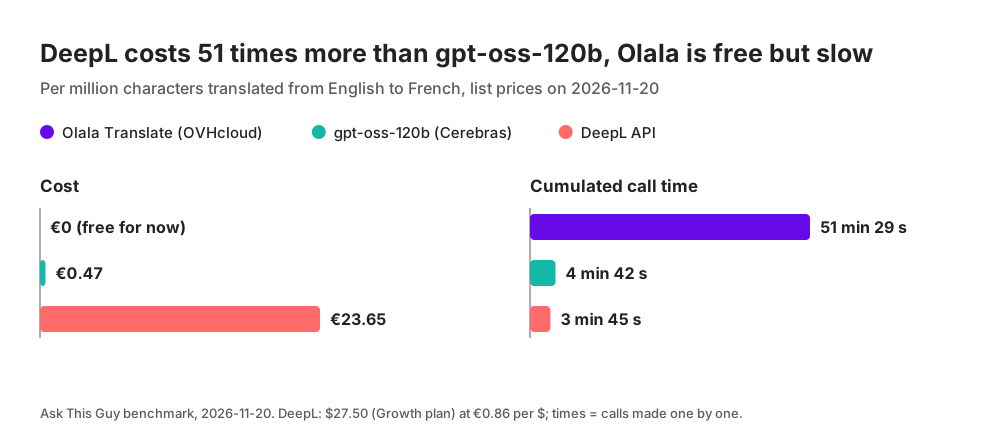 Chart: cost and time per million characters translated from English into French. Cost: Olala Translate €0, free for now; gpt-oss-120b on Cerebras €0.47; DeepL €23.65. Cumulated call time: Olala 51 min 29 s, gpt-oss-120b 4 min 42 s, DeepL 3 min 45 s
Olala costs nothing today, and nothing says how long that will last. The AI Endpoints catalogue lists it at €0, with no mention of a time limit or a preview.
DeepL's price is the overage rate of its API Growth plan, $27.50 per million characters, which we converted to euros. On the French price list, the Growth plan costs €23.80 per month billed annually, with 12 million characters a year included, then €22 including VAT per additional million. The included volume also works out at €23.80 per million. The order of magnitude does not change: DeepL costs about 50 times more than gpt-oss-120b served by Cerebras, even though the latter's reasoning tokens are billed.
Olala's slowness on AI Endpoints is its real weak point: 16 seconds per chunk at the median, against one to two seconds for the other two. That is the speed of the (free) service, not of the model: measured two days after launch, it may still improve, and the published weights make it possible to serve Olala on faster infrastructure. For background processing, it matters little anyway. Run in parallel, the test's 600 translation calls, all methods combined, fit into 13 minutes. Instant translation, in an interface where the user waits for the answer, is what it does not suit: that use requires deploying the model on other infrastructure to work well.
Are the three methods reliable?
Out of 600 translation calls, none failed and none returned an empty answer. Olala and DeepL translated all 200 texts assigned to them, in both directions. Olala had to split a single chunk in two to fit its 8,000-token context.
gpt-oss-120b made the only serious mistake of the test: on a short chunk from a manufacturing record, it returned the English text unchanged, with no error or warning, even though its prompt tells it to translate everything. In production, an automatic check of the output language is enough to catch this case, but it has to exist. Olala, which can only translate, let nothing of the kind slip through.
Which is the best LLM for translation in a business?
None of the three wins everywhere, and each has its own ground.
Olala Translate's ground is working documents, read internally or by a machine. Indexing a multilingual document base, letting an assistant answer from documents written in another language, translating reports for internal reading: fidelity is what counts, and Olala matches DeepL on it. It is served in France, free for now, and its open weights can be installed on a company's own servers, for documents that must not leave the building. Slowness matters little when translation runs in the background. For financial documents, its stated domain, and with a glossary, it could do better than in our test, which used neither.
DeepL keeps the ground of publication. A website, a brochure, a contract that will be signed: when the text will be read as is, DeepL's 0.2 points of fluency count. Even then, a legal text deserves human review, as Olala's own model card points out for its translations.
That leaves low-cost mass translation, the ground of gpt-oss-120b on fast inference. It gets the same overall rating as DeepL for a fraction of the price, at comparable speed. It is the method to pick for translating millions of characters a month, provided the language check described above is added. We walk through this calculation for a non-technical reader in our guide to paying 50 times less than DeepL for translation.
For an IT manager concerned with sovereignty, choosing Olala has one more argument going for it: a French model, served in France by a European cloud provider, that translates as faithfully as the market leader.
DeepL is European too: the company is German, it has installed its own supercomputers in Sweden, and its privacy policy states that documents are "processed on our infrastructure in the EEA". But its terms and conditions allow it to process customer texts "on technical infrastructure owned and/or operated by third party cloud providers", which they do not name, and leave the choice of processing location to DeepL. Its list of sub-processors is not publicly available: from the outside, there is no way to know whether an American hyperscaler is involved. At OVHcloud, which owns its data centres, the model is served from France; our understanding is that the provider runs its whole AI stack in-house, without subcontracting to a hyperscaler.
gpt-oss-120b is also in the AI Endpoints catalogue, at €0.08 and €0.40 per million tokens for input and output: cheaper still than on Cerebras, but slower, at 52 tokens per second on the Hugging Face router on 20 November. We did not test it there.
Translating the documents of an AI project or a chatbot
An assistant that answers from a company's documents, whether an internal chatbot or an answer engine over a document base, soon runs into languages. Contracts are in English, procedures in French, the subsidiary's reports in German: a question asked in French struggles to find a passage written in English. Translating the documents when they are indexed solves this. The assistant searches in a single language, then answers in the user's.
That is exactly the setting of our test: PDFs converted to Markdown, split into chunks of up to 8,000 characters, translated one by one. And this is where volume changes the equation. At our test's prices, translating a 50-million-character document base costs about €1,180 with DeepL, €24 with gpt-oss-120b on Cerebras, and nothing today with Olala. Every new document then adds to the bill.
The model is only one part of the pipeline. PDFs must be converted without losing tables, split without cutting a clause in two, kept within the model's context limit; each translation's language must be checked, failures retried, and a decision made on where the documents are processed. At ATG, we have studied and implemented this whole pipeline, this benchmark included. Our clients do not have to build it or redo these measurements: the ATG platform handles the translation of their documents, and we choose the model with them according to their cost and sovereignty constraints.
The limits of this test
The ratings come from a single automatic judge, not from professional translators. Jev is confident on fidelity, much less so on fluency, which it rates 3 for most texts: small differences in style should be read with caution. The documents are synthetic, created by a language model for fictional companies, and we only tested English into French. The corpus is general-purpose (contracts, engineering, quality, finance), whereas Olala is pitched at finance. Finally, this is a snapshot from 20 November 2026: prices, models and speeds change fast.
In the interest of transparency: ATG is an OVHcloud customer, and OVHcloud hosts our platform. This test was neither commissioned nor reviewed by OVHcloud, DeepL or Cerebras.
Frequently asked questions about Olala Translate and LLM translation
Is Olala Translate free?
Yes, as of 20 November 2026: the OVHcloud AI Endpoints catalogue lists it at €0 per million tokens, for input and output, with no stated time limit. A price may appear later. The model weights are also published for free on Hugging Face, under the Apache 2.0 licence, for installation on a company's own servers.
Is Olala Translate better than DeepL?
It is as faithful, not as fluent. On 100 chunks of business documents translated from English into French, Olala and DeepL get the same fidelity rating (4.46 and 4.45 out of 5), but DeepL writes more natural French (3.89 against 3.69) and leads Olala by 0.09 points on the overall rating. Olala is free for now; DeepL costs about €22 to €24 per million characters.
Which languages does Olala Translate support?
Eighteen languages according to its Hugging Face model card: English, French, German, Spanish, Italian, Dutch, Portuguese, Swedish, Danish, Norwegian, Finnish, Polish, Czech, Russian, Arabic, Chinese (simplified and traditional), Japanese and Korean. Our test only covers English into French.
Can Olala Translate run on your own servers?
Yes. The weights are published under the Apache 2.0 licence, which allows commercial use. With about one billion active parameters, the model is light, but for now it requires vLLM with a specific setting, as mainstream tools such as Ollama cannot yet load Olala's architecture.
Can an LLM replace DeepL for translating documents?
For working documents, yes: in our test, Olala Translate and gpt-oss-120b preserve meaning as well as DeepL, for free in the first case for now, and at a fiftieth of the price in the second. For a text published as is, DeepL remains more natural. A general-purpose LLM also requires checking the output language: gpt-oss-120b returned one text in 100 untranslated.
Olala Translate is two days old and already matches DeepL on what matters most, the meaning. The next step is to put it to the test on its stated ground, financial documents, with a domain glossary, and in the other languages it covers. If you translate large volumes of documents and want to know what this test would show on yours, let's talk.