Data room AI: Datasite, Intralinks, iDeals and MCP compared
Using your own AI on a Datasite, Intralinks or iDeals data room: built-in assistant, MCP or file access. What each room actually allows, and where it stops.

On Monday, the seller's data room is on Datasite. On Wednesday, another deal opens on Intralinks. On Friday, a third sale process lands on iDeals. For a transaction services team, an M&A lawyer or a fund's deal team, that is an ordinary week, and the data room is never their choice: it belongs to the host, the seller or its investment bank, who pays for it and sets everyone's permissions. On iDeals, for example, only the account owner or its managers can create API keys.
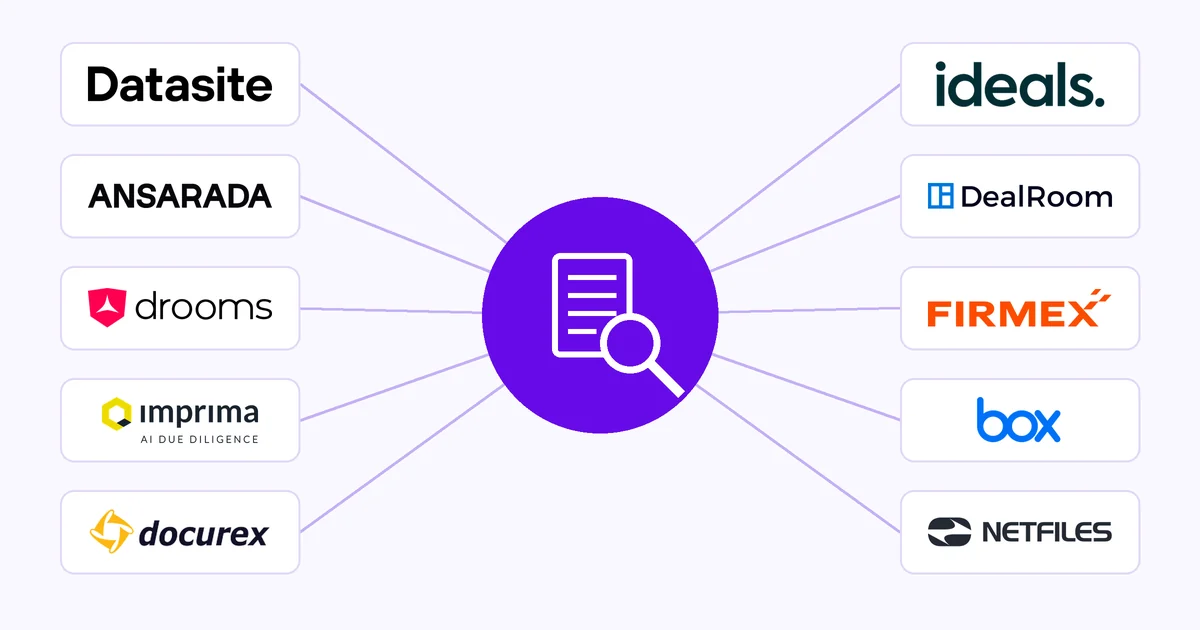
Each of these rooms now comes with its own AI. Datasite launched an MCP server on April 28, 2026 for any compatible AI (Claude, ChatGPT, Ask This Guy and others), iDeals has done the same, and Intralinks has its own MCP server inside DealCentre. So the question becomes: can you use your own AI across all your data rooms, instead of a different assistant on every deal?
You can, in three ways, with limits that vary a lot from one room to the next. MCP solves access to the documents; the quality of the search is still the vendor's, and no data room vendor publishes a measure of that quality.
Three ways to use AI on a data room
A virtual data room (VDR) is a secure sharing space where the seller uploads the documents of a transaction, with fine-grained permissions per bidder, watermarks and a log of every view. AI can get in three ways.
| Route | How | What you gain | The limit |
|---|---|---|---|
| Built-in AI | the assistant sold with the room (Blueflame, DealCentre AI, AiDA…) | nothing to install, permissions already applied | a different AI in every room, unpublished accuracy, no cross-checking with the deal's other sources |
| MCP | your own assistant queries the room, with your permissions | one AI for several rooms, without copying documents | search is often the vendor's, or done one document at a time |
| File access | API, SFTP or room export, indexed by a document search AI | a search you choose and can measure, cross-checked with the rest of the file | requires download rights, and often the host's agreement |
Built-in AI is the simplest route. With Blueflame, Datasite advertises search, summaries, clause explanations, redaction of more than 120 types of personal data and translation into more than 17 languages. Ansarada has its AiDA assistant, Drooms an assistant that answers across the whole room. The drawback comes from the reader's job: they switch assistants on every deal, with features, settings and a quality they cannot compare.
MCP in two minutes, and who supports it
MCP (Model Context Protocol) is an open standard that Anthropic introduced on November 25, 2024 to connect AI assistants to the software where data lives. A vendor that exposes an MCP server describes its tools once (list folders, read a document, search), and any compatible assistant can call them, with the permissions of the signed-in user. The protocol has since been handed over to the Agentic AI Foundation, under the Linux Foundation; our article on MCP covers it in detail.
For our reader, the appeal is obvious: connect Datasite, iDeals and DealRoom to a single assistant and find all their rooms in one place. Provided they know what each server lets through.
| Data room | MCP server | What MCP returns | Assistants named by the vendor |
|---|---|---|---|
 | yes | the text of files, within the user's permissions | Claude, Copilot, ChatGPT |
 | yes (beta) | the full extracted text of each document | Claude, ChatGPT, Gemini Enterprise, Copilot, any compatible client |
 | yes, since April 2026 | content only through Blueflame search, otherwise metadata | Claude, ChatGPT, Copilot, Blueflame |
| Intralinks | yes (DealCentre) | search, summary and analysis, no download | "Claude or other MCP-compatible applications" |
 | yes | structure and metadata, no content | Claude, ChatGPT |
 | yes | listing, reading, search and Box AI questions | any compatible client (OAuth) |
| Drooms, Firmex, Imprima, Docurex, netfiles | none found |
The details come from the vendors' own pages: iDeals, DealRoom, Datasite, Intralinks, Ansarada and Box. The list keeps growing: Donnelley Financial announced an MCP connector for its Venue data rooms on October 27, 2026, naming Microsoft Copilot.
On the assistant side, Claude, ChatGPT and Copilot are named everywhere.  ATG does the same: it connects to any MCP server the user is authorized to use, with each user's own account and without any particular partnership with a vendor (see our MCP servers documentation). The distinction matters, because Datasite requires a written agreement for any commercial distribution of an application, and Intralinks admits vendors to its integration program at its discretion.
The limit of MCP: search stays with the vendor
The table shows two families. DealRoom and iDeals return the text of the documents to the assistant. Datasite, Intralinks and Ansarada keep content behind their own engine, or do not expose it at all. Datasite's official repository says so plainly: "searchDocuments is the only permitted source of document content", a search available with Blueflame or partner entitlements; without it, the assistant only sees metadata.
In the first case, the assistant reads documents one by one as the conversation goes, with no index over the whole room. In the second, answer quality depends on the vendor's search engine, which the assistant merely calls. Nothing in the protocol tells you whether the tool will find the change-of-control clause or the right fiscal year among thousands of pages.
Yet that is what drives accuracy. On FinanceBench, the reference question set on financial filings, accuracy depends first on what the system has to find by itself among hundreds of documents. We dig into this in AI and due diligence: the hard part is finding the right document.
No data room vendor publishes its AI's accuracy
We looked at Datasite, Intralinks, Ansarada, iDeals, Imprima, Drooms, DealRoom and Box for a FinanceBench result or any other figure measuring the accuracy of their AI. We found none. Blueflame is a telling case: in a September 1, 2026 post on AI benchmarks in finance, Datasite's engine says it uses "a suite containing many thousands of questions" built in-house and adapts public benchmarks, without naming any or publishing a score.
Nothing here suggests these AIs answer badly. The reader simply cannot compare Datasite's assistant with Intralinks', or with the one they use elsewhere. For our part, we publish our numbers: on FinanceBench's 150 public questions, ATG answers 138 correctly (92%) by searching 368 filings on its own, without being told which file to open, with every answer available for review.
Room by room: what the guest can do, what the host can do
For each room, three questions matter. As a buy-side guest, what can I let my AI read? As the sell-side host, can I connect an AI to the whole room? And what is the built-in AI worth?
Datasite. Guests go through MCP with their own permissions, but projects that enforce MFA are excluded and content only comes out through Blueflame search. For hosts, self-service APIs exist, with no publicly visible download endpoint. The built-in AI, Blueflame, relies notably on OpenAI models.
Intralinks. Guests query the room through the DealCentre MCP server, which searches and summarizes without downloading. For hosts, the ILIA adapter downloads whatever is new or changed. AlphaSense already syncs these rooms through the API, and Harvey, Legora and Rogo announced DealCentre integrations in June 2026. Files under IRM stay encrypted. The built-in AI runs on models operated by Intralinks.
iDeals. The most open of the large rooms: a public API specification and an MCP server that reads file text. But a user with view-only or "Fence View" access only gets a link, not the content, and only the host creates API keys. The built-in AI summarizes, translates, redacts and searches.
Ansarada. For guests, MCP only shows the structure: "Document content is not read, exported or downloaded through MCP". For hosts, the GraphQL API lists the index with modification dates and downloads documents, one at a time or in bulk. The AiDA assistant answers questions about the documents.
 Firmex. No MCP and no public API documentation: API access goes through the account manager. Protected files require the Seclore IRM plug-in. That leaves the bulk ZIP download, if the administrator has enabled it. The product updates from January 2024 to July 2025 include no AI feature.
DealRoom. The most open MCP server for a third-party assistant: it returns the full text of documents, with the same permissions as the interface, and only sends metadata for restricted files. A REST API is available as an option. The built-in AI relies on OpenAI.
 Drooms. No API or MCP server found. Downloading is a group permission, sometimes limited to watermarked PDFs delivered as a ZIP, and the host can order a certified archive at closing. The built-in AI is developed in-house: questions across the whole room, tabular review, semantic search.
 Imprima. The vendor says it provides an API but offers to build the integration itself, and its SharePoint sync runs from SharePoint into the room, not the other way round. No MCP server found. When the seller feeds the room from SharePoint, that source is what an AI can index.
Box. Box also serves as a data room. It has the most complete API of the lot, webhooks and an MCP server limited to content the user can see. Box Shield can, however, block reading and downloading by third-party integrations. Box AI relies notably on OpenAI and Gemini models.
 Docurex. The vendor publishes its API specifications: recursive listing, download, ZIP, with the signed-in user's permissions, in a module reserved for the Premium edition. Its AI answers questions with references, without third-party models.
 netfiles. No built-in AI, but three documented interfaces: WebDAV, SFTP and an API. SFTP is enabled on request by support. A netfiles room can then be read with a plain SFTP connector, such as ATG's.
The other rooms met on deals (Brainloop and Diligent, Admincontrol, Closd, SecureDocs) expose no public API that we found. CapLinked opens a developer portal on application, ShareVault reserves its API for the Enterprise plan, Virtual Vaults provides it on request and Digify publishes its own, with no content download endpoint.
What really gets in the way for a buy-side guest
Permissions matter more than the protocol. Four locks come up from one room to the next.
The first is the download permission. A data room exists first to control distribution: in view-only mode, in "Fence View" on iDeals or behind Intralinks' secure viewer, no external AI gets the content. DealRoom's own MCP server only sends metadata for restricted files.
The second is IRM, the protection that follows files after download. On Intralinks, Firmex or Datasite, a protected document stays encrypted and only opens in an authenticated application: a text extraction tool gets nothing out of it.
The third is the API key, which belongs to the host. The guest has no hand on the seller's room API; what remains is MCP, with their own permissions. The fourth is session protection: Datasite's MCP server refuses projects that enforce MFA.
The ideal setup: a measured AI with access to the files
MCP is the practical route, and sometimes the only one when you are not allowed to download. But as soon as permissions allow it, another setup puts you in control of quality: the room's files indexed by an AI whose accuracy is known. The host can get there through the room's API or SFTP, or by indexing the SharePoint source that feeds it directly. The buyer can upload the export they are allowed to retrieve.
That is the route we favor with ATG's RAG. Documents come in through file upload, the SFTP connector or the SharePoint, OneDrive and Google Drive connectors. They are indexed by a search whose accuracy is published on FinanceBench, and cross-checked with the company databases and case law already in ATG's MCP catalog, as described on our M&A and due diligence page. When MCP is the only option, ATG connects with the user's permissions, just like Claude or ChatGPT.
This choice has trade-offs. Copying documents requires the host's agreement, means deleting them at the end of the deal (iDeals requires it in its API terms) and does not follow last-minute additions in real time, unless the sync runs regularly.
Frequently asked questions about AI and data rooms
Can Claude or ChatGPT connect to a Datasite data room?
Yes. In April 2026 Datasite opened an MCP server that accepts any compatible AI (Claude, ChatGPT, Ask This Guy and others), with the user's permissions. Document content, however, goes through the search of Blueflame, Datasite's AI: without that access, the assistant only sees metadata. Projects that enforce multi-factor authentication are excluded.
Can an AI read an Intralinks data room without downloading the documents?
Yes, through the DealCentre MCP server, which searches, summarizes and analyzes content without downloading it, checking the user's permissions on every request. Intralinks names Claude and other MCP-compatible applications. Search is then Intralinks' own.
Are the AI assistants built into data rooms accurate?
There is no way to tell from the outside. At the time of publication, no data room vendor publishes an accuracy measure for its AI, whether on FinanceBench, the public reference test on financial documents, or on any other benchmark. Blueflame, Datasite's AI, says it tests on thousands of internal questions without publishing results. Ask This Guy, by contrast, publishes its FinanceBench results: 138 correct answers out of 150, or 92%, searching on its own through 368 financial filings, with every answer and its verdict in downloadable reports. The safest course is to test a room's AI on your own questions before relying on it.
Which data rooms have a public API?
iDeals publishes an API specification, Ansarada a documented GraphQL API, Docurex its OpenAPI specifications, netfiles WebDAV and SFTP access, and Box a full API. Datasite, Intralinks, DealRoom, CapLinked and Virtual Vaults open their API under contract or on request. No public API was found for Drooms, Firmex, Imprima, Brainloop or Admincontrol.
Is MCP enough to run due diligence with AI?
It is enough to reach the documents, not to guarantee the quality of the answers. Depending on the room, the assistant reads documents one by one or goes through the vendor's search engine, and no vendor publishes an accuracy measure. For heavy use, an AI specialized in document search, with measured accuracy, that indexes the room's files gives more control.
The seller's next data room will not be more open than the last one. The useful question at the start of a deal is about the AI that will read the documents: how it searches, and what it finds, matters more than the room's logo. We can measure it on a data room of your choice.