
Post-merger integration: could AI spare you the IT overhaul?
Post-merger integration of IT systems can take years and millions. AI connected to each company's tools gives a group-wide view without waiting for the merger.

A deal closes in a few months; the target's information systems take years to merge. In an op-ed published by CFO.com on November 19, 2026, a Grant Thornton partner puts the cost of consolidating a group's ERPs at "tens of millions of dollars, two or three years of work". The stakes are real: according to Bain, IT-dependent synergies contribute 30% to 60% of a merger's benefits.
So between signing and the end of post-merger integration, leadership runs a group it can only see in pieces: two ERPs, three CRMs, contracts spread across four SharePoint sites, and answers that arrive by email, in Excel, a week later. The reflex is to launch a big project: merge the IT systems or, failing that, centralize the data in a warehouse.
Our view: for many needs, that project is no longer the prerequisite. AI connected to each company's tools gives the group-wide view without waiting for the migration, and without merging anything. Merging systems is still justified where it creates value; it no longer has to be the condition for understanding what you bought.
Why merging IT systems after an acquisition is so expensive
A company's information system is the sum of its software and data: an ERP for accounting and purchasing, a CRM for customers, HR tools, business databases, document repositories. After a deal, the acquirer ends up with two systems that don't talk to each other, and the temptation to keep only one.
That merger carries a large share of the expected value. Bain finds that more than half of business synergies are often contingent on systems integration, and BCG that technology and data support the realization of up to 85% of business synergies, while directly driving only about 10%. The distinction matters: IT earns little on its own, but almost nothing happens without it.
It is also expensive and slow. Bain puts a full integration at two to three years and sees integration budgets overrun by 20% to 50%. According to EY-Parthenon, technology is the third-largest deal cost, at 2.5% of deal value, and up to 70% of technology synergies only arrive 18 to 36 months after closing. The overall result is disappointing: in PwC's 2026 survey, only about one in three acquirers fully achieve their deal thesis objectives.
TSB, or what a failed migration costs
The best-documented case is British. When Sabadell bought TSB in 2015, a full migration of TSB's IT services onto the Proteo platform was a key strategic aim of the acquisition, with around £160 million a year in IT savings expected. Sabadell had already migrated seven banks onto Proteo.
The April 2018 switchover turned into a full-scale outage. UK regulators fined TSB £48.65 million over a migration that affected 5.2 million customers, the FCA finding that the bank had failed to plan the migration properly. TSB reported £330.2 million of post-migration costs for 2018, and a pre-tax loss instead of the previous year's profit. Seven successful migrations were not enough, which says a lot about the risk for an acquirer doing this for the first time.
Merge, federate or coexist: the recognized options
A full merger is only one option among several, and consultancies say so themselves. Deloitte describes four IT integration strategies, from convergence onto a single system to "full federation", where each company's applications keep operating independently. The firm sees federation as relevant when data ownership and control come first.
Bain makes the same point. It warns against rushing to integrate systems that could continue to run independently, and accepts running two IT systems in parallel for a while, because the cost of selecting and reconnecting some systems may outweigh the benefits. In private equity, Grant Thornton argues that it makes little sense to fund huge ERP system upgrades at a portfolio company close to exit or whose systems do the job.
This weighs heavily in buy-and-build, the model where a fund acquires a platform and then bolts smaller companies onto it. Add-ons accounted for 72.9% of US PE buyouts in 2025 according to PitchBook, and Bain notes that nearly half of add-ons are at least the fourth acquisition by the same platform. A group that acquires every year will never finish merging its systems: the sixth company arrives before the third has been migrated.
Keeping systems separate solves the cost and risk of migration. What remains is the problem of data silos: each company keeps its figures, customers and documents in its own tools, and group leadership has no overall view.
The data project: centralizing without merging, but not without a project
The classic answer to these silos is a data project: extract each company's data, gather it in a data warehouse or a shared platform, then build dashboards on top. For private equity portfolio companies, RSM recommends, when a single ERP isn't feasible before exit, a data warehouse or analytics layer to aggregate data from multiple ERP systems.
It is lighter than a merger, and it is still a project. Databricks, a vendor in the field, says a realistic modernization timeline spans two to four years for large enterprise data warehouse estates, and six to twelve months for a mid-sized one. Each source must be mapped, pipelines written and maintained, charts of accounts and customer master data reconciled. The "85% of big data projects fail" figure, often attributed to Gartner, is not a study, though: it is an analyst's remark reported by TechRepublic in 2017, which we don't repeat.
Above all, the data project has two blind spots in an acquisition context. It deals with figures, not documents: contracts, procedures, terms and conditions and meeting notes stay outside the warehouse. And it answers the questions planned in advance, the ones a dashboard was built for. The questions of an executive discovering a newly acquired company are rarely planned.
What AI changes: querying several companies without merging them
The approach we advocate reverses the order of things. Instead of moving data to a single place in order to query it, you leave the data where it is and connect an AI to it. It reads documents, queries databases, calls tools, and answers in plain language by combining the sources of several companies.
In practice, an enterprise AI such as Ask This Guy (ATG) can take as input almost everything a group uses:
- documents, through connectors to SharePoint, Google Drive, Confluence, Notion, Slack or an FTP server, refreshed automatically;
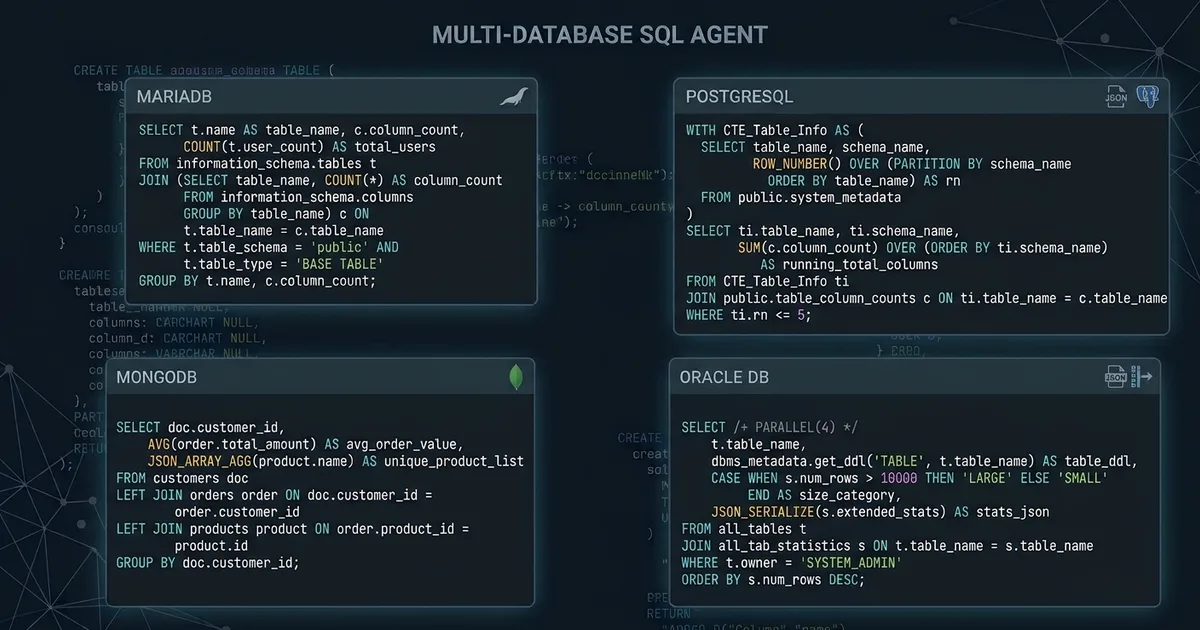
- databases, queried with AI-generated SQL, read-only, on selected tables or views;
- internal tools (in-house CRM, ticketing, business applications), called through their APIs with tailored tools;
- off-the-shelf software that exposes an MCP server, connected from the admin console.
MCP (Model Context Protocol) is the standard that makes this last route routine. Anthropic introduced it on November 25, 2024 to free AI models from information silos: a vendor describes once what its software exposes, and any compatible assistant can call it. OpenAI adopted it in March 2025, and the Linux Foundation counted more than 10,000 published MCP servers in December 2025. We covered one M&A use in our article on data rooms and MCP.
What a group-level question looks like
Take a fictional example: a technical distribution group that has acquired two companies in eighteen months. The parent company runs one ERP, the first target another, and the second target manages its orders in an in-house database. Customer contracts sit in three different document repositories.
The question "which customers buy from at least two of our companies, and which of them have a contract expiring within six months?" currently takes three extracts, a manual match of customer names in Excel and a search through the contracts. With an AI connected to the three databases and the three repositories, it can be asked as is. The AI queries each database, matches the customers, looks for expiry dates in the contracts and cites its sources. The answer takes minutes instead of days, and the next question, just as unplanned, costs the same effort.
This is what we call Talk to Data: querying your data in plain language, documents and databases together. We described it for a single company in "Your databases are a gold mine"; in a group built through acquisitions the value multiplies, since cross-company analysis is exactly what nobody can do today.
What acquirers already do
Acquirers have taken up AI, mostly upstream. In PwC's 2026 survey, roughly three in four acquirers use AI somewhere in integration, and Deloitte finds that most traction is in pre-sign stages. Bain describes a commodities merger where procurement, hedging and mixing data from both companies fed an AI model: the synergy plan was completed in about two months instead of more than twelve, with $100 million in expected savings according to the firm.
The Grant Thornton op-ed in CFO.com argues a thesis close to ours: connect existing ERPs through a shared data layer and let AI operate across systems, without replacing every ERP first.
IT merger, data project, connected AI: what each option covers
| IT systems merger | Data project (warehouse) | AI connected to the sources | |
|---|---|---|---|
| What changes | each company's tools | nothing in the tools, the data is copied | nothing, the AI connects to the tools |
| First answer | at the end of the migration, years according to consultancies | at go-live, months to years | as soon as the first sources are connected |
| What it covers | processes, data, documents | planned figures and KPIs | documents, databases, tools, unplanned questions |
| Next acquisition | a new migration | new pipelines and mappings | new connections |
| The limit | cost, risk, duration | document blind spot, planned questions only | business definitions, accuracy to measure, access rights |
These options are not mutually exclusive. We see AI as the read layer that works from day one, while the group decides, system by system, what is worth merging. It even helps make that decision: knowing which customers, suppliers and processes really overlap is the first question of any integration plan.
The limits: what AI does not replace
Diverging business definitions
An AI connected to three systems inherits their three vocabularies. Grant Thornton makes the point in the same op-ed: an agent working across three charts of accounts, three vendor masters and three sets of cost-center definitions can give contradictory answers. The work of harmonizing definitions doesn't disappear: it becomes smaller (a mapping table, a description of each field) and can be done question by question.
Accuracy has to be measured
On Spider 2.0, a benchmark built on real enterprise databases, the best text-to-SQL agent solved only 21.3% of the tasks, compared with 91.2% on textbook databases. The RAG-based legal assistants tested by Stanford were wrong more than 17% of the time. Hence two rules for us: expose documented views to the AI rather than raw schemas, and test the typical questions before relying on it. We describe this approach in our guide to building a text-to-SQL agent.
Statutory consolidation
Consolidated accounts remain a calculation, not a conversation. IFRS 10 requires consolidated financial statements to be prepared using uniform accounting policies across the group. It requires harmonized rules, not a single ERP, but producing the accounts must stay deterministic and auditable. AI is for asking questions; a published figure comes from a reliable, reproducible process.
Security of the acquired systems
Keeping systems separate doesn't exempt you from auditing them. After acquiring Starwood in 2016, Marriott kept the two computer systems separate. Starwood's systems had been compromised since 2014; the attack was only detected in 2018, after exposing 339 million guest records, and the UK regulator imposed a £18.4 million fine. Connecting an AI to an acquired company's tools requires knowing how secure they are and limiting what the AI can read: least privilege, read-only access, access logs. The MCP specification itself recommends this least-privilege model.
Synergies that require a common platform
Large-scale cross-selling, a central purchasing function or license savings often require a single tool. At Kraft after the Cadbury acquisition, Bain reports that cross-selling required one platform. AI doesn't remove these projects; it stops them from being the prerequisite for everything else.
What a group growing through acquisitions can take from this
For an executive, a CFO or a fund doing one deal after another, the timeline changes. The group-wide view no longer waits for the end of the migration: it can exist as soon as each company's sources are connected, with read-only rights. Merging IT systems goes back to what it should have remained, an investment decision to justify system by system, by the synergies it unlocks.
We see three situations where this approach makes the most sense: buy-and-build groups, which acquire faster than they migrate; portfolio companies whose exit is too close to pay back an ERP overhaul; and acquired companies that are deliberately kept autonomous. In finance, from M&A advisory to transaction services teams, the same logic already applies to due diligence files (see our AI for finance page).
It all starts with a list of questions that leadership asks and that nobody can answer quickly: shared customers, duplicate suppliers, contracts at risk, margin gaps between companies. That list tells you which sources to connect first, and it is where our scoping engagements begin.
Frequently asked questions about AI and post-merger integration
Should IT systems be merged after an acquisition?
Not necessarily. The large consultancies describe several strategies, from full integration to federation, where each company keeps its applications. Bain puts a full integration at two to three years, with budgets that often overrun. A merger is justified when a specific synergy requires it, such as a common cross-selling platform or license savings, not as a prerequisite for a group-wide view.
How long does IT integration take after a merger?
According to Bain, a full IT integration typically takes two to three years. EY-Parthenon finds that up to 70% of technology synergies arrive 18 to 36 months after closing, and Grant Thornton estimates that a single ERP conversion can take 18 months or more. An AI connected to the existing sources answers as soon as the first sources are plugged in, without waiting for that deadline.
Can AI replace a data warehouse for group reporting?
Not for official reporting. Consolidated accounts and the KPIs tracked every month call for a deterministic, auditable calculation, which a data warehouse or the consolidation tool produces better. AI covers what the warehouse doesn't: documents, unplanned questions and fast cross-company analysis. The two complement each other, and the AI can query the warehouse too.
How does an AI access the data of several companies?
Through several routes: connectors for document repositories (SharePoint, Google Drive, Confluence), read-only SQL queries on databases, API calls to internal tools, and the MCP protocol for off-the-shelf software that supports it. The data stays in each company's tools; the AI queries it at the time of the question, with limited rights.
What are the risks of connecting an AI to an acquired company's systems?
Three main risks: contradictory answers when companies don't use the same definitions, query errors on poorly documented databases, and the security of the acquired systems, which have not always been audited. They are reduced with mapping tables, documented views, tests on typical questions, read-only access and least-privilege rights.
A deal is judged on what it returns, and what it returns depends on what you know about the group you have just formed. For years, that knowledge waited for the end of the migration. It can now come first, and perhaps shrink the migration's scope: an acquirer who already sees shared customers, duplicate suppliers and overlapping processes knows better which system mergers are worth their price.