Tech CEOs: Engineers by Trade in the US, by Degree in France
Tech CEO profiles: of 112 bosses studied, 60% of appointed US tech CEOs had held a technical job, against 16% in France, where most are engineers by training.

On February 16, 2025, in the interview with Emmanuel Macron published by Underscore_, a French tech YouTube show, its host Micode asked the president what the founders of the ten American tech giants have in common, and gave the answer himself, in words we translate, as we do every quote from French videos and hearings in this article: "they are also all engineering profiles". Emmanuel Macron agreed in his own way: "in Europe, our CEOs are much more managers". On one side of the Atlantic, then, tech CEOs would be technical; on the other, administrators.
We wanted to check this against the record. For 112 chief executives of tech and digital companies in office in November 2026, 51 French and 61 American, we noted their first job and looked for whether they had ever held a technical role: building software, designing products, doing research. Among appointed CEOs, those who did not found their company, 60% of the Americans have held such a role, against 16% of the French.
The gap does not come from education. Appointed French CEOs are overwhelmingly engineers by training, but three out of four have never worked as one. None of this proves that engineers make American tech successful. The contrast is still striking: the United States holds 61 of the world's top 100 tech companies by market value, France just one.
What did Emmanuel Macron and Quentin Adam say on Underscore_?
The passage in the presidential interview lasts three minutes, in the chapter on French start-ups. Micode names Alan, Mistral, OVH and Exotec, then claims that French Tech, the country's start-up scene, has "roughly 15% engineer co-founders", and asks whether there is a distrust of technical profiles. The figure is sourced neither on air nor on screen, and we have not found it in any published study.
Emmanuel Macron first answers with science education, then shifts the question. What "shocks" him, he says, is that "in Europe, our CEOs are much more managers and our companies are much older than the American ones". He then adds that while American bosses are "maybe all engineers", "there are not many women among those top CEOs". His diagnosis targets managers and the age of companies, and our data prove him right on the first point.
A month later, on March 20, 2025, Quentin Adam, co-founder and CEO of Clever Cloud, came back to the subject in another Underscore_ episode. He blames the failure of the state-backed clouds Cloudwatt and Numergy on "erratic leadership because it was not technical" and concludes: "if you want to solve technical problems, ask a technician to do it". He also recalls that when he was raising money for Clever Cloud, investors suggested he step back to CTO and put "a real CEO" in his place.
How did we compare French and American tech CEOs?
We call a technical stint any job, at any point in a career, in which the person personally developed software, designed a product or did research: developer, design or R&D engineer, researcher, technical lead of a team that writes code, founder who wrote the first product. We classified industrial engineering separately (production, quality or drilling engineer). A degree is not enough: the job has to be documented by an official biography, a filing with the US SEC, a press release or a press profile. Patents without a job title are not enough either.
The sample covers the top executives in office on November 20, 2026. On the French side, the large digital groups (Capgemini, Dassault Systèmes, Orange, Thales, STMicroelectronics, Atos, Sopra Steria, Iliad, Bouygues Telecom…) and the scale-ups (Mistral AI, Doctolib, Qonto, Alan, Pigment, Dataiku, Back Market, Contentsquare…). On the American side, the giants, semiconductors and infrastructure (Apple, Microsoft, Nvidia, Alphabet, Amazon, Meta, AMD, Intel, Cisco, IBM…), then software, internet and AI (Netflix, Salesforce, ServiceNow, OpenAI, Anthropic, Uber, Snowflake, Databricks, Stripe…).
We separated founders from appointed CEOs. Without that precaution, the study would mostly measure that American companies are younger, and so more often run by the people who created them. Every classification points to a source, which we share on request; careers we could not establish remain marked as unknown, and results are given with ranges.
What is the profile of tech CEOs in the United States and France?
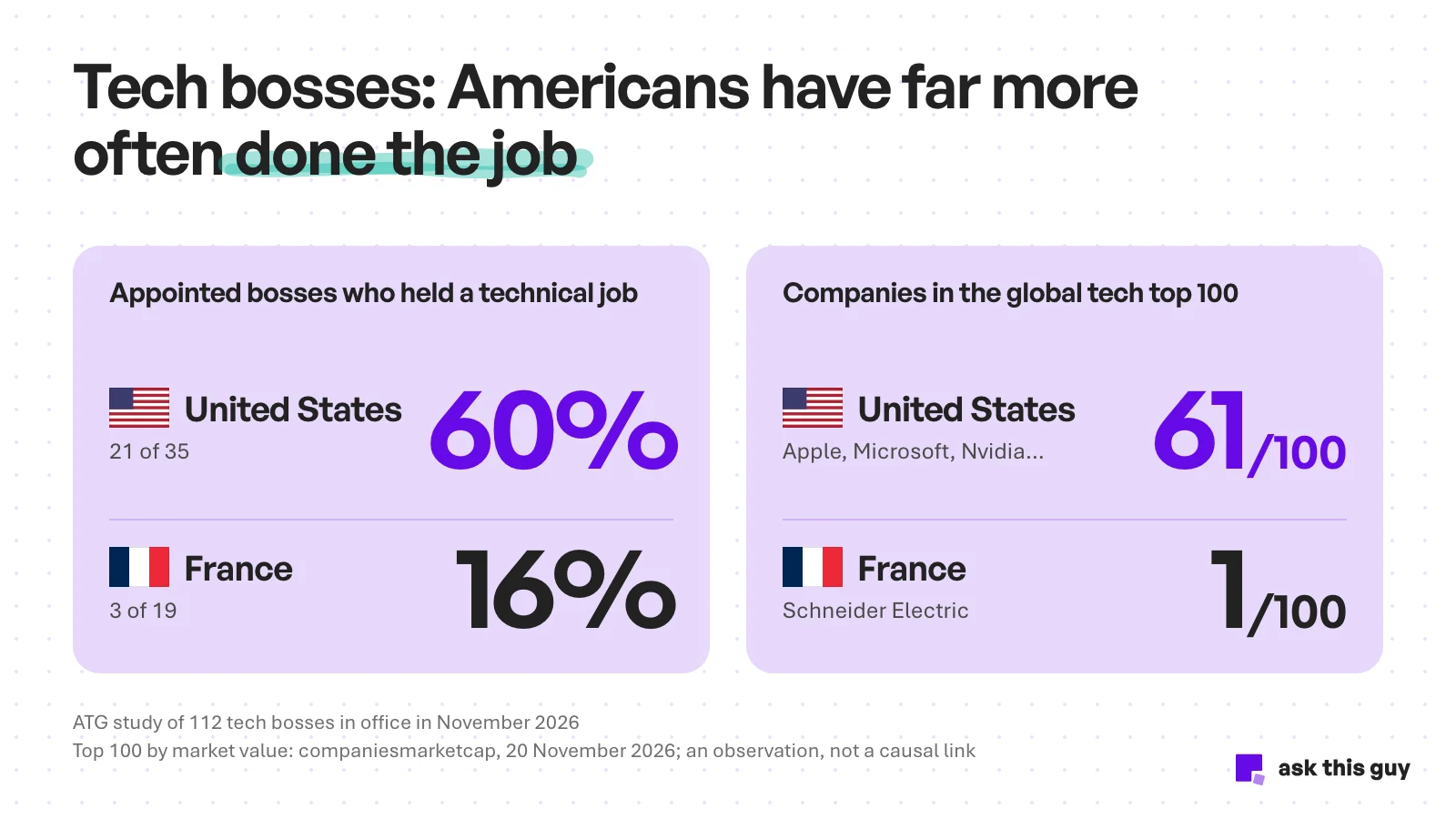 Infographic: among appointed CEOs, 60% of US tech CEOs held a technical job (21 of 35), against 16% of French ones (3 of 19). In the world's top 100 tech companies by market value, 61 are American and only one is French, Schneider Electric. ATG study of 112 leaders in office in November 2026; an observation, not a causal link
Appointed CEOs: 60% against 16%
| Measure | France | United States |
|---|---|---|
| Appointed CEOs who have held a technical job (known careers) | 16% (3 of 19) | 60% (21 of 35) |
| Same measure if all unknown careers were technical, or none | 11% to 41% | 57% to 62% |
| Appointed engineering or science graduates who have held a technical job | 23% (3 of 13) | 77% (20 of 26) |
| Founders who have held a technical job | 50% | 58% |
| Founders with an engineering or science degree who have held a technical job | 89% (8 of 9) | 70% (7 of 10) |
| The 20 largest companies in each country | 21% | 74% |
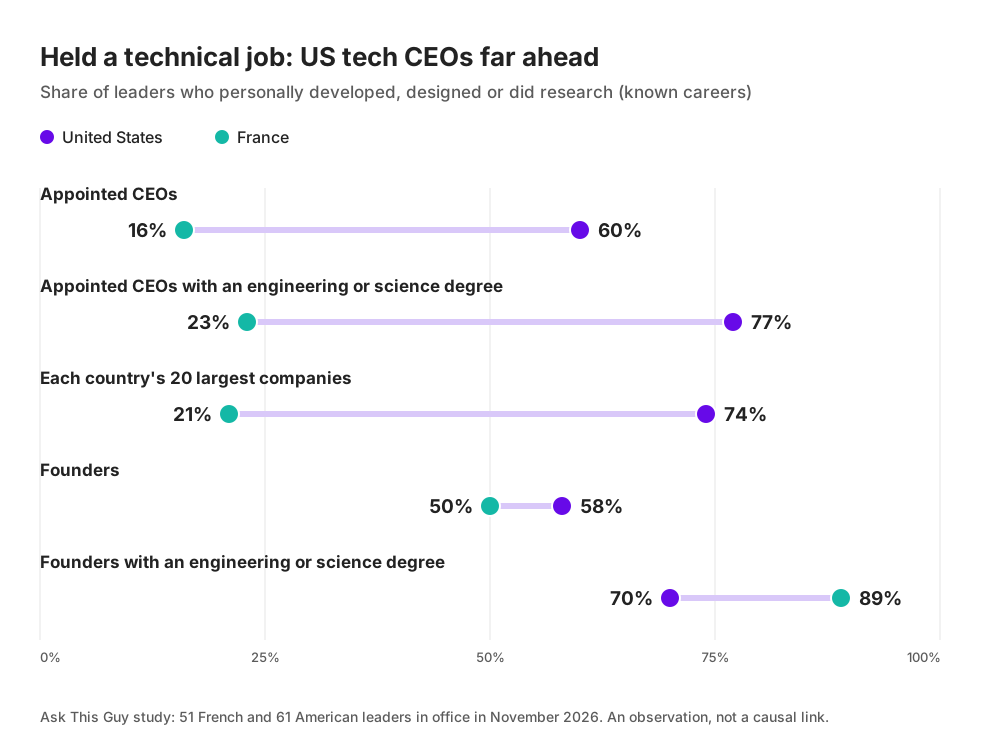 Dumbbell chart: share of leaders who held a technical job, France versus the United States. Appointed CEOs: 16% versus 60%. Appointed CEOs with an engineering or science degree: 23% versus 77%. Each country's 20 largest companies: 21% versus 74%. Founders: 50% versus 58%. Founders with an engineering or science degree: 89% versus 70%, the only measure where France leads
The result holds even under the least favorable assumption. If every French CEO whose career we could not establish had worked in a technical job, they would top out at 41%, below the American floor of 57%. Across the 20 largest companies in each country, the gap is one to three and a half.
Engineers by training who never worked as engineers
The paradox fits in one row of the table. Most appointed French CEOs are engineers by training (18 of the 23 whose degree we know), as many as their American peers. But three out of four French engineers have never held a technical job, while three out of four Americans have.
On the French side, Patrice Caine, a graduate of Polytechnique ("l'X", France's top engineering school, which also feeds the senior civil service) and a member of the corps des Mines, started out in the prefectural administration, the state's regional civil service, before joining Thales through its strategy department. Christel Heydemann, a graduate of Polytechnique and the Ponts et Chaussées engineering school, began at Boston Consulting Group before running Orange. Pascal Daloz, a Mines engineer, came from investment banking and consulting before Dassault Systèmes. Bruno Vaffier, another Polytechnique graduate, went through JP Morgan and then finance roles before running Cegid.
On the American side, AMD's Lisa Su started at Texas Instruments, then built a career in semiconductor R&D at IBM. Arvind Krishna, head of IBM, came from IBM Research. Chuck Robbins, Cisco's CEO, started as an application developer at a bank. Sridhar Ramaswamy, who runs Snowflake, was a database researcher at Bell Labs. John Ternus, Apple's CEO since September, is a mechanical engineer by trade.
Tech founders: the French ones did the work
Among founders, the gap narrows: 50% of the French have held a technical job, 58% of the Americans. French founders with an engineering degree almost all did: Arthur Mensch was a researcher at Google DeepMind before co-founding Mistral AI, Florian Douetteau ran R&D at Exalead before Dataiku, Romain Niccoli was a software engineer at Microsoft before Criteo and then Pigment, and Octave Klaba designed OVH's first servers himself.
So the gap opens up in the track of appointed CEOs. Founders with no technical stint exist on both sides: Stanislas Niox-Chateau, who came from investment before Doctolib, or Jonathan Cherki, who says he launched Contentsquare with "zero technical skills"; in the United States, Marc Benioff, who worked in sales at Oracle before founding Salesforce.
What about CAC 40 CEOs?
France's large groups follow the same slope, and career studies partly explain why. In the CAC 40, the Paris stock index of the 40 largest listed companies, 30% of CEOs were Polytechnique graduates in 2022 according to Russell Reynolds, and 8% had attended ENA, the former school for senior civil servants. Using 2019 data, sociologists François-Xavier Dudouet and Antoine Vion count 9 out of 10 CAC 40 chief executives coming from a "bureaucratic career", public or private, 7.5% heirs and 1.5% founders. And according to Heidrick & Struggles, 78% of CAC 40 CEOs were promoted from within, after 14.5 years on average, against 9.2 years in Europe.
There, the engineering degree often opens the door to the state rather than to the workshop: in 2018, the Observatoire des multinationales counted 20 CAC 40 leaders who went through Polytechnique or ENA and then a grand corps, the corps des Mines or the Inspection des finances, two elite civil-service corps, often after a stint in a minister's office. Economists Francis Kramarz and David Thesmar found that listed companies where networks of former senior civil servants carry weight replace an underperforming CEO less often and make acquisitions that create less value. Henri Verdier, France's former ambassador for digital affairs, summed up the effect before members of parliament in March 2026: digital is treated "on the same footing as real estate or the canteen", when it "should have a place at executive committee level".
Do the schools make the difference?
The data say little that is clear-cut. One school stands out in France: Polytechnique trained 24% of the tech CEOs in our sample whose careers are known, while Stanford, the most represented school in the United States, trained 13%. Among appointed CEOs, Polytechnique, Mines and HEC account for 44% of the French; Harvard, the University of Pennsylvania and MIT for 25% of the Americans.
But the share of CEOs from an elite school is comparable: 52% in France, 47% in the United States, with Stanford very present among American founders. The difference lies rather in the variety of backgrounds. On the American side, there are public universities, graduates from India, China or Brazil, seven CEOs without a degree and humanities graduates; nearly one American tech CEO in two was born abroad. We draw no conclusion about the role of schools.
Apple, Nvidia: do the US giants pick engineer CEOs?
Not always, as the news shows. Since Jensen Huang stepped down on November 12, 2026, Nvidia has been run on an interim basis by its CFO, Colette Kress, while it looks for a successor. The contrast is sharp: Jensen Huang, an electrical engineering graduate, designed microprocessors at AMD and LSI Logic before co-founding Nvidia in 1993. The choice of Nvidia's next CEO will show whether the company stays in an engineer's hands.
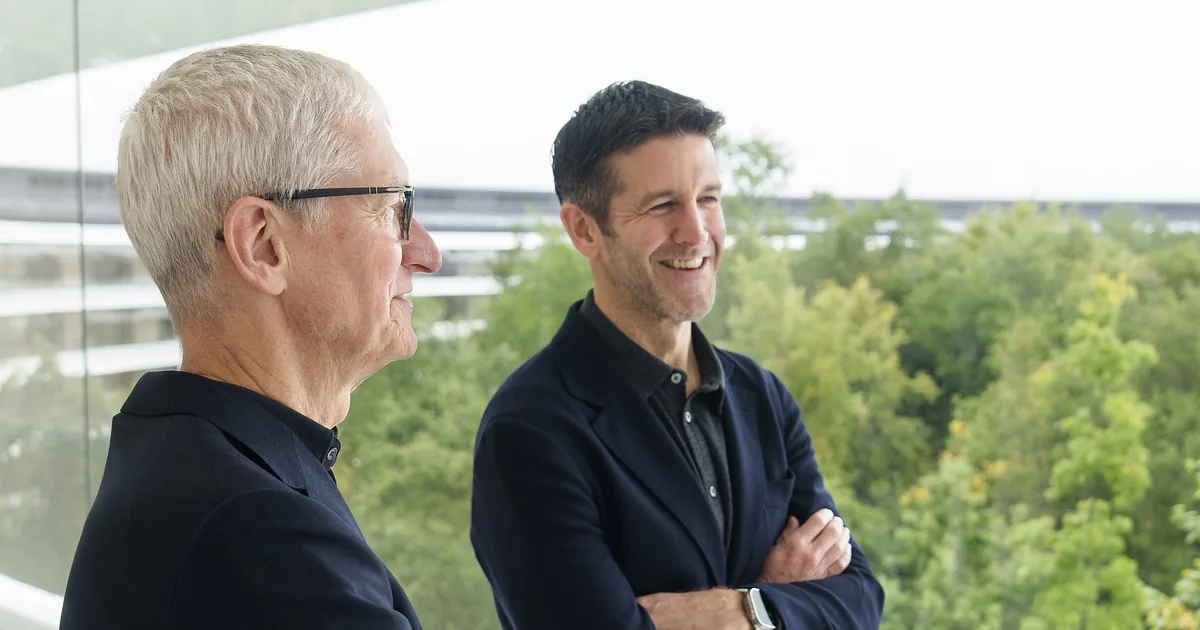
Apple settled the matter in that direction in April: to succeed Tim Cook, whose background is in operations, the board chose John Ternus, who according to Tim Cook has "the mind of an engineer". Conversely, Amazon is run by Andy Jassy, a government graduate with an MBA from Harvard Business School, with no known technical job. The technical profile is the majority among American tech CEOs, not the rule.
Can we conclude that engineers make American tech successful?
No, and we do not claim it. Our study establishes a difference in careers, not a cause. The United States has a unified market, unmatched capital and recently founded companies, factors that probably weigh as much as their leaders' first jobs. Bain observes that since 2015, founder-led tech companies in the S&P 500 have delivered 2.6 times the shareholder return of the index's other tech companies; that is a correlation too.
The success itself is beyond dispute. In the global ranking of tech companies by market value, the United States holds 9 of the top 10 places and 61 of the top 100; the only French company in the top 100 is Schneider Electric, in 42nd place. The Draghi report put it this way in September 2024: no European company worth more than €100 billion has been built from scratch in fifty years, while the six American companies worth more than €1 trillion all were.
On gender balance, Emmanuel Macron's remark applies to both sides: our sample has 5% women among American tech CEOs, 6% among French ones.
What companies can take from this
The question goes beyond the CAC 40. In a small or mid-sized company, decisions on AI, cloud or data are often made far from the people who understand these technologies, and a leadership team in which no one has ever held a technical job decides blind, or leaves it to its vendors. Digital sovereignty choices are a case in point: comparing AWS with OVHcloud, or assessing what becomes of a start-up once it is acquired, requires understanding what you are buying.
We do not think every company needs an engineer at the top. We do think, however, that real technical experience belongs where digital choices are made; scoping an AI project is precisely about bringing leadership and the people who will build it around the same table.
Frequently asked questions about tech CEO profiles
Are CAC 40 CEOs engineers?
Many are by training: according to Russell Reynolds, 30% of CAC 40 CEOs were graduates of Polytechnique, France's top engineering school, in 2022. But the engineering degree often leads to the senior civil service, consulting or finance rather than to a technical job. In our study of 51 French tech CEOs, only 23% of appointed CEOs with an engineering or science degree have held a technical job, against 77% in the United States.
What is the profile of French tech founders?
Half of the French founders in our sample have held a technical job, and almost all founders with an engineering degree have: Arthur Mensch (Mistral AI) was a researcher at Google DeepMind, Florian Douetteau (Dataiku) ran R&D at Exalead, and Octave Klaba designed OVH's first servers. Those without a technical stint mostly come from business schools, such as Stanislas Niox-Chateau (Doctolib, HEC) or Jonathan Cherki (Contentsquare, ESSEC).
Who has been running Nvidia since Jensen Huang stepped down?
Colette Kress, Nvidia's CFO, has been interim CEO since Jensen Huang stepped down on November 12, 2026, while keeping her finance role. Nvidia has said it is looking for a successor, internally or externally. Colette Kress holds a degree in finance and has spent her whole career in finance leadership, at Texas Instruments, Microsoft, Cisco and then Nvidia.
What did Jensen Huang study?
Jensen Huang, co-founder of Nvidia, holds a bachelor's degree in electrical engineering from Oregon State University (1984) and a master's in electrical engineering from Stanford. He started as a microprocessor designer at AMD, then at LSI Logic, before co-founding Nvidia in 1993.
Where does the figure of 15% engineers among French Tech co-founders come from?
It was put forward by Micode in the interview with Emmanuel Macron published by Underscore_ on February 16, 2025, with no source cited. We have not found it in any published study. The available data cover other scopes, for instance the schools of founders in the Next40, the French government's index of leading scale-ups, where Polytechnique and HEC come out even.
The choice of Nvidia's next CEO will be a good test: will the board of a company valued at more than $3.5 trillion pick an engineer or a manager? In France, the same question deserves to be asked at every appointment at the head of a large digital group.