EuroHPC AI Factories: the public money behind OVH's Olala
OVH's Olala LLM was trained on public supercomputers. EuroHPC, AI Factories, GENCI: who paid, how much, and how an SME can get access to the same compute.

On November 19, 2026, OVH released the weights of Olala mini, its first LLM, along with a technical report whose acknowledgements tell us who paid for the compute. Pre-training ran on JUPITER, EuroHPC's European supercomputer, as part of a competition funded by the European Union; fine-tuning ran on Jean Zay, the French public supercomputer; and part of the agent work ran on MeluXina, in Luxembourg, with credits from EuroHPC's AI Factories. OVH puts this support at the equivalent of €7 million in computing hours.
In other words, Olala's compute is almost entirely public. The total cost of the model has not been published, so nobody can say what share public money covered, only that it is a large one.
There is nothing wrong with that: these programmes were set up precisely so that European players could train models. Most of them are also open to SMEs and startups, often free of charge, under conditions, and Olala shows in very concrete terms how they work.
How did public money fund Olala?
Olala was trained in three stages, each on a different public machine and through a different programme. The technical report gives the details:
| Stage | Public machine | Programme | Country |
|---|---|---|---|
| Pre-training (12.8 trillion tokens) | JUPITER, 1,024 GH200 GPUs | Large AI Grand Challenge, access awarded by EuroHPC | Germany |
| Supervised fine-tuning, reinforcement learning | Jean Zay, H100 GPUs | GENCI allocation | France |
| Part of the agent research | MeluXina | EuroHPC AI Factories credits | Luxembourg |
Pre-training: JUPITER and the Large AI Grand Challenge
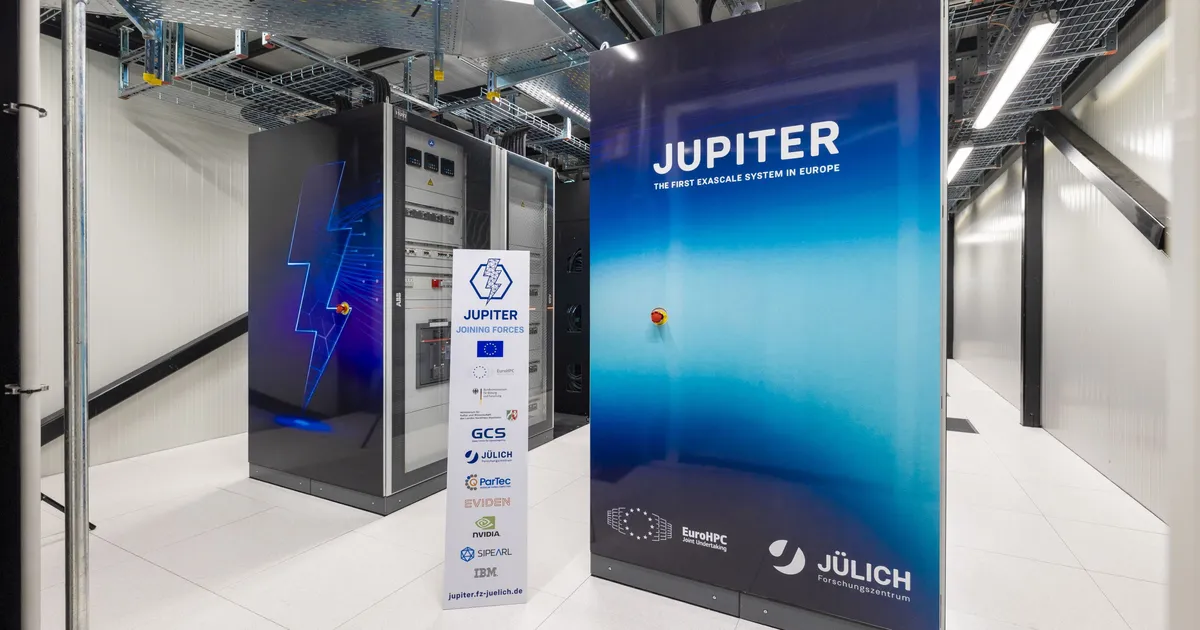
Pre-training is the heaviest stage: the model reads 12.8 trillion tokens to learn the language. It ran on 1,024 GH200 GPUs of JUPITER, the exascale supercomputer inaugurated in September 2025 in Jülich. JUPITER has about 24,000 Nvidia GH200 chips; it belongs to EuroHPC, which paid for half of it, the other half coming in equal shares from the German Federal Ministry of Research and the state of North Rhine-Westphalia. The Register puts its cost at €500 million, including six years of operation.
Access came from a competition. According to the report, "a major part of this work" was carried out under the Large AI Grand Challenge, organised by the AI-BOOST project together with EuroHPC and funded by the European Union. AI-BOOST is a Horizon Europe project with nearly €4 million in EU funding. Launched in November 2023, the competition named four winners in June 2024, who shared €1 million in prizes and 8 million computing hours, with twelve months to develop their model. Among them was Lingua Custodia, a Paris startup specialising in finance, now Dragon LLM. ActuIA credits it with 3.2 million hours on Leonardo and Jupiter.
OVH then acquired Dragon LLM in March 2026 to found its AI lab. The ticket to JUPITER was therefore won by a startup, then brought into OVH along with it.
Fine-tuning: Jean Zay and GENCI
After pre-training, the model learns to follow instructions (supervised fine-tuning) and then to reason better (reinforcement learning). According to the report, most of the fine-tuning was done on Jean Zay, the supercomputer that GENCI provides at IDRIS, GENCI being the French national agency for high-performance computing and IDRIS the CNRS computing centre that operates the machine. One fine-tuning run took about 25 hours on 128 H100 GPUs, and reinforcement learning used up to 64 nodes of four GPUs. The report also mentions "a smaller DGX cluster": it is the only non-public compute cited.
GENCI opens its machines to companies, from startups to large groups, free of charge for open research projects, provided they publish their results. Applications go through two calls for projects a year.
Agents: MeluXina and the AI Factories
The last programme is a smaller one: GPU credits on MeluXina, the Luxembourg supercomputer, were used for part of the agent research. The project code starts with EHPC-AIF, which in all likelihood refers to EuroHPC's AI Factories calls. MeluXina hosts Luxembourg's AI Factory, in service since April 2025 and aimed at startups and SMEs.
What share of Olala's cost did public money pay?
It cannot be calculated, for lack of data. The €7 million announced by OVH is a value of computing time, not money paid out, and Olala's total cost has not been published. Salaries, the other major cost item, are borne by OVH, which has "a little under a hundred people" working on AI across all projects, and is not raising funds for this strategy.
The orders of magnitude, on the other hand, are consistent. At OVHcloud's list price for an H100 GPU, €2.80 per hour excluding VAT, €7 million comes to about 2.5 million GPU hours, in the same range as the 3.2 million hours awarded to Dragon LLM according to ActuIA.
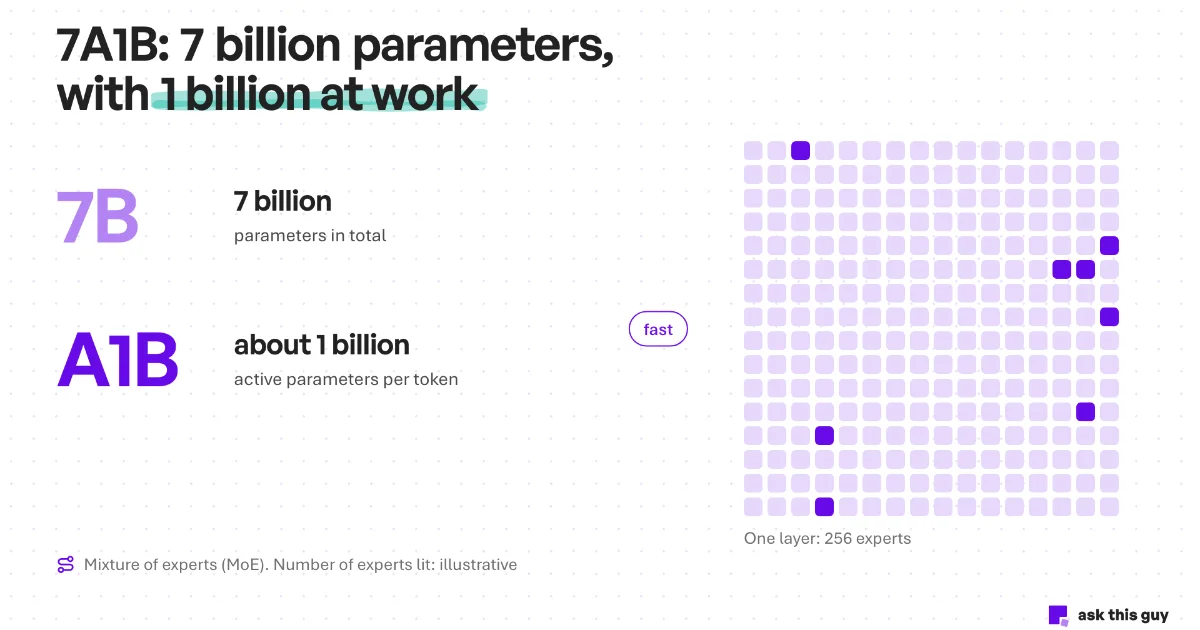
What is surprising is how small the final run is. Our estimate: a model with one billion active parameters reading 12.8 trillion tokens needs about 7.7 × 10²² operations, or 70,000 to 140,000 GPU hours at the efficiency the report measures on its GPUs. That is a few hundred thousand euros at market prices. Most of the public hours therefore went into research, not into training the final model: the many preliminary experiments the report describes, fine-tuning and reinforcement learning. That is how a model gets made, and in our view it is the hardest part for a startup to fund.
For this first model, we believe the public share weighs as much as the private share, if not more. That cannot be proven until OVH publishes its costs.
What is EuroHPC?
EuroHPC is the European joint undertaking that buys and co-funds the EU's large supercomputers, together with the countries that host them. JUPITER is a case in point: owned by EuroHPC, paid for half by the joint undertaking and half by Germany. These machines are not rented out like a cloud: their computing time is mostly awarded on application, through calls open to all users, researchers and companies alike. It is free for research and for innovative SMEs, and pay-per-use for other companies.
The budget is following. In February 2025, the Commission launched InvestAI, which aims to mobilise €200 billion for AI, including a €20 billion fund for AI "gigafactories". That figure mixes public and private money: it is a mobilisation target, not a public budget.
What are EuroHPC's AI Factories?
An AI Factory is a centre that opens a public supercomputer to companies and researchers developing AI, with compute, support and training. The EU has 19 of them, plus 13 antennas, which offer free support to SMEs and startups. In France, AI Factory France is run by GENCI with the CEA, the CNRS, Inria, La French Tech and Station F, among others, and provides a single entry point to Jean Zay, Adastra, Joliot-Curie and, later, Alice Recoque.
EuroHPC offers four access modes, all open as of November 20, 2026:
| Access mode | For whom | Size | Timing |
|---|---|---|---|
| Playground | SMEs, startups, beginners | limited resources, for testing | access within two working days |
| Fast Lane | AI SMEs and startups used to high-performance computing | up to 50,000 GPU hours, three months maximum | answer within four working days |
| Large Scale | models needing more than 50,000 GPU hours | one year maximum | several cut-off dates a year |
| AI for Science | researchers, public sector, European projects | depends on the call | depends on the call |
"Industrial innovation" access is free for AI SMEs and startups, for innovation projects; other companies can pay per use. For an SME, 50,000 free GPU hours is more than fifteen times Olala's fine-tuning run on Jean Zay (25 hours on 128 GPUs, about 3,200 GPU hours).
Was the public money well spent?
In our view, yes, and the stakes go well beyond Olala. Europe needs good models of its own, and European inference even more: models that run at European operators, under European law, without depending on an American provider that can change its prices or cut off access. The two feed each other. A company that trains its own models learns to serve them, its customers and their data stay in Europe, and its revenue funds the next generation. Public compute starts this virtuous circle, at a stage where neither a startup nor a hosting provider could move forward alone.
Olala shows the circle already turning. The model is released under the Apache 2.0 license, commercial use included, whereas the Large AI Grand Challenge only asked for release under an open-source license, at least for non-commercial use; the technical report and datasets are public, and anyone can download and use it. It is also served in France on AI Endpoints, OVH's inference service: trained on European public machines, it runs at a European operator.
Money is not the only gain, either. Access to GPUs is a challenge in its own right, and it is probably where public compute helped OVH most. In June 2026, the company stated on its public roadmap that its H200s were "fully allocated due to high demand", and the Blackwell generation only reached its offering in November. Olala's pre-training could draw on 1,024 GH200s of JUPITER at once, without taking capacity from its customers or waiting for its own deliveries. Public compute saved it time as much as money.
Two points are worth following, without changing that verdict. The hours were won by a startup and now benefit OVH, through an ordinary acquisition. And the competition rules called for a model of at least 30 billion parameters, trained from scratch: Olala mini has 7, but the announced version 2.0, at 100 to 300 billion parameters according to Octave Klaba, would go well beyond.
That version 2.0 will change the scale of the cost, as we explain in our article on OVH's AI strategy. If it needs public compute again, we would not see that as a failure. Given what sovereign AI means for the years ahead, this is in our view money well spent.
What a company can take away
- Public supercomputers are not reserved for researchers. An SME or an AI startup can apply for hours through the Playground or the Fast Lane, free of charge for an innovation project, with an answer within a few days.
- Choosing the right programme. The AI Factories suit experimentation and model fine-tuning; GENCI suits a research project whose results the company is willing to publish; Large Scale access suits training a model.
- Weighing what is expected in return. Free access comes with conditions: innovation, publication, limited duration. A production service, with customers and an availability commitment, belongs with a cloud or inference provider, as we explain in our comparison of ways to run a model in a company.
- Making use of what public money has already produced. Olala is under the Apache 2.0 licence: a European model, trained on public compute, that a company can run on its own servers without depending on an American provider, one of the criteria of sovereign AI.
Frequently asked questions about AI Factories, EuroHPC and Olala
What is a EuroHPC AI Factory?
An AI Factory is a European centre that opens a public supercomputer to companies and researchers developing AI, with compute, support and training. The EU has 19 of them, plus 13 antennas. In France, AI Factory France is run by GENCI and provides access to Jean Zay, Adastra, Joliot-Curie and, later, Alice Recoque.
What is EuroHPC?
EuroHPC is the European joint undertaking that buys and co-funds the EU's large supercomputers with the countries that host them, such as JUPITER in Germany, half of which was paid for by EuroHPC. Its computing time is awarded free of charge on application, through calls open to researchers and companies.
Was Olala funded by public money?
Its compute, almost entirely. Pre-training ran on JUPITER under the Large AI Grand Challenge, fine-tuning on Jean Zay through GENCI, and part of the agent research on MeluXina. OVH values this support at €7 million in computing hours. Salaries and everything else are borne by OVH, with no published figure. Beyond money, these machines gave OVH immediate access to GPUs while its own were fully allocated: a gain in time as much as in budget.
Can an SME use a European supercomputer for free?
Yes, under conditions. The AI Factories' Playground and Fast Lane access modes are free for AI SMEs and startups running an innovation project; the Fast Lane goes up to 50,000 GPU hours over three months, with an answer within four working days. GENCI also opens Jean Zay free of charge to companies, for open research projects whose results are published.
What is the Large AI Grand Challenge?
It is a competition launched in November 2023 by the European AI-BOOST project with EuroHPC and the Commission. In June 2024, four startups, Lingua Custodia, Unbabel, Tilde and Textgain, shared €1 million in prizes and 8 million computing hours to develop a large language model within twelve months, with an obligation to publish.
What is Dragon LLM?
Dragon LLM is the former Lingua Custodia, a Paris startup building specialised AI models for finance, and a winner of the Large AI Grand Challenge in 2024. OVH acquired it in March 2026 to create its AI lab, OVHai LLM, which trained Olala mini.
Olala's case shows a European chain that works: a competition spots a startup, public supercomputers give it compute, a French company brings it in-house and releases an open model. For a company, the question is simpler: what project would it run tomorrow with 50,000 GPU hours, if it applied for them?