Software vendors and B2B SaaS
Build AI into your software, without making it your business
Your software holds years of domain expertise. Your customers now expect to be able to talk to it.
ATG gives you the platform and the engineers to put an assistant into production inside your product, then see what your users do with it. What we develop for you belongs to you.
What your customers expect
Three levels of AI in your software
Your interface stays in place. Conversation is added to it, and becomes a deciding factor against your competitors.
Level 1
Find help on the product
Where is this menu? How do I do this? Users ask in plain language and the assistant answers from your documentation, without them leaving the product.
The product support assistantFictional example
Level 2
Query data in conversation
Users could find the information in your screens. Asking is faster, and each answer leads to the next question. That convenience becomes a competitive edge.
Talk to DataFictional example
Level 3
Trigger actions
Some actions are painful in menus. A carrier receives a purchase order in its customer's format and has to key everything in again. It drops the PDF or Excel file, the assistant pre-creates the order, and all that is left is to approve it.
Agentic automationFictional example
Start with the first level. Add the next ones when your customers use them.
Read our guide to chatbots in SaaSProduct discovery
Your customers express their needs spontaneously
An interview answers your questions. An assistant collects theirs, in their own words: what they can't find, what's missing, needs nobody has ever reported to you.
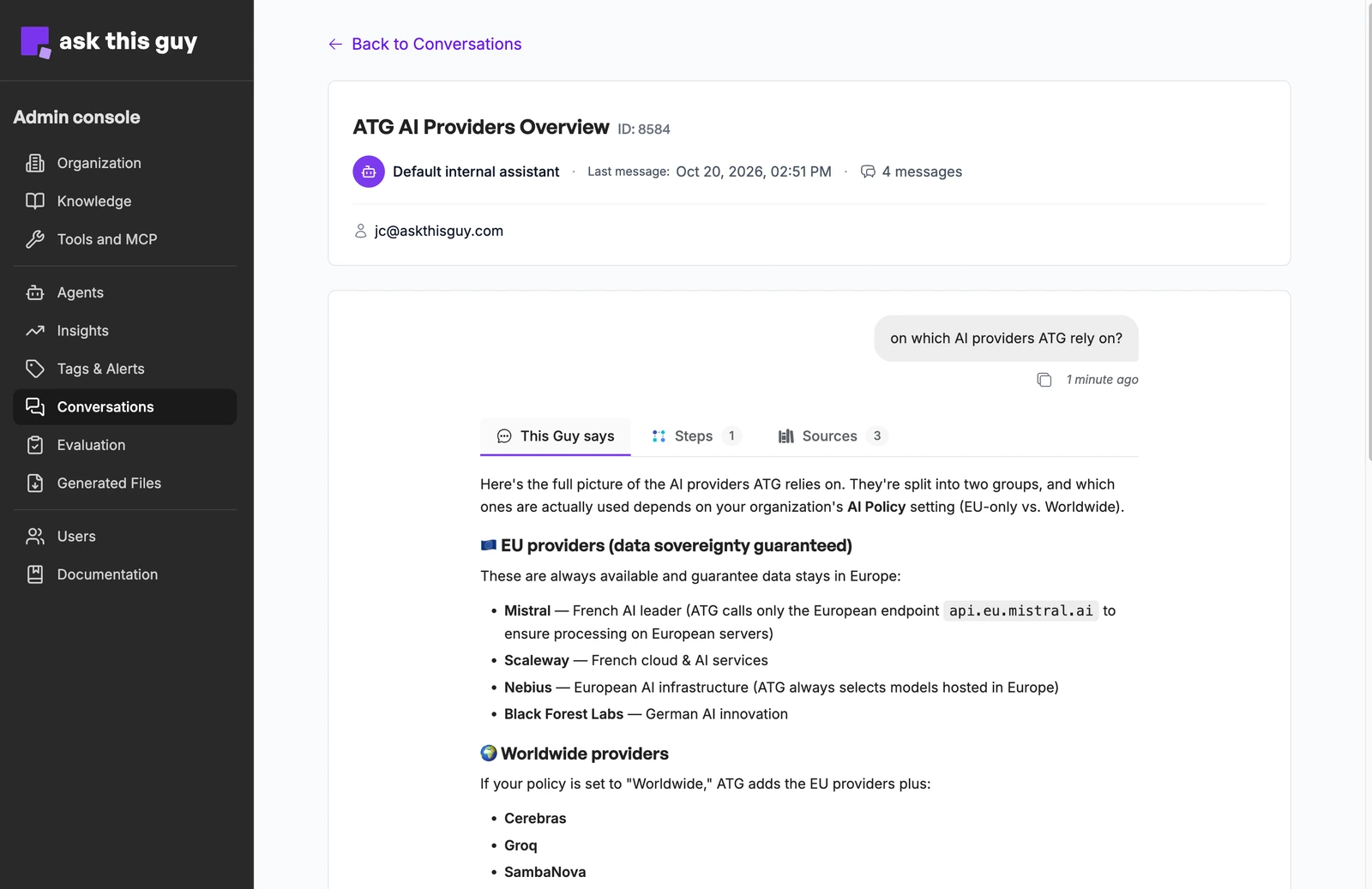
Conversations and trends
Read what your users actually ask for, and track volume and sentiment over time.
See conversations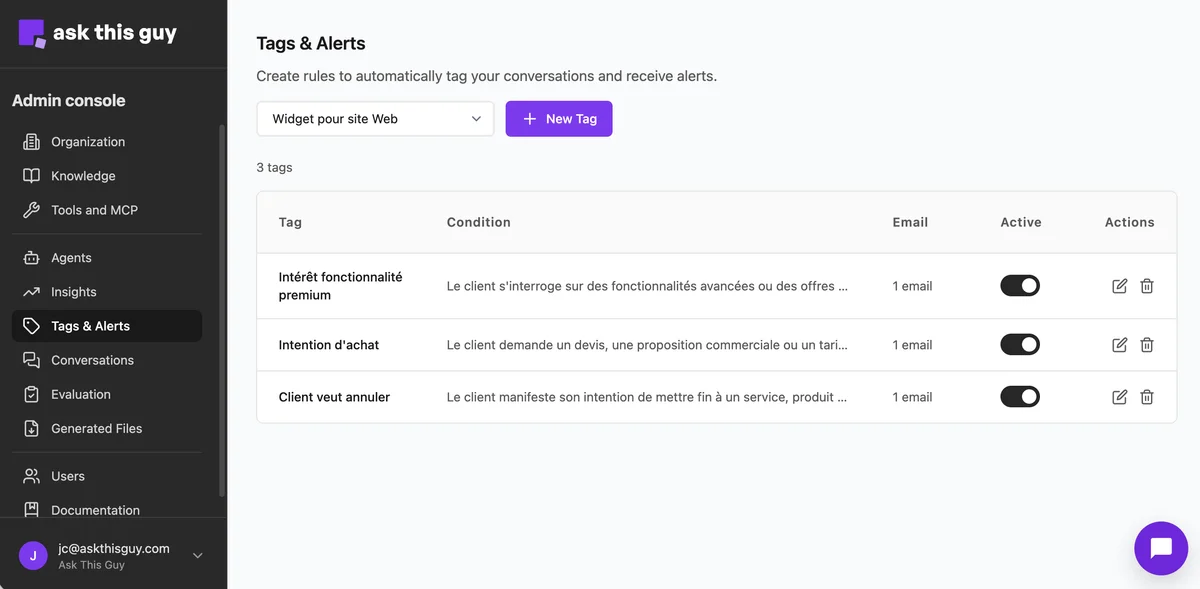
Tags and alerts
Describe a rule in plain language. When a conversation matches it, the right team gets an email: an unhappy customer or a sales need no longer goes unnoticed.
See tags and alerts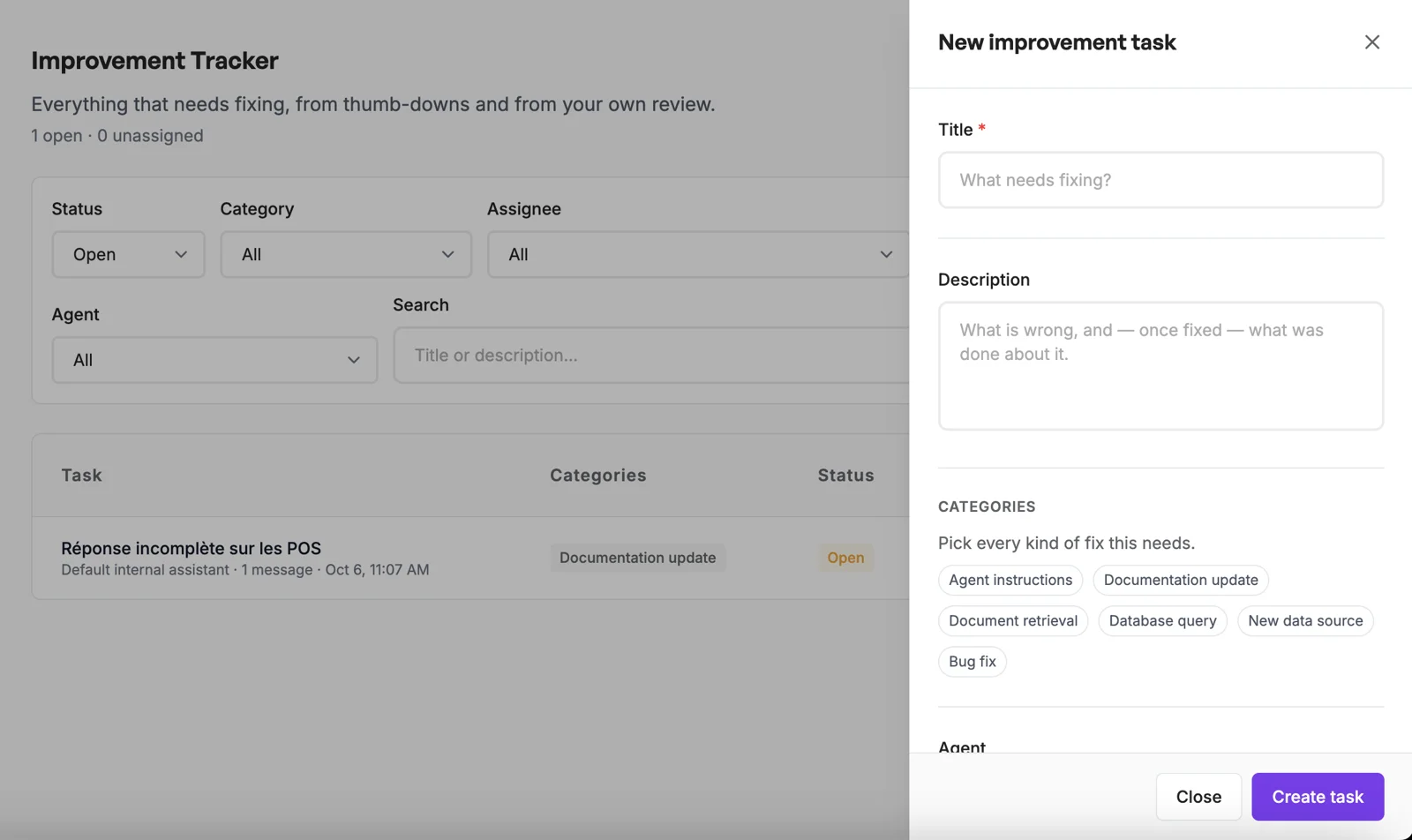
Improvement tracker
Every bad answer becomes a categorised, assigned task. Your action plan is ready: what needs fixing, and who is on it.
See the improvement trackerDomain knowledge
Your domain knowledge, however technical
Manuals, specifications, tables, diagrams, charts: ATG reads your documents, text and images included. Document search is handled on our side, so you have no RAG to build.
We measure this search on FinanceBench: 150 questions over 368 filings, all in one knowledge base. These are financial documents: for your field, the right test remains a sample of your own documentation.
FinanceBench

Correct answers
Average time

Correct answers
Average time
Support
From the first use case to self-sufficient teams
Identify the right use cases
Which level of AI brings value to your customers, and which one can wait: we make that call with you before any code is written.
Scope the technical implementation
APIs to expose, rights management, choice of models, inference costs: the architecture is set before the first development. An idea to validate first? We turn it into a prototype.
Build with you
Our engineers work inside your teams, on your code and your tools, on their own or co-developing with you.
Train your developers
Tools, models, shared rules, human review: AI in your development processes, on your code.
Reversibility
Test fast, stay in control
Our platform spares you from redeveloping the basic building blocks. You launch quickly, with real production quality, you watch usage and feedback, then you decide what comes next.
If AI one day becomes your core business, you bring it in-house: what was developed for you is not lost.
The platform is the foundation
Chat, document search, permissions, monitoring and hosting are already there.
Custom work stays targeted
Your APIs, your actions and your user context: development focuses on what sets you apart.
Your developments are yours
The code and intellectual property of specific developments go to you.
Built on standards
APIs and MCP: your developments stay reusable, with or without us.
Your customers' requirements
What your own customers will ask you
Isolation and rights
Your data is isolated from that of other vendors. For your users, two options: the assistant reuses their authentication to call your APIs, or your backend signs the rights of each session.
Your customers' documents
Where useful, the assistant can also query each customer's documents (SharePoint or another source), in an isolated category.
European hosting
The platform and data storage are hosted by European providers, in European data centres.
Choice of AI providers
The EU-only providers policy restricts processing to European providers. We publish the effect of that choice on accuracy and latency.
Sourced answers
Every answer cites the documents used: your users can check, and your teams know what to fix.
Your brand
The widget fits into your product as a white-label component, in your colours.
Frequently asked questions
How do you add AI to existing software?
By starting with a narrow first use case. The assistant fits into your product as a widget and relies on your documentation, then calls your APIs when it needs to read data or trigger an action. Your current interface stays in place.
Do we need an in-house AI team?
No. The platform covers chat, document search, permissions and monitoring, and our engineers handle the specific development, alone or with your teams. If the topic becomes strategic, you can bring it in-house.
How long does it take to put a first assistant into production?
A few days to a few weeks for an assistant connected to your documentation. Data queries and actions are added afterwards and need more scoping, especially around rights and workflows.
What do we keep if we bring it in-house?
The code and intellectual property of the specific developments made for you: tools, connectors, integrations with your APIs. They rest on standards and stay reusable. The ATG platform remains our product: if you leave it, you replace its generic building blocks.
How are our customers' rights managed?
Your data is isolated from that of other vendors. For your users, the assistant can reuse their authentication to call your APIs, or your backend signs, for each session, the information that determines their rights. If the assistant queries your customers' documents, each customer has an isolated category.
Can we meet our customers' sovereignty requirements?
Yes. The platform and storage are hosted by European providers, and the EU-only providers policy restricts processing to those providers. Where needed, deployment in your own environment is possible.
How is this different from a support chatbot?
A support chatbot answers from documentation. An embedded assistant also knows the user's context, queries their data and triggers actions in the product. Support benefits from it, and the product itself evolves.
Can you train our developers on AI?
Yes. We work on tools, models and working rules, directly on your code. That is what we did with the development team at Ucopia, the vendor of network software created in 2002.
Let's test it on a real journey in your product
Pick a user journey, or a question your customers often ask you. We will look together at what AI can bring to it.