Microsoft 365 alternative: sovereign suites and their AI
Email, calendar, files, video calls, office apps: the European suites that replace Microsoft 365 and Google Workspace, and what their built-in AI really does.

On July 1, 2026, Microsoft raised Microsoft 365 prices by up to 33%, citing "major advancements in AI (ex. Copilot Chat)". On December 9, it will turn on Anthropic's Claude models in Copilot by default for companies in the European Union. Looking for a Microsoft 365 alternative, or a Google Workspace alternative, is therefore no longer just a matter of picking an email service and a word processor: it also means choosing who will run the AI that reads everything else.
An office suite's assistant sees everything. Copilot draws on each employee's emails, calendar, chats, meetings and documents. Yet when questioned under oath by the French Senate in June 2025, the director of legal affairs of Microsoft France admitted that he could not guarantee this data would never be handed over to US authorities: "No, I cannot guarantee it" (our translation). Nor is the law the only lever: in February 2025, Donald Trump sanctioned members of the International Criminal Court by a mere executive order, its prosecutor lost access to his Microsoft email, according to AP, and a French judge at the Court, Nicolas Guillou, has lived under US sanctions ever since. A US service can be cut off by a White House decision, without a trial, as we described in What if the United States turned off your digital tap?. In July 2026, a commission of inquiry of the National Assembly, the lower house of the French parliament, urged companies to "give up using the services of US players".
Serious alternatives exist. For email, calendar, files and video calls, the European offering is mature: the German state of Schleswig-Holstein has moved nearly 44,000 mailboxes to Open-Xchange. Online office apps remain the weakest link. And AI is what sets the suites apart: missing from some, wired to OpenAI by default in others, run in Europe on open models in the most advanced ones.
Why does AI change the Microsoft 365 sovereignty question?
Until now, an office suite's sovereignty was judged mainly by where its data was stored. With AI, the question becomes: who reads that data, with which model, and who decides to change it?
Copilot answers from the organization's data, "such as user documents, emails, calendar, chats, meetings, and contacts", within the user's permissions. Its memory, still in preview, is stored in the Exchange mailbox, and Microsoft states that retention policies configured by the administrator in Purview do not apply to it. For a third-party agent, access to the same data through Work IQ is billed on usage, even when the user already pays for Copilot, as we detailed in our article on wiki MCP servers.
The models, meanwhile, keep changing. Since July 24, 2026, models operated directly by OpenAI have been enabled by default in Copilot for all eligible commercial customers. Claude models, until now excluded from the EU Data Boundary and disabled by default in the EU, will be enabled on December 9 with processing brought back to Europe, unless the administrator opts out beforehand. Microsoft itself warns that "not every model change is communicated through a dedicated announcement".
As for where processing happens, France has never been on the list of countries where Copilot processes data in-country: since April 2026, the European Union has been handled at regional level, within the EU Data Boundary. The data therefore stays in Europe, with a provider that remains subject to US law: the CLOUD Act requires a US provider to hand over the data it controls "regardless of whether such communication, record, or other information is located within or outside of the United States". Microsoft commits to challenging government demands "where we have a lawful basis to do so"; it cannot promise more.
What AI already adds to the bill
The July 1, 2026 increase applies at each contract renewal. Microsoft justifies it by the AI added to every plan, notably Copilot Chat, included at no extra cost but distinct from the full Copilot.
| Microsoft plan (per user per month, with Teams) | Before | Since July 1, 2026 | Increase |
|---|---|---|---|
| Microsoft 365 F1 | $2.25 | $3 | +33% |
| Microsoft 365 Business Basic | $6 | $7 | +17% |
| Microsoft 365 F3 | $8 | $10 | +25% |
| Microsoft 365 Business Standard | $12.50 | $14 | +12% |
| Office 365 E3 | $23 | $26 | +13% |
| Microsoft 365 E3 | $36 | $39 | +8% |
| Office 365 E5 | $38 | $41 | +8% |
| Microsoft 365 E5 | $57 | $60 | +5% |
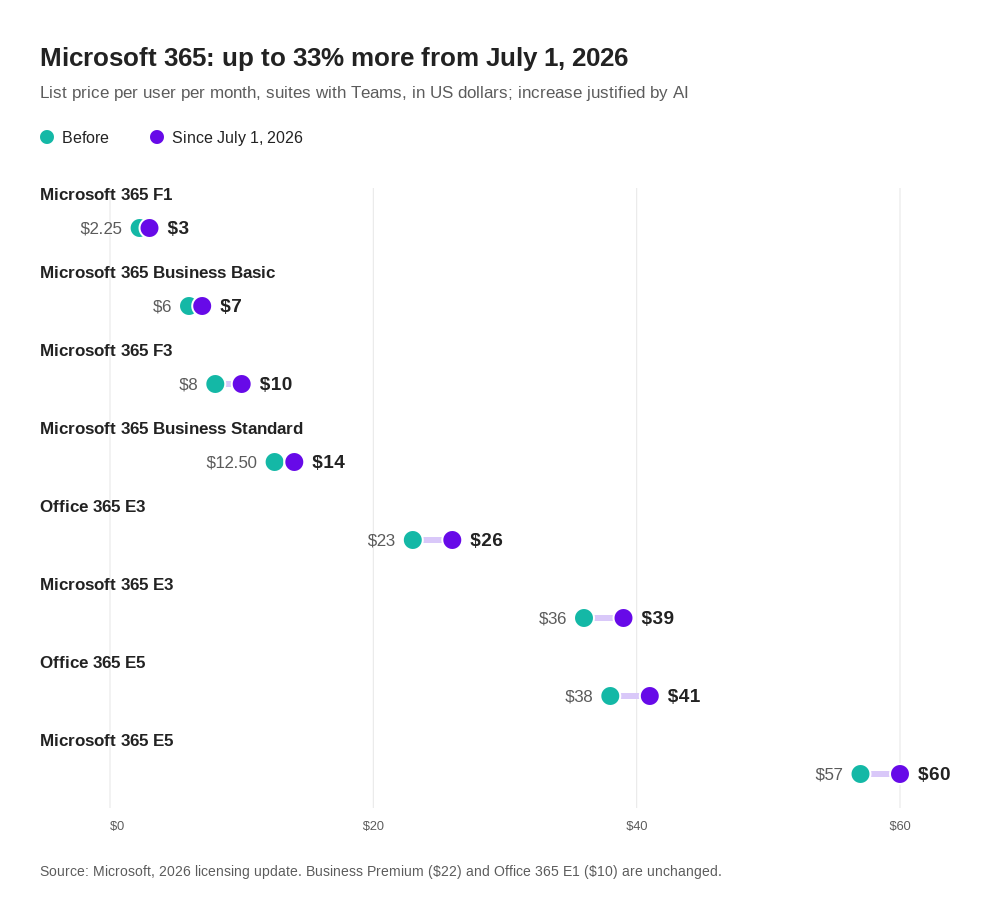 Dumbbell chart: Microsoft 365 F1 goes from $2.25 to $3, Business Basic from $6 to $7, F3 from $8 to $10, Business Standard from $12.50 to $14, Office 365 E3 from $23 to $26, Microsoft 365 E3 from $36 to $39, Office 365 E5 from $38 to $41 and Microsoft 365 E5 from $57 to $60, per user per month as of July 1, 2026
On top of this comes Microsoft 365 Copilot, at €26 excl. VAT per user per month in France, or Copilot Business for SMEs, at €18.20 excl. VAT, cut to €15.60 in a promotion running until December 31, 2026. Google made a different choice: Gemini has been included in Workspace since 2025, with Business Standard rising to €13.60 per month on an annual plan. But processing of data "in use" in a chosen region is only covered by the Enterprise Plus and Frontline Plus plans; Business plans only guarantee where data is stored.
How do we assess a sovereign Microsoft 365 alternative?
We apply to each provider the test described on our sovereign AI page, with three questions.
- Who controls the operator? A parent company outside Europe exposes data to its home country's law, whatever the hosting region. We accept the European Economic Area and Switzerland, which the European Commission recognizes as providing adequate data protection.
- Where is the data stored and processed? Backups and subprocessors included.
- Who runs the AI? Which model, with which operator, and can the administrator enforce that choice for every user?
One distinction avoids many misreadings: self-hosted open-source software does not take on its vendor's nationality. If a company hosts software designed in London or San Francisco itself, the vendor's country becomes a dependency (updates, support, project governance), not a legal exposure. If it buys the same software as a service hosted by that vendor, the test applies in full.
The origin of the AI model follows the same logic. An open-weight model, whether it comes from Alibaba (Qwen) or Google (Gemma), runs at the operator that hosts it, under that operator's law. A closed model such as GPT or Claude is only run by its vendor, or by a US hyperscaler the vendor has chosen: we showed this when comparing the French AI products sold to businesses.
Which European alternatives exist, component by component?
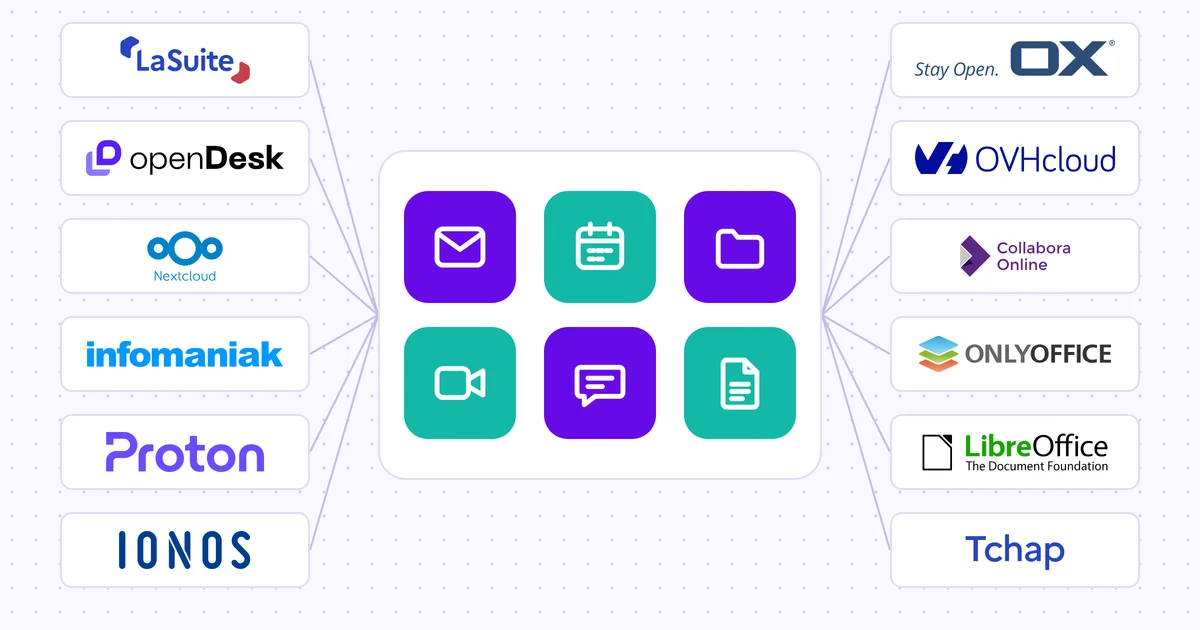
An office suite covers five uses, and each can be replaced separately. Cigref, the association of large French companies' IT departments, said so as early as 2021: the alternative offering is credible but "requires designing a component-by-component approach" (our translation).
| Component | Microsoft and Google | European or open-source software | Vendor | Possible AI |
|---|---|---|---|---|
| Email and calendar | Outlook, Exchange, Gmail |   SOGo, BlueMind | Germany, France | OX AI Service as an option; Nextcloud Assistant |
| Files | OneDrive, SharePoint, Drive |  kDrive | Germany, France, Switzerland | questions about files (Nextcloud Context Chat, Euria in kDrive) |
| Video calls | Teams, Meet |  (LiveKit)  Jitsi, Nextcloud Talk | United States, Germany, Canada | transcription and meeting minutes (pyannoteAI, local Vosk) |
| Team chat | Teams, Google Chat |   (Matrix), Nextcloud Talk, kChat | United Kingdom, Germany, Switzerland | rarely built in |
| Office apps | Word, Excel, PowerPoint, Docs, Sheets |     Euro-Office | United Kingdom, Latvia, Germany | assistant disabled by default, model chosen by the customer |
First surprise: even "sovereign" components often have a vendor outside Europe. Visio, the French government's video-conferencing tool, is "Powered by LiveKit", a company based in San Francisco. Tchap, the government's messaging app, is derived from Element, a vendor based in the United Kingdom. Grist, the government's collaborative spreadsheet, is published by Grist Labs, in New York, and Jitsi is a brand of the US company 8x8. All of them are open-source software that the administration runs itself: the dependency on the vendor is real, but the vendor's exposure to the CLOUD Act does not reach the data.
Another weak spot: online office apps have no vendor that is at once European-controlled, mature and undisputed. Collabora, the engine behind Nextcloud Office and openDesk, is controlled by two British shareholders, one of which traces back to a Canadian holding company. ONLYOFFICE describes itself as owned by a company in Riga, under a Singapore holding company, and led by a founder of Russian and Turkish nationality. Nextcloud and IONOS derived a European fork from it, Euro-Office, in March 2026, which ONLYOFFICE accuses of violating its license. LibreOffice, finally, remains desktop software, and its foundation refuses any AI in the default configuration until six conditions are met, including "No content may leave the computer without authorisation".
There is a functional price, and Bercy, the French Ministry of the Economy and Finance, said so bluntly before members of parliament: "You can do office work with LibreOffice, but you don't get the user experience of Office 365 […] We lost a lot in terms of functionality" (our translation).
La Suite numérique: can a company use it?
La Suite numérique is the set of collaborative tools that DINUM, the French government's digital agency, develops for state employees: Tchap, Visio, Docs, Grist, Fichiers, FranceTransfert, Audioconf and a Messagerie with calendar built on Open-Xchange. It claims more than 500,000 public servants every month, and in January 2026 the government announced the rollout of Visio across all state services by 2027.



The answer to the question companies ask is written in black and white (our translation): "LaSuite is not intended for internal use by private companies", but any organization can "deploy its own instance and run it under its own responsibility". The code of Docs is under the MIT license, and the project invites the private sector to use it, sell it and contribute to it. Service providers have started doing so: the lasuite.coop cooperative for nonprofits and the social economy, and mosa.cloud, a Dutch company, for businesses. La Suite has no PowerPoint equivalent, and its spreadsheet, Grist, is a collaborative database more than an Excel equivalent.
On the AI side, the French state rolled out L'Assistant to all its public servants on June 16, 2026, a chat tool "developed by DINUM with Mistral AI on Outscale SecNumCloud infrastructure" (SecNumCloud being the cloud security qualification issued by ANSSI, the French cybersecurity agency). Visio produces meeting minutes with technology from the French company pyannoteAI. Docs is "model agnostic and gateway agnostic": a key and a URL are enough to plug in any model. The documentation of Grist's assistant published on the government's site, however, states that without further configuration, requests, the schema and the data go to OpenAI. We could not find which model the government's instance actually uses, but the example shows that in an open-source suite, AI sovereignty comes down to a setting.
Germany made the same choice with openDesk, backed by ZenDiS, its federal center for digital sovereignty: ten open-source components, including Docs, Nextcloud, OX App Suite, Element, Jitsi and Collabora, and no AI features shipped to date. The private sector has been able to buy it through approved partners since September 2026, and the International Criminal Court has confirmed it is leaving Microsoft Office for openDesk. Adoption remains slower than the announcements: 8,475 licenses in production in the federal administration in April 2026.
Which complete suites can a company buy, and with what AI?
A company that does not want to host a dozen pieces of software itself can now find complete suites sold by European players. Seven of them pass the test; their AI ranges from nothing at all to a local assistant.
| Suite | Control | Components | AI and model | Entry price |
|---|---|---|---|---|
 kSuite | Swiss foundation | email, calendar, kDrive, kMeet, kChat, ONLYOFFICE office apps | Euria, open models run in Switzerland | CHF 1.76 excl. VAT per user per month (Standard) |
 Workspace | Swiss foundation | email, calendar, Drive, Docs, Sheets, Meet; no chat or presentations | Lumo: Qwen 3.5, GLM 5.3, Apertus 1.5 on Proton's servers | $14.99 per user per month (annual) |
 Nextcloud Workspace | United Internet (Germany) | email, calendar, files, Talk, Euro-Office | assistant connected to IONOS's model catalog | €9 incl. VAT per user per month |
| (self-hosted or with a hosting provider) | Nextcloud GmbH (Germany) | files, email, calendar, Talk, Euro-Office or Collabora | local assistant (Qwen 3.5 9B, Gemma 4, OLMo 3) or model of choice | assistant included in the Ultimate plan, €204.75 excl. VAT per user per year |
| Twake Workplace | LINAGORA (France) | email, calendar, drive, video calls, chat, ONLYOFFICE | LinTO transcription, unnamed open models | €4 per month (Standard) |
 OVHai Workspace | OVHcloud (France) | email, calendar, contacts, drive, video calls; no chat | Olala 1.0 mini, OVHcloud's model | free in alpha, 5 GB |
| mailbox.org | Heinlein (Germany) | email, calendar, drive, video calls, office apps | none | €4 excl. VAT per month (Standard) |
Sources: Infomaniak, Proton, IONOS, Nextcloud, Twake, OVHcloud and mailbox.org, checked on November 24, 2026.
Nextcloud goes furthest on local AI. Its llm2 app runs any model in GGUF format on an 8 GB GPU or even on a CPU, and the assistant answers questions about files, summarizes email threads and takes actions in the calendar. Two caveats, taken from its own documentation: file search does not respect advanced access control rules (files_accesscontrol), and the email writing assistant uses OpenAI as its example of a recommended integration.
OVHai Workspace is the youngest: opened as a free alpha on November 19, 2026, it runs on Olala, the in-house model we analyzed at launch, but its documentation does not yet describe a word processor or a spreadsheet. Delos, which we had listed among French AI products, has rebuilt its site around autonomous agents and its security page no longer mentions its hosting provider: we are waiting for clarification before classifying it.
Euria and Lumo: Swiss AI on open models
Euria, the assistant Infomaniak launched in December 2025, is free, even without an account, and its requests are processed "exclusively in Infomaniak's data centers in Switzerland". Infomaniak does not name its models; a test by the French tech site Clubic found Qwen 3.5 and the Swiss model Apertus 1.5. In kSuite, Euria summarizes emails, searches kDrive and transcribes kChat voice messages. Infomaniak is controlled by a Geneva foundation that holds 63.3% of the voting rights and makes any takeover impossible without its consent. One detail to check before signing: the Business plan also includes Microsoft Office Online.
Proton, for its part, publishes the list of Lumo's models, run "exclusively on servers Proton controls". In a sign that Switzerland is no absolute safe haven, Proton set up Lumo in Germany because of a proposed revision of Swiss surveillance law, its CEO arguing that if the text passed, its services in Switzerland would be "less private than those offered by Google".
"Trusted" Microsoft and Google: Bleu and S3NS
That leaves the middle path: keeping US software, operated by a French company. Bleu, a joint venture between Orange and Capgemini, distributes Azure and Microsoft 365, but was still not SecNumCloud-qualified in October 2026; qualification of the Microsoft 365 part is announced for the first half of 2027, and Copilot is "one of the notable absentees" from the offering. French members of parliament sum up the trade-off (our translation): Bleu "would allow strong continuity of use while maintaining technological dependence on Microsoft". S3NS, a SecNumCloud-qualified Thales subsidiary, does not offer Google Workspace and does not offer Gemini.
What IT leaders can take from this
Documented migrations started with email, calendar and video calls, and left office apps for last. Schleswig-Holstein reports more than €15 million in license savings, against €9 million in one-off investments in 2026, and CNRS, France's national research center, €20 million over six years by leaving Exchange, both figures declared by the organizations themselves. Office apps are moving more slowly: LibreOffice runs on nearly 80% of Schleswig-Holstein's workstations, excluding the tax administration, and Switzerland, which is testing openDesk, talks of disengaging from Microsoft in "acht bis zehn Jahre", eight to ten years.
For AI, the choice of model should rest with the administrator, not with the vendor's default setting. Collabora ships its assistant disabled by default, with the option of a model hosted by the customer; ONLYOFFICE offers a dozen providers, including local models through Ollama; Jitsi provides a transcription example configured with an OpenAI key. For a model served in Europe, our comparison of European LLM APIs (in French) gives measured prices and speeds.
Companies staying on Microsoft 365 face a close deadline: on December 9, 2026, Claude will be enabled in Copilot for European tenants that have not opted out; some Anthropic models, disabled by default in this case, even fall outside Microsoft's contract and retain data for up to 30 days, a topic we covered for Claude Fable. The setting is in the admin center, and has to be changed before that date.
Exit costs, meanwhile, fall in 2027: from January 12, the Data Act prohibits cloud service providers from charging switching fees. What the AI has accumulated moves less easily: Copilot's memory can only be exported by the administrator through eDiscovery, without users' custom instructions, and we found no account of migrating that memory to another suite.
Where ATG comes in: AI kept separate from the suite
ATG does not replace the office suite: it connects to the company's documents, wherever they are, and answers by citing its sources. For a company switching suites, separating the AI from the suite avoids changing assistants with every migration: the same agent reads the old SharePoint during the transition and the new sources afterward.
ATG's connectors cover SharePoint and OneDrive, Google Drive, Confluence, Notion, Slack, FTP servers and websites, and we build custom connectors for other tools; for a source that exposes an MCP server, ATG plugs into it with the user's permissions. Everything runs at a French company, hosted by OVHcloud, and the "EU only" policy keeps AI processing with European providers. That is the principle of our internal chatbot for company documents.
Frequently asked questions about Microsoft 365 alternatives
Can a private company use La Suite numérique?
Not the government's instance, which is reserved for public servants: DINUM, the French government's digital agency, writes that La Suite "is not intended for internal use by private companies". Its code, however, is open source (MIT license for Docs, Visio and Fichiers), and a company can host it itself or go through a provider such as the lasuite.coop cooperative or the Dutch company mosa.cloud.
Is Euria, Infomaniak's AI, sovereign?
By our criteria, yes: Infomaniak is controlled by a Swiss foundation, Switzerland benefits from a European Union adequacy decision, and Euria processes requests in Infomaniak's data centers in Switzerland, on open models (Qwen 3.5 and Apertus according to a test by the French tech site Clubic). Infomaniak does not publish the list of its models.
Does Microsoft 365 operated by Bleu protect against the CLOUD Act?
Bleu is owned by Orange and Capgemini, with no stake held by Microsoft, and on that basis claims to be out of reach of the CLOUD Act. The software, its updates and its roadmap remain Microsoft's. As of November 24, 2026, Bleu did not hold SecNumCloud, the cloud qualification of the French cybersecurity agency; qualification of Microsoft 365 was expected in the first half of 2027, and Copilot was not part of the offering.
Is there a Microsoft 365 alternative with AI that runs locally?
Yes. Nextcloud offers a local assistant (the llm2 app, based on llama.cpp, with Qwen 3.5 9B, Gemma 4 or OLMo 3) included in its Ultimate plan. Collabora and ONLYOFFICE accept a model hosted by the customer, and LibreOffice's AI extensions connect to Ollama or LM Studio.
Does Copilot use Anthropic's models in Europe?
Not by default yet. Claude models are disabled by default for European Union tenants, because they are excluded from the EU Data Boundary. Microsoft will enable them by default on December 9, 2026, with processing brought back into the EU, unless the administrator opts out before that date.
For a long time, companies chose an office suite for its word processor and its email. The next choice will be just as much about the AI that will read everything the company puts into it: its model, its operator, and who has the right to change them. Before migrating, we would run a simple test: ask each candidate suite's AI the questions teams actually ask, on their own documents, and look at where the answers come from. We can run this test with you.