

Enterprise AI SLA: one AI provider for your agents is not enough
Why one provider is not enough for an enterprise AI SLA. Compare commitments, multi-provider gateways and fallbacks for RAG and AI assistants.
Open Anthropic's status page. You will likely land on an averaged availability rate between 99% and 99.5%. "Two" nines.
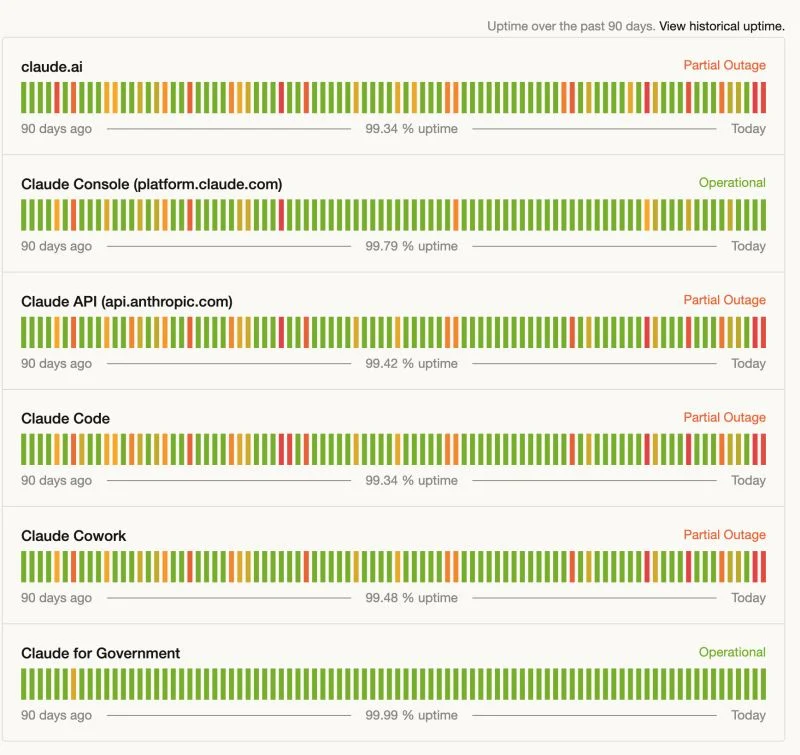
We went from an era where people aimed for four nines (99.99%) to one where 99.3% uptime barely raises an eyebrow (not enough). "Vibe coders" using Claude are fine with that, but is it enough for your company? Probably not...
Is Anthropic an outlier? No. Operationally, it is very hard to keep a high service level for AI inference on large models.
If you remember only one thing
Pointing your production stack (RAG, internal assistant, agents) at a single AI provider (for example Claude, ChatGPT, Gemini, Mistral) means accepting that your system could experience several cumulative days of downtime per year, depending on how availability is measured. For a business-critical service, that risk deserves to be treated as an infrastructure dependency.
A reminder of what the nines mean
Orders of magnitude for unavailability, all causes included, over one year:
| Nines | Uptime | Approx. downtime |
|---|---|---|
| Two nines | 99% | ~3.6 days |
| Three nines | 99.9% | ~8.8 hours |
| Four nines | 99.99% | ~52 minutes |
Are you ready for several days of downtime per year on your AI project?
Your users are used to "four nines" on everyday services. Here, for example, is Microsoft 365's real-world availability:
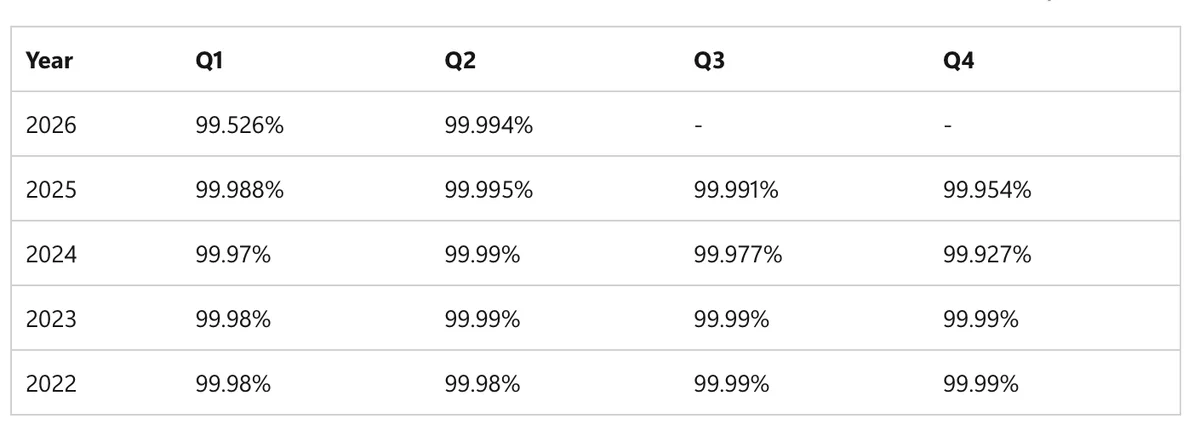 Microsoft 365 worldwide availability by quarter, around 99.9% and above (source Microsoft Learn)
What about Anthropic's competitors?
OpenAI and Mistral also publish their availability. The figures are not directly comparable: each page covers different components and periods. As of July 31, 2026, Mistral displayed 99.4% over the previous three months.
A status page is not a financial SLA. Some specific offers do publish a commitment, such as Gemini Online Inference at 99.5% or OpenAI Scale Tier at 99.9% (a specific option).
Hyperscalers can offer stronger commitments on some managed inference services, for example 99.9% on Azure AI. That covers endpoint availability, not necessarily latency, answer quality, or the availability of the full RAG chain.
That remains far from the usual guarantees of productivity SaaS, where three nines are a standard with no surcharge.
The open-weights revolution and LLM gateways
Open models change the equation. They can run on many inference providers, which makes it possible to provide a fallback path when one of them becomes unavailable.
The answer: a multi-provider gateway, or LLM gateway. In practice, the software must be able to call several models and providers based on current performance, cost, availability, and failover rules.
Those providers do not all show 99.9%. Used with a gateway, health checks, and a fallback mechanism, they can reach it. Here is a snapshot of what we see in production at Ask This Guy, measuring call success over the last 30 days:
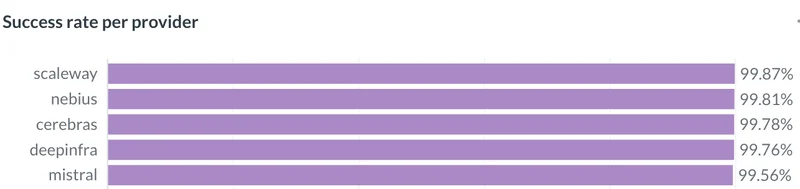 Success rate by inference provider: Scaleway 99.87%, Nebius 99.81%, Cerebras 99.78%, DeepInfra 99.76%, Mistral 99.56%
Products exist for this need. For example, OpenRouter provides a single access point to many providers, with fallback rules to configure. On the European side, Eden AI, a French vendor, exposes more than 500 models behind a single API, with built-in fallback, a European endpoint and zero data retention. Enough to pool availability without moving your context outside the GDPR perimeter.
You can also build the gateway yourself: connect to many providers, measure their performance, and implement priority and fallback logic.
And some platforms bake it in natively, as we do at Ask This Guy.
An enterprise RAG SLA is not only about LLM uptime either: sources, retrieval, tools, and measurement matter just as much. For the pitfalls after the POC, see Enterprise RAG: 5 production mistakes.
Frequently asked questions about enterprise AI SLAs
What is an enterprise AI SLA?
An enterprise AI SLA defines the expected availability of an AI service, along with its measurement scope, exclusions, and any service credits. A status page helps you observe incidents, but it does not replace a contractual commitment.
What SLA should an enterprise RAG target?
An enterprise RAG SLA should cover more than the model API: source ingestion, retrieval, tools, the gateway, latency, and service quality. 99.9% can be a useful availability baseline, but the figure only means something when the scope and measurement method are explicit.
How can you improve an AI assistant SLA?
To improve an AI assistant SLA, avoid a single point of failure: use a multi-provider gateway, several models, health checks, automatic failover, and monitoring for errors and latency. Also plan a degraded mode for times when generation is unavailable.
At Ask This Guy
Our AI provider gateway selects available, performing models. Client-side goal: to target a service level above 99.9% within the defined scope, without depending on a single frontier model. EU-only or worldwide policy depending on your sovereignty constraint; details on AI providers.
No miracle. An architecture that assumes cloud LLMs fail, and is designed for that. It underpins our enterprise RAG solution, and the same gateway powers a product support assistant when your users are your customers.
If you are industrializing a RAG or an internal assistant and want to see this gateway in real conditions: book a demo.