Best AI model: compar:IA vs LMArena vs Artificial Analysis
compar:IA, LMArena (now Arena) and Artificial Analysis each name a different best AI model. We cross-checked 92 models to see why these leaderboards disagree.

On 24 November 2026, three AI leaderboards give three different answers to the question "what is the best AI model?". On compar:IA, the French Ministry of Culture's blind-vote arena, Claude Opus 5.5 comes first. On Arena, formerly LMArena, it is Gemini 4 Carbon. On the Artificial Analysis index, Claude Fable 5.2. Which leaderboard should be believed?
None of the three is wrong: they are not asking the same question. compar:IA and Arena ask users to vote blind between two answers; Artificial Analysis runs automated tests, in English, mostly on agent tasks. To measure what these differences change, we cross-checked the three leaderboards on the models they have in common.
Language makes almost no difference: in Arena, the French ranking follows the English one. Votes and automated tests agree moderately. compar:IA, however, stands apart from all the others, and Chinese models drop nearly twenty places there, for reasons no one has established yet.
What is the best AI model? Three leaderboards, three answers
Each leaderboard has its own top three, and no model comes first everywhere.
| compar:IA (24 Nov 2026) | Arena, text (22 Nov 2026) | Artificial Analysis (24 Nov 2026) | |
|---|---|---|---|
| 1st | Claude Opus 5.5 | Gemini 4 Carbon | Claude Fable 5.2 |
| 2nd | Muse Spark 1.2 | Gemini 4 Argon | GPT-6.2 Astra |
| 3rd | Muse Spark 1.3 | Gemini 4 Neon | Gemini 4 Neon |
Part of the gap comes from the catalogue. The latest flagship models, Claude Fable 5.2, GPT-6.2 and the Gemini 4 family, are not yet in the compar:IA leaderboard, which lists 127 models. Arena ranks more than 400 in its text category, and Artificial Analysis scores 70 in its default view. But method weighs more: even on the models they share, the three leaderboards do not rank them in the same order, because they do not measure the same thing.
How does the compar:IA leaderboard work?
compar:IA is a free chatbot comparison tool launched by the French Ministry of Culture: a user asks a question, receives two answers from anonymous models and votes for the one they prefer. The leaderboard is calculated from these votes with the Bradley-Terry model, a statistical method that infers each model's strength from all of its head-to-head matches. As of 24 November 2026, it covers 127 models and 257,000 votes. The page itself warns that it "measures neither the factual accuracy of the answers nor the overall performance of the models".
Style control is on by default: it removes the effect of length and formatting (headings, bold, lists), so that the score reflects substance. The audience is mostly French-speaking and in education: according to the team's research paper, 89% of conversations are in French and the service is widely used in schools and universities. The post announcing the first leaderboard mentions "the often simple nature of the questions asked".
The platform's code is open source, and we read it. Two points do not appear on the leaderboard page. First, the page says the score is calculated "from all votes and reactions", but the code has only used votes since 26 May 2026: a commit on that day removed likes and dislikes from the calculation. Second, serving conditions are the same for every model: a temperature of 0.7, the setting that controls randomness in the writing, no reasoning level explicitly requested, and a 30-second timeout on the response stream. Almost all models, whether American, French or Chinese, are called through OpenRouter, a service that routes each request to a host of the model.
Arena (formerly LMArena): a leaderboard built on votes from around the world
Arena applies the same principle on a global scale. Known first as Chatbot Arena, then LMArena, the platform has been called Arena since 28 January 2026. Its text leaderboard rests on more than 9.2 million votes, including 185,415 in French as of 22 November 2026. It uses the same style control as compar:IA, which adopted it in June 2026.
Its strength lies in category leaderboards. The question behind each vote is tagged by language, and a category's ranking is computed only from its own votes: Arena's French leaderboard uses only the matches whose question is in French. There are others for coding, maths, creative writing and law.
Arena is a company, valued at $3.1 billion in October 2026. It has drawn criticism: a study by researchers from Cohere and several universities, "The Leaderboard Illusion", accused it of letting large labs test many variants privately before publishing one. Arena replied that the effect of these tests was minimal. compar:IA, a public service with no commercial stake, is free of that suspicion.
Artificial Analysis Intelligence Index: tests, not votes
The Artificial Analysis Intelligence Index asks no one's opinion. It is a score out of 100 that aggregates nine automated evaluations, in four categories weighted 25% each: knowledge work, coding, science and general knowledge. Each task is graded automatically, and the methodology states that the suite is mainly in English.
Version 5, released on 27 October 2026, shifted the centre of gravity: agent tasks, where the model uses tools or a terminal, now weigh 55% of the index, and 60% rely on private test sets that labs cannot learn by heart. Each reasoning level is scored as a separate model: the table shows the most intensive variant by default, often "Max". The index therefore measures what a model can do when it is allowed to think for a long time, not what it answers in a few seconds to an everyday question.
LMArena vs Artificial Analysis vs compar:IA: do the leaderboards agree?
To compare two LLM leaderboards, we used Spearman's rank correlation. It equals 1 when two leaderboards rank the models in the same order, and 0 when their orders are unrelated. We computed it on the models present in both leaderboards being compared, with a confidence interval that shows the margin of error.
| Leaderboards compared | Shared models | Correlation | 95% confidence interval |
|---|---|---|---|
| Arena English × Arena French | 92 | 0.98 | 0.96 to 0.98 |
| Artificial Analysis × Arena French | 20 | 0.74 | 0.44 to 0.90 |
| Artificial Analysis × Arena English | 24 | 0.71 | 0.35 to 0.90 |
| compar:IA × Arena French | 92 | 0.57 | 0.40 to 0.71 |
| compar:IA × Artificial Analysis | 30 | 0.47 | 0.07 to 0.76 |
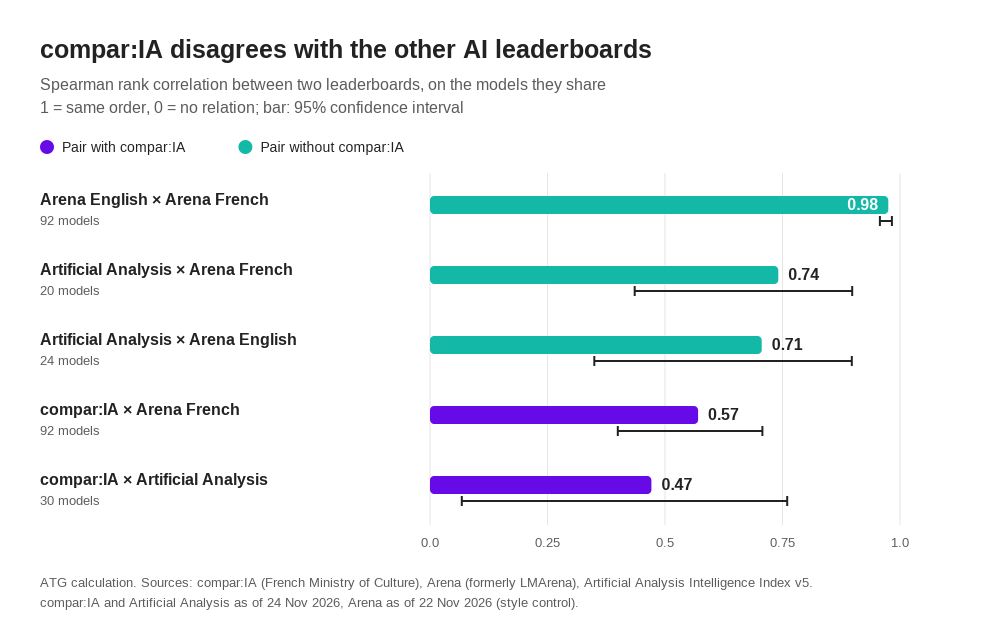 Chart: rank correlation between AI leaderboards. Arena English and Arena French: 0.98 across 92 models (interval 0.96 to 0.98). Artificial Analysis and Arena French: 0.74 across 20 models (0.44 to 0.90). Artificial Analysis and Arena English: 0.71 across 24 models (0.35 to 0.90). compar:IA and Arena French: 0.57 across 92 models (0.40 to 0.71). compar:IA and Artificial Analysis: 0.47 across 30 models (0.07 to 0.76)
Three levels of agreement emerge. Arena's two leaderboards, English and French, are almost identical. Human votes and automated tests broadly agree, at around 0.7, which is notable for two such different methods. compar:IA stands apart from all of them, including Arena in French, which measures the same thing in the same language. The result holds when we keep only models released in 2026, to rule out the effect of older generations: 0.95 between the two Arena rankings, 0.51 between compar:IA and Arena in French.
The detail of the 30 models ranked by both compar:IA and Artificial Analysis shows where the gap lies.
| Model | Lab | compar:IA (rank of 127) | Arena French (rank of 306) | Artificial Analysis (index v5) |
|---|---|---|---|---|
| Claude Opus 5.5 | Anthropic (US) | 1 | 20 | 59 |
| GPT-6.1 Sol | OpenAI (US) | 7 | 37 | 55 |
| Claude Sonnet 5.5 | Anthropic (US) | 8 | 33 | 55 |
| Kimi K3.1 Pro | Moonshot AI (China) | 69 | 24 | 46 |
| Muse Ember | Meta (US) | 4 | – | 36 |
| Claude Haiku 5.5 | Anthropic (US) | 19 | 109 | 36 |
| DeepSeek V4.1 Flash | DeepSeek (China) | 70 | – | 33 |
| GLM-5.3 | Zhipu (China) | 65 | 11 | 32 |
| Gemini 3.8 Flash | Google (US) | 12 | 26 | 31 |
| MiMo-V2.6-Pro | Xiaomi (China) | 26 | – | 30 |
| MiniMax-M3.1-Flash | MiniMax (China) | 107 | – | 29 |
| GPT-6 Luna | OpenAI (US) | 58 | 98 | 28 |
| GLM-5.3-Flash | Zhipu (China) | 62 | 31 | 28 |
| MiMo-V2.6-Flash | Xiaomi (China) | 39 | 78 | 27 |
| Mistral Large 4 | Mistral AI (France) | 43 | 110 | 26 |
| DeepSeek V4 Pro | DeepSeek (China) | 55 | – | 23 |
| Qwen 3.8 27B | Qwen (China) | 100 | 90 | 20 |
| MiniMax-M3 | MiniMax (China) | 38 | 117 | 19 |
| Nemotron 3.5 Super VL | Nvidia (US) | 83 | – | 14 |
| Inkling Small | Thinking Machines (US) | 103 | 139 | 13 |
| Gemini 3.5 Flash-Lite | Google (US) | 17 | 69 | 12 |
| Inkling | Thinking Machines (US) | 64 | 97 | 12 |
| Muse Glimmer 30B | Meta (US) | 93 | – | 6 |
| Command A+ | Cohere (Canada) | 111 | – | 6 |
| Nemotron 3.5 Lightning | Nvidia (US) | 120 | 172 | 6 |
| Mistral Medium 3.5 | Mistral AI (France) | 33 | 132 | 5 |
| Granite 4.2 8B | IBM (US) | 119 | – | 5 |
| Gemma 4 31B | Google (US) | 16 | 105 | 4 |
| Mistral Small 4 | Mistral AI (France) | 51 | – | 4 |
| gpt-oss-120b | OpenAI (US) | 102 | 211 | 4 |
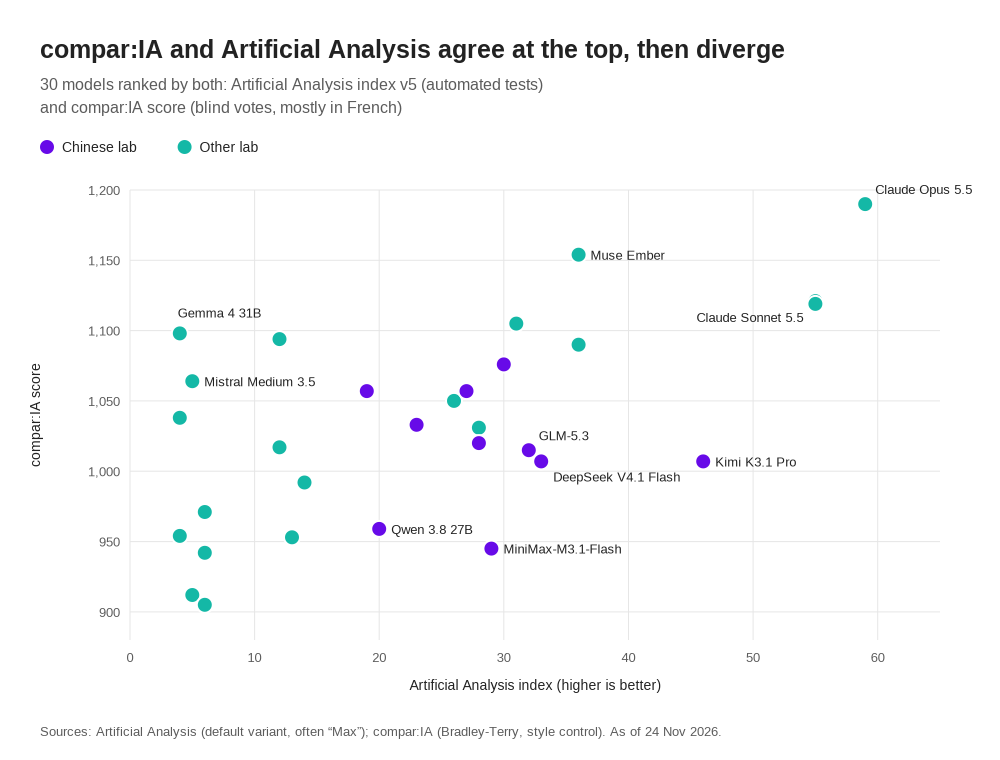 Scatter plot: Artificial Analysis index on the horizontal axis, compar:IA score on the vertical axis, for 30 models. Claude Opus 5.5 is at the top right (index 59, score 1,190). Chinese models, in purple, sit mid-index but low on compar:IA: Kimi K3.1 Pro (46, 1,007), DeepSeek V4.1 Flash (33, 1,007), GLM-5.3 (32, 1,015), MiniMax-M3.1-Flash (29, 945), Qwen 3.8 27B (20, 959). Gemma 4 31B (4, 1,098) and Mistral Medium 3.5 (5, 1,064) have a low index and a high compar:IA score
At the top of the table, everyone agrees: Claude Opus 5.5, GPT-6.1 Sol and Claude Sonnet 5.5 are among the best everywhere. Disagreements start in the middle. Kimi K3.1 Pro, 4th of these 30 on the Artificial Analysis index, is 69th on compar:IA. Conversely, Gemma 4 31B and Mistral Medium 3.5, near the bottom of the index, are 16th and 33rd on compar:IA. The index rewards long agent tasks; compar:IA rewards answers that read well. A model can excel at one without shining at the other.
Which AI is best in French?
One might assume compar:IA stands apart because it is French-speaking. The figures say otherwise. In Arena, the French and English rankings are in almost the same order (0.98): a model that is good in English is also good in French, at least in the voters' eyes. Arena's top model in French, Gemini 4 Neon, has in fact gathered only 184 votes there, too few to separate it from the models just behind.
Our own benchmark of French writing quality points the same way. Across 576 texts rated blind, DeepSeek V4.1 Flash, a Chinese model, writes the best French, tied with GPT-6 Luna and Mistral Large 4. None of the six models tested slipped a Chinese character into its answers. The weakest, Qwen 3.8 27B, is also Chinese. Correct French does not depend on where a model comes from, and it does not explain the gaps on compar:IA: DeepSeek V4.1 Flash ranks 70th out of 127 there.
Why does compar:IA rank Chinese models lower?
This is the clearest finding of our cross-check. Across the 92 models ranked by both compar:IA and Arena in French, the 32 Chinese models (Qwen, DeepSeek, Kimi, GLM, MiniMax, MiMo) rank 19 places lower on average on compar:IA. Open models from other countries (Gemma, Mistral, Llama) gain 11 places there, and proprietary models 10. The gap between Chinese models and the others, 29 places, is too large to be due to chance: a permutation test gives a probability below 1 in 10,000.
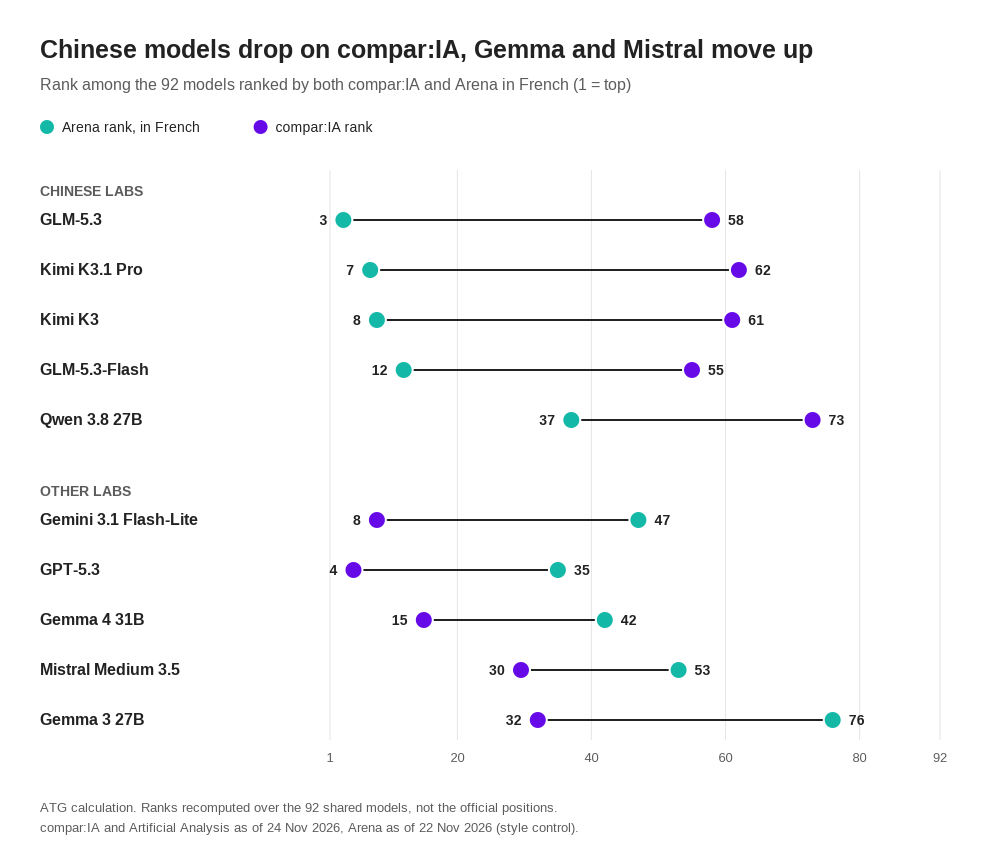 Dumbbell chart: rank among the 92 models shared by compar:IA and Arena in French. Chinese labs: GLM-5.3 goes from 3rd on Arena to 58th on compar:IA, Kimi K3.1 Pro from 7th to 62nd, Kimi K3 from 8th to 61st, GLM-5.3-Flash from 12th to 55th, Qwen 3.8 27B from 37th to 73rd. Other labs: Gemini 3.1 Flash-Lite goes from 47th to 8th, GPT-5.3 from 35th to 4th, Gemma 4 31B from 42nd to 15th, Mistral Medium 3.5 from 53rd to 30th, Gemma 3 27B from 76th to 32nd
We ruled out several explanations. Language first: in Arena, the average rank of Chinese models is the same in French, in English and overall. Then the type of question: across fifteen Arena categories (coding, maths, creative writing, law, science, long conversations), their average rank never moves more than 1.3 places from their overall rank. Speed: we found no clear link between the response time measured by Artificial Analysis and the drop on compar:IA. Finally, user reactions have not counted towards the score since May.
Two hypotheses remain that we cannot settle. The first concerns the audience and its questions. compar:IA is widely used in education, and its questions are mainly about science, education, the economy and society. Arena does not publish a profile of its voters. Different expectations about tone, concision or general culture may play a part without showing up in Arena's categories.
The second concerns serving conditions. On compar:IA, the reasoning level is not set, the temperature is the same for all models and the stream is cut off at 30 seconds: a model that thinks at length before answering may suffer. Open models also go through third-party hosts, and the compar:IA team acknowledges that some may serve compressed versions without saying so. Yet Gemma, also an open model, does not drop: this lead does not explain everything.
compar:IA's conversations, published on Hugging Face with restricted access, would make it possible to test these leads. A word on where we stand: ATG uses a Chinese model, Qwen 3.8 27B, to write the answers of its assistant, and our own measurements place it last on French writing quality. This finding does not say that compar:IA is wrong; it says that compar:IA measures something other than the other leaderboards.
Which leaderboard to check when choosing an AI model?
Each leaderboard answers a specific question, and the useful one is the one that asks yours.
- For an agent that chains tools, code and long tasks, the Artificial Analysis index is closest to that use, provided one looks at the reasoning level and the cost per task it displays.
- For an assistant that writes in French to customers or colleagues, compar:IA is the only signal from an ordinary French-speaking audience. Its gaps with Arena are a good reason to test the candidate models on one's own questions.
- For general preference, across all languages, Arena is the broadest leaderboard, and its categories make it possible to filter by use.
For answering from documents, none of the three is enough, because the software around the model matters more than the model. On the FinanceBench benchmark, according to Mistral, the same model goes from 22.7% to 78.7% correct answers just by changing how it searches the documents. Our own test points the same way: on FinanceBench, replacing Qwen 3.8 27B with Gemini 3.8 Flash does not change the score significantly. Choosing the model comes after checking how the assistant searches, splits and cites its sources. That is what we examine first in a scoping engagement.
The limits of this cross-check
Model names differ from one leaderboard to another, and we matched them by hand; a poorly chosen variant (reasoning level, dated version) can move a rank. The drop of Chinese models rests on 32 models from six families, which makes it robust to a single error. Some models have only a few hundred French votes in Arena: keeping only those with at least 300, the correlation between compar:IA and Arena in French stays at 0.54. Finally, these leaderboards change every week; our figures date from 22 November for Arena and 24 November 2026 for the other two.
Frequently asked questions about AI leaderboards
What is the best AI model right now?
It depends on the leaderboard. As of 24 November 2026, Claude Opus 5.5 is first on compar:IA, Gemini 4 Carbon on Arena and Claude Fable 5.2 on the Artificial Analysis index. The three leaderboards agree on a small leading group, from the large American labs, but they do not ask the same question: the preference of French-speaking users, the preference of users worldwide, or success on automated tests in English.
What is compar:IA?
compar:IA is a free chatbot comparison tool launched by the French Ministry of Culture. A user asks a question, receives answers from two anonymous models and votes for the better one. The leaderboard, calculated from 257,000 votes as of 24 November 2026, reflects preferences, not the accuracy of the answers. 89% of conversations are in French, and the service is widely used in education.
What is Arena, formerly LMArena?
Arena, called Chatbot Arena and then LMArena until January 2026, is a global platform that compares AI models through blind votes. Its text leaderboard rests on more than 9 million votes and comes in versions by language and by use (coding, maths, creative writing). Its French leaderboard follows its English leaderboard very closely.
How is the Artificial Analysis Intelligence Index calculated?
The Artificial Analysis index aggregates nine automated evaluations in four equally weighted categories: knowledge work, coding, science and general knowledge. Since version 5, released on 27 October 2026, agent tasks weigh 55% of the index. The tests are mainly in English, and each reasoning level of a model is scored separately.
Is the compar:IA leaderboard reliable?
It is reliable for what it measures: the preferences of its audience, mostly French-speaking and in education, under the platform's serving conditions. It measures neither the accuracy of the answers nor the ability to carry out complex tasks. Its order differs from Arena in French and from the Artificial Analysis index, especially for Chinese models, which rank markedly lower there.
A leaderboard answers the question of those who vote or those who write the tests. A company has its own: its documents, its customers, its language, its budget. In our view, fifty questions drawn from its own daily work, put to three models, say more than all three leaderboards combined.