Best LLM for French: six models tested on 576 texts
Which LLM writes the best French? DeepSeek, Qwen, GLM, Gemma, Mistral and GPT-6 Luna wrote 576 texts, rated blind. Errors, invented words, cost: our results.
On 24 November 2026, we asked six language models to write in French: 576 texts in total, from answers based on documents to emails, summaries, articles and messages between friends. Five open-weight models (DeepSeek V4.1 Flash, Qwen 3.8 27B, GLM 5.3 Flash, Gemma 4 31B, Mistral Large 4) and OpenAI's closed GPT-6 Luna as a reference. Two automated judges rated them blind, and two grammar checkers, Grammalecte and LanguageTool, counted the errors. For any company whose chatbot answers French-speaking customers or staff, the question is practical: which model can be trusted to write French?
The result is clear. The best French in the test was written by a Chinese model, DeepSeek V4.1 Flash, tied with GPT-6 Luna and Mistral Large 4. So was the worst: Qwen 3.8 27B made at least one major error in 23 texts out of 96, against 3 for DeepSeek.
For a company deploying a chatbot, the origin of a model says nothing about its French: it has to be measured. And every model writes worse when it answers from documents in English, which is the daily routine of an internal assistant.
How did we measure the quality of French written by LLMs?
The quality of an LLM's French is its ability to write like a French-speaking professional: no spelling or agreement errors, no calques from English, the requested tone (the informal tu or the formal vous, a formal letter or a message between colleagues), and French typography. That is what we set out to measure, on tasks close to those of a business assistant.
We wrote 48 prompts in French, split into eight styles of six prompts each: answering a question from excerpts in English, then in French, writing a business email, summarising a long document, writing editorial content, explaining simply, replying to a friend, rewording. Each prompt sets a target length, from 50 to 420 words. Companies, people and figures are made up, so no model can answer from memory. Each model answered every prompt twice, with the same system prompt, at the lowest reasoning setting its provider accepts.
Each text was then rated and checked in four ways:
- Gemini 3.8 Flash, from Google, plays the demanding copy editor: it gives five ratings from 1 to 5 (correctness, naturalness, register, typography, overall) and lists every problem with its severity, the faulty excerpt and the correction;
- Jev, the TypeSafe model we already use to rerank search results, answers three closed questions on fluency, naturalness and register; its fluency question is word for word the one from our translation test;
- Grammalecte and LanguageTool count grammar and spelling errors;
- automated checks catch characters from other scripts, passages in English (with lingua) and French typography errors.
Since Gemini is a Google model, like Gemma, we checked that it did not favour its cousin: compared with Jev, it rates Gemma no more generously than the other models. Neither judge ever sees the model's name.
Everything is published: the full report (method, prompts, statistics, French version) and the workbook, with all 576 texts, every rating and every error flagged.
Which LLM writes the best French?
Three models stand out and cannot be separated: DeepSeek V4.1 Flash, GPT-6 Luna and Mistral Large 4. Gemma 4 31B follows closely, GLM 5.3 Flash a notch behind. Qwen 3.8 27B is clearly last: its gap with each of the other five is statistically significant.
| Model | Overall rating (Gemini, out of 5) | Fluency (Jev, out of 5) | Texts rated 5 out of 5 | Texts with a major error | Cost per 1,000 answers |
|---|---|---|---|---|---|
| DeepSeek V4.1 Flash | 4.90 | 4.47 | 90% | 3 of 96 | €0.35 |
| GPT-6 Luna | 4.84 | 4.52 | 88% | 3 of 96 | €0.11 |
| Mistral Large 4 | 4.84 | 4.49 | 84% | 4 of 96 | €1.00 |
| Gemma 4 31B | 4.77 | 4.39 | 81% | 6 of 96 | €0.10 |
| GLM 5.3 Flash | 4.70 | 4.43 | 73% | 11 of 96 | €0.17 |
| Qwen 3.8 27B | 4.43 | 4.37 | 50% | 23 of 96 | €0.91 |
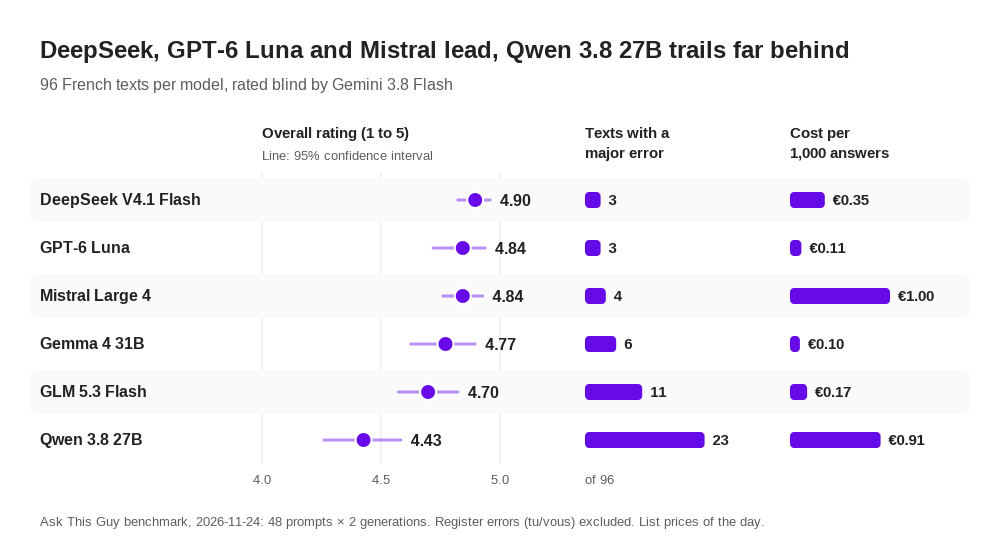 Chart: six LLMs rated on 96 French texts each. Gemini overall rating out of 5: DeepSeek V4.1 Flash 4.90, GPT-6 Luna 4.84, Mistral Large 4 4.84, Gemma 4 31B 4.77, GLM 5.3 Flash 4.70, Qwen 3.8 27B 4.43. Texts with a major error, register excluded: 3, 3, 4, 6, 11 and 23 of 96. Cost per 1,000 answers: €0.35, €0.11, €1.00, €0.10, €0.17 and €0.91
Ratings are high across the board: on Gemini's scale, 4 already means "correct with minor awkwardness". What separates the models is the share of flawless texts: 90% for DeepSeek, one in two for Qwen. The count of major errors, which we drew from Gemini's reviews, leaves out register errors (tu instead of vous), for a reason explained below.
Jev, the second judge, confirms the overall order but separates the models less: it rates fluency between 4.37 and 4.52, and puts GPT-6 Luna first. The two judges agree on how the models rank, much less text by text.
Qwen 3.8 27B is also the least consistent: between two answers to the same prompt, its rating varies by 0.44 points on average, against 0.08 for Gemma 4 31B and 0.12 for DeepSeek V4.1 Flash. It collapses mostly on free writing: 3.83 on messages between friends, 4.25 on articles and explanations.
What mistakes do LLMs make in French?
Reading the 590 problems flagged by Gemini, two families emerge.
Mistakes a human makes too
The best models make the mistakes of a writer in a hurry. Mistral Large 4 writes "Engagé dans la transition énergétique […], l'entreprise développe", a past participle that should agree with the feminine entreprise; DeepSeek V4.1 Flash writes "aucune représailles".
One prompt caught almost everyone out. A technician asks when to replace a part, and the English manual says "every 8,000 operating hours or every two years". In French, heure is feminine, so "every 8,000 hours" is toutes les 8 000 heures. Five models out of six wrote the masculine "tous les … heures" at least once, carried along by tous les deux ans ("every two years") in the same sentence: DeepSeek, GPT-6 Luna and Mistral in both their answers, Qwen and GLM in one of two. Only Gemma 4 31B got the agreement right every time. A proofreader catches this mistake; a hurried reader does not see it.
These mistakes have something in common: the word that agrees is written before the noun it depends on. Tous before heures, aucune before représailles, Engagé before l'entreprise; and from Qwen, "aucun action", "de réelles atouts", "pas d'un lecture". An LLM is trained to write one word at a time, and it never goes back. It does plan ahead: Anthropic researchers have shown that a model picks the rhyme of a line of poetry before writing it. But in French, the determiner and the participle come before the noun: the model commits to a gender or a number it can no longer correct. That is our hypothesis, and it makes these mistakes very human: a person writing from left to right falls into the same trap, for the same reason.
Mistakes no human makes
The other family gives the machine away. These are words that do not exist, words from another language, sentences that lose their meaning. Qwen 3.8 27B writes "des indisponences récurrentes", "le formaldémeth", "tu viveras moins bien", "lire tes diaposites", "l'effet de compoundage", "Aérer en grand jetant les fenêtres". GLM 5.3 Flash invents "des surfaces closées", "je defendedrais", "Nous vous prisons de bien vouloir" (prions, "we kindly ask"), and three times mentions "ton ke favorite". Gemma 4 31B writes "On a longtemps chromosomalisé la semaine de quatre jours", leaves an English "reducing" in the middle of a sentence, and slips in an Indonesian word: "une approche cohérente et sederhana".
These mistakes are worse than the first kind. A "tous les 8 000 heures" passes for a slip; "formaldémeth" tells the reader that no human proofread the text. In a chatbot that answers customers, the company's credibility takes the hit. They are concentrated in three models: Qwen 3.8 27B, GLM 5.3 Flash and Gemma 4 31B.
Tu or vous: the model follows the tone of the question
Two prompts explicitly asked for a formal vous answer to questions phrased casually: "I signed a new client yesterday. What do I need to do this week?", or "Someone told me I had to turn on some two-factor authentication thing". GPT-6 Luna, Gemma 4 31B and GLM 5.3 Flash answered with the informal tu, which Gemini counts as a major error.
It is not a language error but an instruction not followed: the models mirrored the tone of the question instead of applying the instruction, even though it was written in the prompt. We kept these cases out of the count of major errors, which measures the quality of the French. For a chatbot, the finding still matters: a register rule can give way to the user's tone. It is safer to set it in the system instructions and check it in the output than to rely on the model.
Do Chinese models write worse French?
No. That was the starting question of the test, and the answer leaves no doubt: the best and the weakest model of the test are both Chinese. DeepSeek V4.1 Flash first, Qwen 3.8 27B last, GLM 5.3 Flash in between.
The most widespread fear, a Chinese model slipping ideograms into a French sentence, did not materialise: not one Chinese, Japanese, Korean or Cyrillic character in the 576 texts, and no text with more than 5% English. The only foreign word other than English came from a Google model.
This sheds light on an oddity of the rankings. In the compar:IA arena run by the French Ministry of Culture, where users vote blind between two answers, nearly always in French, Chinese models rank far lower than elsewhere: DeepSeek V4.1 Flash is 70th out of 127, while Gemma 4 31B is 16th. Our measurement of French quality puts DeepSeek ahead of Gemma. The correctness of their French does not explain that drop; other factors, such as style, tone or the platform's audience, must be at play. It does agree with compar:IA on one point: Qwen 3.8 27B is 100th there.
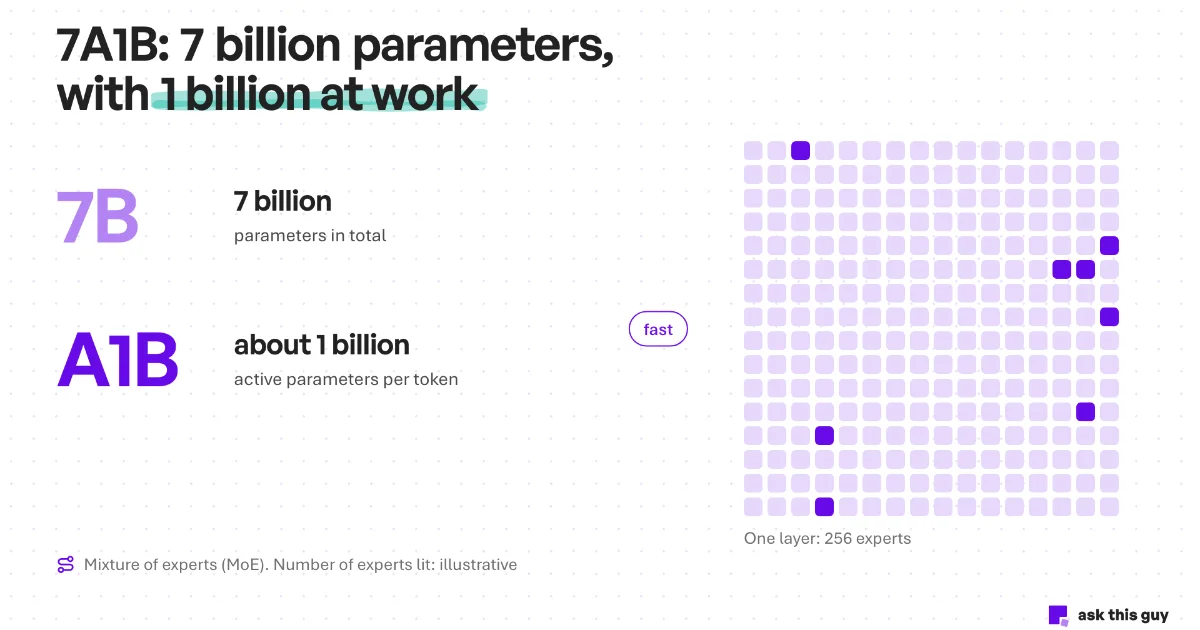
Model size does not explain everything either. The two dense models under 32 billion parameters, Qwen 3.8 27B and Gemma 4 31B, are among the three that invent words. But GLM 5.3 Flash, a much larger mixture-of-experts model, invents them too, while DeepSeek V4.1 Flash, which activates only 8 to 16 billion parameters per token, invents none.
Why does a chatbot write worse French from English documents?
This is the most useful finding of the test for a company. One prompt in four had the model answer from document excerpts: six times in English, six times in French. With French sources, the six models are nearly tied. With English sources, the fluency of every model drops, from 4.47 to 4.09 out of 5 on average according to Jev.
| Model | English excerpts | French excerpts | Gap |
|---|---|---|---|
| Qwen 3.8 27B | 3.91 | 4.47 | 0.56 |
| GLM 5.3 Flash | 4.04 | 4.51 | 0.47 |
| Gemma 4 31B | 4.08 | 4.51 | 0.44 |
| DeepSeek V4.1 Flash | 4.07 | 4.47 | 0.40 |
| Mistral Large 4 | 4.19 | 4.47 | 0.28 |
| GPT-6 Luna | 4.26 | 4.42 | 0.15 |
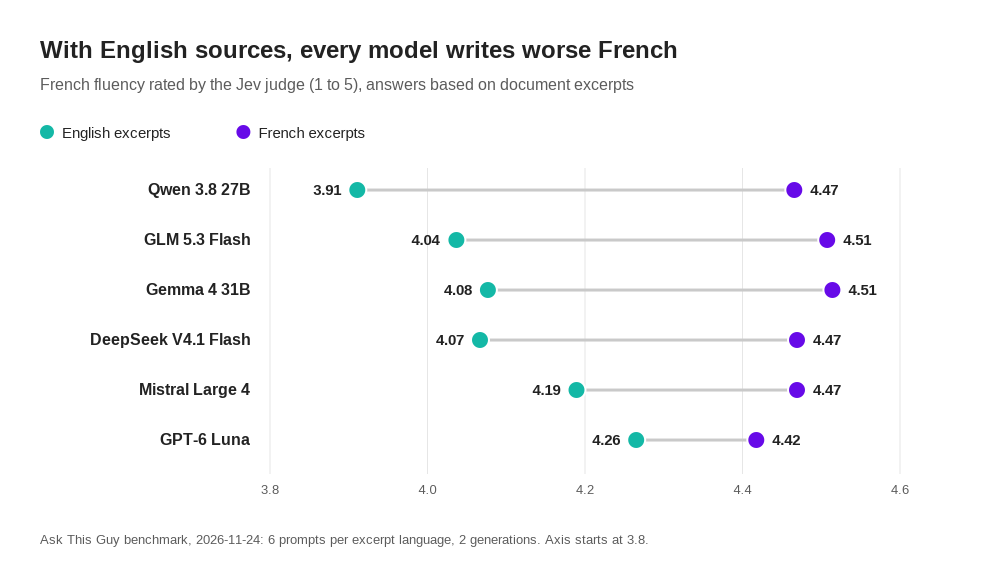 Chart: French fluency rated by Jev out of 5, answers based on English then French excerpts. Qwen 3.8 27B 3.91 and 4.47; GLM 5.3 Flash 4.04 and 4.51; Gemma 4 31B 4.08 and 4.51; DeepSeek V4.1 Flash 4.07 and 4.47; Mistral Large 4 4.19 and 4.47; GPT-6 Luna 4.26 and 4.42
The mechanism is that of translation. The model reads "misaligned filter" and writes "une mauvaise alignment du filtre" (Qwen), keeping the English noun; it reads "to get back to you" and writes "Je me permets de vous revenir", a calque. The French remains understandable, but it sounds translated. GPT-6 Luna holds up best, Mistral Large 4 next; Qwen 3.8 27B loses more than half a point.
This is the situation of every assistant that answers from company documents: contracts, manuals and procedures are often in English, the questions in French. There are two remedies. Choose a model that holds up against English, or translate the documents when indexing them, so the assistant reads and answers in the same language. Our document translation test shows that a translation LLM now preserves meaning as faithfully as DeepL, at little or no cost.
How much does good French cost?
Not necessarily much. DeepSeek V4.1 Flash, the leader of the test, costs €0.35 per 1,000 answers on OVHcloud AI Endpoints, which served it here. GPT-6 Luna costs €0.11 and Gemma 4 31B €0.10. At the other end, Mistral Large 4 comes to €1.00, partly because it reasons even at its lowest setting, and Qwen 3.8 27B to €0.91, for the lowest rating in the test.
Speed matters for a chatbot too. The median answer took 1.3 seconds for DeepSeek V4.1 Flash, 1.9 s for Qwen 3.8 27B, 2.5 s for GPT-6 Luna, 3.0 s for GLM 5.3 Flash, 5.7 s for Mistral Large 4 and 7.4 s for Gemma 4 31B, with peaks beyond a minute. None of the 576 calls failed.
These costs and times are those of the provider chosen for each model, at 24 November prices, not of the model itself: the same open model is often offered by several providers, at different prices and speeds. The whole test, judges included, cost €0.96.
What a company can take away for its chatbot
French is only one criterion among others when choosing a chatbot's model, but it is the first one users see. A correct answer badly written inspires less trust than a correct answer well written; an invented word casts doubt on everything else.
The other criteria weigh just as much: faithfulness to sources, refusing to answer outside its scope, speed, cost, where the data is processed, security. For an assistant that answers from documents, as we have shown elsewhere, the software around the model matters more than the model itself: search, chunking and the context provided make the difference between a good and a bad answer.
This test still gives three pointers. A model's origin does not predict the quality of its French, nor does its size: it has to be measured. English sources degrade the French of every model, which argues for a robust model or upstream translation. And such a test costs less than a euro: there is no reason to choose a model on a hunch.
At ATG, this is the work we do for our clients. We measure models on tasks close to theirs, choose with them the one that fits their quality, cost and sovereignty constraints, and build the rest of the chain, from the website chatbot to the document assistant.
The limits of this test
The ratings come from two automated judges, not human proofreaders: a human ranking was planned but not done for this first run. The two judges agree on the order of the models but rather little text by text. Gemini sometimes gets it wrong: on "nos échanges nous ont laissé une excellente impression", which is correct, it first suggests "laissée" before contradicting itself in its own explanation.
The corpus has 48 prompts and two answers per prompt: gaps of less than a tenth of a point are not significant. The models are served by different providers, which may use compressed versions, and at different reasoning settings (none for four models, low for GLM 5.3 Flash and Mistral Large 4). Finally, this is a snapshot of 24 November 2026.
For transparency: ATG hosts its platform with OVHcloud, whose AI Endpoints service served Qwen 3.8 27B and DeepSeek V4.1 Flash here. This test was neither commissioned nor reviewed by a model maker or a provider.
Frequently asked questions about LLMs in French
Which LLM writes the best French?
In our test of 24 November 2026, three models share the lead with no significant gap: DeepSeek V4.1 Flash (4.90 out of 5 according to Gemini), GPT-6 Luna and Mistral Large 4 (4.84). They make a major error in only 3 to 4 texts out of 96. Gemma 4 31B follows closely, GLM 5.3 Flash a notch behind, and Qwen 3.8 27B is clearly last.
Which open-source model is best for writing in French?
Among the open-weight models tested, DeepSeek V4.1 Flash and Mistral Large 4 write the most reliable French; DeepSeek is the fastest and costs about three times less than Mistral Large 4 at the prices we recorded. Gemma 4 31B is a good lighter choice, with a few invented words. Qwen 3.8 27B is the least reliable in French.
Do Chinese LLMs write good French?
It depends on the model, not its origin. DeepSeek V4.1 Flash got the best rating in the test, Qwen 3.8 27B the lowest. None of the three Chinese models tested let a Chinese character through in its 96 texts.
Can a chatbot answer in good French from English documents?
Yes, but less well than from French documents. In our test, fluency drops for all six models, by 0.15 to 0.56 points out of 5, with calques such as "je me permets de vous revenir". GPT-6 Luna and Mistral Large 4 hold up best. Translating the documents when they are indexed removes the problem.
How can you check the quality of an LLM's French?
By having it write texts close to its real use, then having them rated blind by an automated judge and counted by a grammar checker such as Grammalecte. Our test of 576 texts cost less than a euro. A human review of a sample remains useful to catch the judge's own mistakes.
This first run is meant to grow: a human ranking to confirm the judges', more models, and prompts drawn from real chatbot conversations. If you are weighing several models for a French-speaking assistant, this test can be rerun on your own texts: let's talk.