Qwen vs DeepSeek: Qwen 3.8 27B or DeepSeek V4.1 Flash?
Qwen vs DeepSeek for business: architecture, Artificial Analysis index, French, hardware, speed and prices measured in Europe, plus our pick for each use case.

Qwen vs DeepSeek: the two Chinese labs have each released a reasonably sized open-weight model, and French hosting providers serve both of them. Qwen 3.8 27B, from Alibaba, was released on August 14, 2026 under the Apache 2.0 license. DeepSeek V4.1 Flash was released on September 10 under the MIT license, then updated on October 17. Both can be downloaded freely and run in France at OVHcloud and Scaleway.
They are often compared because they serve the same needs: both are credible options for general-purpose inference, such as drafting, summarising, answering questions over documents or running an assistant. They are mid-range models, reasonable in cost, that a company can consider hosting itself. They do not have the capabilities of the frontier models from OpenAI, Anthropic or Google; in our view, most enterprise AI use cases do not need them.
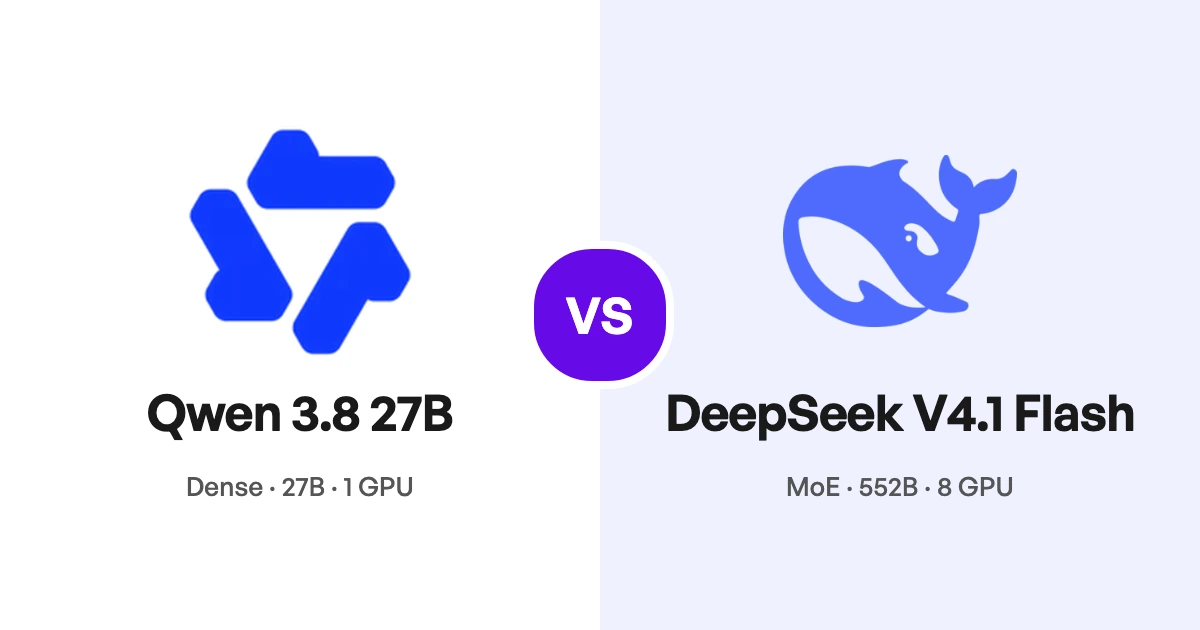
Their architectures, on the other hand, have almost nothing in common. Qwen 3.8 27B is a dense model with 27.8 billion parameters that fits on a single GPU. DeepSeek V4.1 Flash is an MoE (mixture of experts) model with 552 billion parameters, of which only 8 to 16 billion do the work for each word it produces: its weights take up 510 GB, sixteen times more than Qwen's in FP8.
Our conclusion: through an API, DeepSeek V4.1 Flash wins on almost everything; Qwen 3.8 27B remains the right choice as soon as the model has to be self-hosted. DeepSeek scores 32 points on the Artificial Analysis index, against 20, writes much better French according to our benchmark and, at OVHcloud, completes an answer in 3.3 seconds against 5.7 at half the average cost. Qwen, for its part, runs on one graphics card, while DeepSeek needs an eight-GPU server.
Qwen 3.8 27B and DeepSeek V4.1 Flash: who are they?
Both developers are Chinese and both licenses are permissive; their architectures, on the other hand, are opposites.
| Qwen 3.8 27B | DeepSeek V4.1 Flash | |
|---|---|---|
| Developer | Qwen team at Alibaba (China) | Hangzhou DeepSeek Artificial Intelligence (China) |
| Release | August 14, 2026 | September 10, 2026, "1017" revision on October 17 |
| License | Apache 2.0 | MIT |
| Architecture | Hybrid dense: 64 layers, 16 of them with full attention | MoE: 384 experts, 6 active per token, plus an "Engram" memory |
| Parameters | 27.8 billion, all active | 552 billion, 8 billion active when reading and 16 when generating |
| Weights to load | 55.6 GB in BF16, 30.9 GB in FP8 | 510 GB (FP8 and INT8) |
| Context | 262,144 tokens, 1 million with extension | 1 million tokens |
| Inputs | text, image, video | text, image |
| Reasoning | adjustable, from "none" to "xhigh" | adjustable, from "none" to "max" |
A dense model puts all of its parameters to work for every token, the unit of text (three to five characters) that an LLM produces. An MoE spreads its parameters across "experts" and activates only a few of them for each token: it stores a lot of knowledge but computes little per word. We explain this difference in detail in our article on dense and MoE models. It accounts for everything else in this comparison: DeepSeek is the bigger one to host, but the lighter one to run.
Both licenses allow commercial use, modification and resale of an inference service, which is not true of every so-called open license. Both developers are preparing their next generation: since September, DeepSeek has been announcing a V4.1 Pro that has still not been released, and Alibaba promises small Qwen 4 models with no date, as we track in our article on Qwen 4 27B.
Which one is smarter?
The Artificial Analysis index aggregates about ten independent evaluations, mostly agent, coding and reasoning tasks. It rates each model at each reasoning setting, that is, according to how long the model is allowed to "think" before answering.
| Setting | Qwen 3.8 27B | DeepSeek V4.1 Flash |
|---|---|---|
| No reasoning | 10 | 19 |
| Maximum reasoning (xhigh for Qwen, max for DeepSeek) | 20 | 32 |
Artificial Analysis Intelligence Index v5.0.1, read on November 26, 2026.
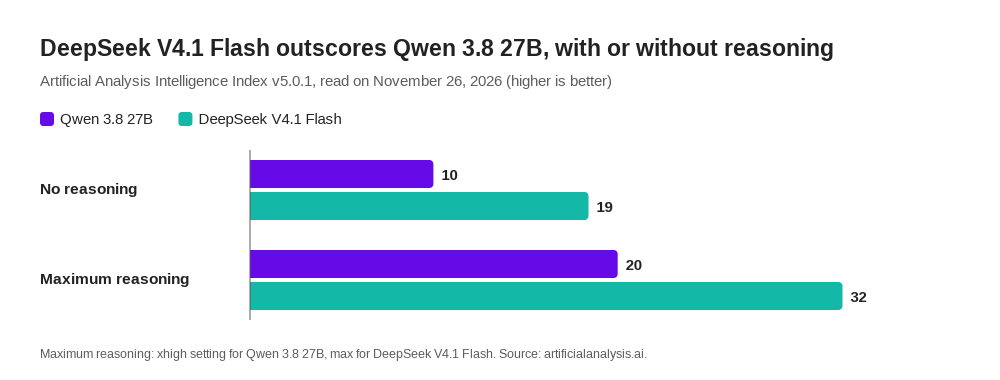 DeepSeek V4.1 Flash outscores Qwen 3.8 27B, with or without reasoning. Artificial Analysis Intelligence Index v5.0.1, read on November 26, 2026. No reasoning: Qwen 3.8 27B 10, DeepSeek V4.1 Flash 19. Maximum reasoning: Qwen 3.8 27B 20, DeepSeek V4.1 Flash 32.
The gap is clear at every setting. Without reasoning, DeepSeek V4.1 Flash does almost as well as Qwen 3.8 27B pushed to its maximum. Artificial Analysis ranks DeepSeek V4.1 Flash 3rd out of 33 comparable models; Qwen 3.8 27B is 3rd out of 14 in its own category, far above models of its size, but not above this MoE twenty times its size.
How many tokens for the same level of intelligence?
Artificial Analysis also publishes the number of tokens each model writes to complete the index, at each reasoning setting. Both models take the same tasks, so we can compare what each one needs to reach a given score. Sorted by score, the settings of the two models interleave:
| Model and setting | Score | Tokens written to complete the index |
|---|---|---|
| Qwen 3.8 27B, no reasoning | 10.0 | 37.5 million |
| Qwen 3.8 27B, low reasoning | 15.7 | 77.3 million |
| Qwen 3.8 27B, medium reasoning | 17.5 | 89.3 million |
| DeepSeek V4.1 Flash, no reasoning | 18.5 | 51.2 million |
| Qwen 3.8 27B, xhigh reasoning (maximum) | 20.1 | 128 million |
| DeepSeek V4.1 Flash, high reasoning | 28.7 | 134 million |
| DeepSeek V4.1 Flash, max reasoning | 32.4 | 174 million |
Output tokens, from the Artificial Analysis pages on Qwen 3.8 27B and DeepSeek V4.1 Flash, read on November 26, 2026.
At the same level, DeepSeek V4.1 Flash writes 1.7 times fewer tokens than Qwen 3.8 27B. Without reasoning, it scores 18.5 points with 51.2 million tokens; to reach 17.5 points, Qwen has to reason at the medium setting and write 89.3 million. Beyond 20 points, Qwen can no longer keep up: DeepSeek reaches 28.7 points with 134 million tokens, barely more than Qwen's 128 million at its maximum.
This gap comes on top of the per-token prices and speeds that we measure below at European hosting providers: for the same result, DeepSeek produces fewer tokens, billed at a lower price and displayed faster. Our own questions in French, without reasoning, point the same way: Qwen writes 1.65 times more tokens than DeepSeek on them.
One last limit: the index is in English. It says nothing about the quality of a text written in French, nor about the ability to answer correctly from your own documents. Our cross-check of AI leaderboards shows how far rankings diverge depending on what they measure.
Which one writes the best French?
On November 24, we had each of these two models write 96 texts in French, among six models tested: emails, summaries, answers based on documents, informal messages. This benchmark measures French writing quality, which matters to any company whose assistant answers French-speaking customers or staff. Both models were served by OVHcloud, without reasoning, and two automated judges rated them blind.
| Measure | Qwen 3.8 27B | DeepSeek V4.1 Flash |
|---|---|---|
| Overall score from the Gemini judge (out of 5) | 4.43 | 4.90 |
| Texts rated 5 out of 5 | 50% | 90% |
| Texts with at least one major error | 23 out of 96 | 3 out of 96 |
| Grammalecte checker alerts per 1,000 words (spelling, grammar) | 2.4 and 1.7 | 0.5 and 1.5 |
| Cost per 1,000 answers | €0.91 | €0.35 |
ATG benchmark of November 24, 2026; major errors excluding register errors (tu or vous). Full results.
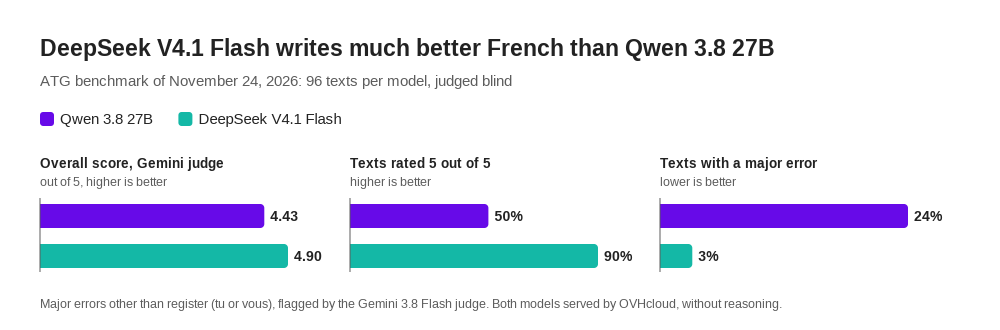 DeepSeek V4.1 Flash writes much better French than Qwen 3.8 27B. ATG benchmark of November 24, 2026, 96 texts per model. Overall score from the Gemini judge: Qwen 3.8 27B 4.43 out of 5, DeepSeek V4.1 Flash 4.90. Texts rated 5 out of 5: 50% against 90%. Texts with a major error: 24% against 3%.
DeepSeek V4.1 Flash is in the top three of our test, tied with GPT-6 Luna and Mistral Large 4. Qwen 3.8 27B comes last of the six, and one text in four contains an error a proofreader would spot. It sometimes invents French words ("indisponnalités", "tu viveras", "diaposites"), a machine error no human would make. DeepSeek's errors are those of a writer in a hurry, such as a gender agreement slip in "tous les 8 000 heures".
The gap widens when the model answers in French from documents in English, the daily routine of an internal assistant: Qwen's fluency drops more than that of any other model tested. Public votes point the same way: on compar:IA, the French Ministry of Culture's chatbot arena, DeepSeek V4.1 Flash ranks 70th and Qwen 3.8 27B 100th, out of 127 models as of November 24.
What hardware does self-hosting take?
This is where Qwen 3.8 27B gets its revenge. Hosting a model yourself, on your own servers or on rented GPUs, means loading all of its weights into graphics memory, plus the memory of ongoing conversations (the KV cache).
| Qwen 3.8 27B | DeepSeek V4.1 Flash | |
|---|---|---|
| Weights in 4-bit | 17 to 18 GB | no official version |
| Weights in 8-bit | 30.9 GB | 510 GB |
| Minimum hardware | one 24 GB card (4-bit), one 80 GB H100 (8-bit) | an 8-GPU server, 8 H100s at Scaleway |
| Memory per conversation token | 64 KiB, plus a fixed state of about 75 MB | 890 bytes |
| Rental in France | one H100 at €2.80 per hour at OVHcloud, €1,940 per month | 8 H200s at €42 per hour at OVHcloud, about €30,700 per month running continuously |
Qwen's memory per token: ATG calculation from the configuration file published by Qwen. Monthly cost of the 8 H200s: €42 × 730 hours, ATG calculation.
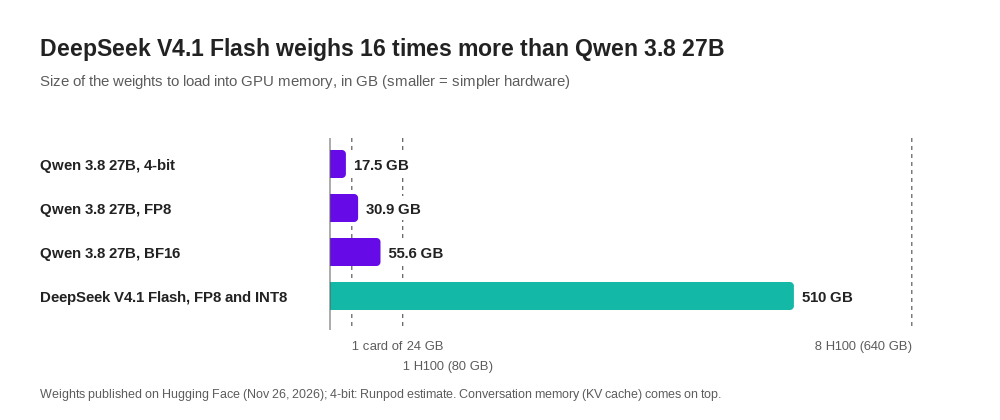 DeepSeek V4.1 Flash weighs 16 times more than Qwen 3.8 27B. Size of the weights to load into GPU memory: Qwen 3.8 27B 17.5 GB in 4-bit, 30.9 GB in FP8, 55.6 GB in BF16; DeepSeek V4.1 Flash 510 GB in FP8 and INT8. Reference points: one 24 GB card, one 80 GB H100, eight H100s or 640 GB.
Qwen 3.8 27B fits on one card; DeepSeek V4.1 Flash requires an entire server. In 4-bit, Qwen runs on a 24 GB card at about 46 tokens per second for one user; an H100 with a serving engine such as vLLM serves it to around fifty simultaneous users, at 32 to 35 tokens per second each. DeepSeek, by contrast, needs eight high-end GPUs: an H200 NVL costs €32,533 excluding VAT at LDLC Pro, so more than €250,000 excluding VAT for eight cards, by our calculation. Hobbyist builds on older hardware exist, but are not fit for production use.
DeepSeek's tiny KV cache matters once the server is set up: it can hold many long conversations in parallel. It does not lower the cost of entry. Qwen 3.8 27B is also easier to customize: a dense model of this size can be fine-tuned on a single GPU, and the community has already published more than 800 fine-tuned versions. Our article on the local AI server details the hardware tier by tier, with Qwen 3.8 27B as the reference.
Through an API, which one is faster and cheaper?
Without hosting anything, most companies call these models through an inference provider. Here we reuse the protocol of our comparison of European LLM APIs (in French): the same questions sent continuously to both models, without reasoning, at OVHcloud and Scaleway, the two French hosting providers that serve both models and state in their contract where and by whom the models run. We add Cerebras, an American provider, for raw speed. The measurement ran from November 23 to 26, with 112 calls per configuration, all successful.
| Provider | Model | Wait before the answer | Display speed (characters/s) | Time for one answer | Answer length (characters) | Input / output price (€ per million tokens) | Average cost (€ per million tokens) |
|---|---|---|---|---|---|---|---|
| OVHcloud | Qwen 3.8 27B | 0.36 s | 763 | 5.7 s | 4,058 | 0.40 / 2.70 | 0.860 |
| OVHcloud | DeepSeek V4.1 Flash | 0.27 s | 984 | 3.3 s | 2,849 | 0.27 / 1.08 | 0.432 |
| Scaleway | Qwen 3.8 27B | 0.37 s | 682 | 6.9 s | 4,215 | 0.60 / 3.30 | 0.948 |
| Scaleway | DeepSeek V4.1 Flash | 0.46 s | 933 | 4.0 s | 2,911 | 0.60 / 1.80 | 0.648 |
| Cerebras (US, not sovereign) | Qwen 3.8 27B | 0.27 s | 5,434 | 1.2 s | 4,494 | 0.90 / 1.36 | 0.992 |
Medians of ATG measurements from November 23 to 26, 2026; list prices excluding VAT as of November 23, and November 26 for Cerebras ($0.99 and $1.49, at $1.099 to €1). Average cost: 40% cached input, 40% new input, 20% output, the split of our own usage; OVHcloud publishes no cache price.
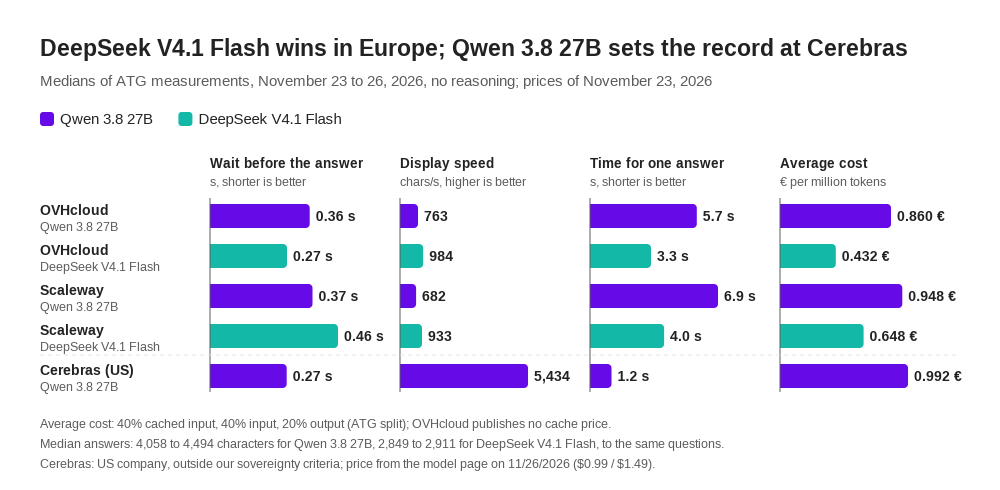 DeepSeek V4.1 Flash wins in Europe; Qwen 3.8 27B sets the record at Cerebras. Medians from November 23 to 26, 2026, without reasoning. OVHcloud, Qwen 3.8 27B: 0.36 second wait, 763 characters per second, 5.7 seconds per answer, €0.860. OVHcloud, DeepSeek V4.1 Flash: 0.27 second, 984, 3.3 seconds, €0.432. Scaleway, Qwen 3.8 27B: 0.37 second, 682, 6.9 seconds, €0.948. Scaleway, DeepSeek V4.1 Flash: 0.46 second, 933, 4.0 seconds, €0.648. Cerebras, US, Qwen 3.8 27B: 0.27 second, 5,434, 1.2 seconds, €0.992.
Both models start answering in under half a second. The difference comes after that: DeepSeek displays its text 29 to 37% faster, and above all Qwen writes 1.4 times more text for the same questions, and therefore 1.65 times more billed tokens. A Qwen answer thus takes 1.7 times longer to display. The only reservation about DeepSeek at Scaleway: an irregular wait, of 3.9 seconds or more in one call out of ten.
That is the paradox of this comparison: the small model costs more through an API. At OVHcloud, Qwen 3.8 27B's output is billed €2.70 per million tokens, against €1.08 for DeepSeek V4.1 Flash. This makes sense: a dense model with 27.8 billion parameters computes more per token than an MoE that activates only 8 to 16 billion. Add Qwen's verbosity, and our French-language benchmark comes to €0.91 per 1,000 answers against €0.35, at the same provider.
Elsewhere in Europe, three other hosting providers that meet our four sovereignty criteria serve Qwen 3.8 27B: IONOS at OVHcloud's price, Regolo slightly more expensive, and STACKIT, whose price, €0.45 for input and €0.65 for output, or an average cost of €0.490, comes in below DeepSeek's at Scaleway, but not at OVHcloud; we have not measured it. DeepSeek V4.1 Flash is served faster and cheaper still by other European providers, led by Umans and Verda: our comparison of European APIs (in French) ranks them, along with their level of sovereignty.
That leaves raw speed, and here Qwen 3.8 27B takes back the lead. The very fast inference providers, which design their own chips, serve Qwen 3.8 27B and not DeepSeek V4.1 Flash: Cerebras's catalog lists only two models, gpt-oss-120b and Qwen 3.8 27B, and Groq offers Qwen 3.8 27B in preview, with no DeepSeek at all. At Cerebras, Qwen 3.8 27B holds the record across all our measurements: 5,434 characters per second, seven times OVHcloud's speed, and a complete answer in 1.2 seconds, for an average cost close to that of the French hosting providers. Groq displays it at 2,043 characters per second. Both companies are American and therefore do not meet our sovereignty criteria; Cerebras also limits the context to 131,072 tokens. For agents that chain dozens of calls, or answers that need to feel instant, with no sovereignty requirement, Qwen 3.8 27B is the only one of the two that can be served this fast. In Europe, the fastest remains DeepSeek V4.1 Flash at Umans, an ATG partner: 3,188 characters per second, and also 1.2 seconds per answer, thanks to shorter answers.
Chinese models: what risk for a company?
The risk comes from the developers' own services. DeepSeek's app and API store data in China, which earned DeepSeek a processing restriction from the Italian data protection authority as early as January 2025. An open-weight model hosted by a European operator, on the other hand, sends nothing to its developer: at OVHcloud or Scaleway, Qwen and DeepSeek run in the European Union, with a French operator and under a French contract. That is the point of our sovereign AI framework: what gets judged is the provider running the model, not the nationality of the people who trained it.
Two legitimate questions remain. Biases inherited from training, on topics that are politically sensitive in China, which matter little for writing an email or summarizing a contract. And dependence on a developer whose timeline is opaque: DeepSeek and Alibaba release at the pace they choose, with no roadmap.
Which one to choose for which use case?
Our reading, use case by use case:
| Use case | Our pick | Why |
|---|---|---|
| Customer chatbot, emails, content in French | DeepSeek V4.1 Flash | 90% flawless texts against 50%, faster and cheaper answers |
| Internal assistant on documents | DeepSeek V4.1 Flash through an API | cheaper and faster; but document search matters more than the model |
| Agents, code, long tasks | DeepSeek V4.1 Flash | 32 points against 20, and 1.7 times fewer tokens for the same score |
| On-premises hosting, air-gapped network, industrial site | Qwen 3.8 27B | one graphics card instead of an 8-GPU server |
| Customized model (fine-tuning) | Qwen 3.8 27B | a 27-billion dense model can be fine-tuned on a single GPU |
| Very long documents in one piece | DeepSeek V4.1 Flash | 1 million tokens of native context against 262,144 |
| Maximum speed, with no sovereignty requirement | Qwen 3.8 27B at Cerebras | 5,434 characters per second, a complete answer in 1.2 seconds |
For the document assistant, one point we draw from our own RAG: on the FinanceBench benchmark, replacing Qwen 3.8 27B with Gemini 3.8 Flash made no significant difference. What makes an internal assistant good is first of all the way it searches, splits and cites documents. The model comes second, and what DeepSeek V4.1 Flash mainly brings there is better French and a lower cost.
What IT leaders can take away
Three points seem decisive to us. The question "Qwen or DeepSeek?" depends less on the models than on how they are hosted: through an API, DeepSeek V4.1 Flash dominates; on your own machines, Qwen 3.8 27B is the only one of the two that fits on one card. The price per million tokens is also misleading: a verbose model, or one that writes slowly, costs more per answer, and only a measurement on your own questions gives the real cost. Finally, both models will be replaced, perhaps in the coming weeks: an application that calls models through a standard, OpenAI-compatible interface switches models with one line of configuration, and that is what best protects the investment.
Frequently asked questions about Qwen and DeepSeek
What is the difference between Qwen 3.8 27B and DeepSeek V4.1 Flash?
Qwen 3.8 27B, from Alibaba, is a dense model with 27.8 billion parameters under the Apache 2.0 license, and it fits on a single GPU. DeepSeek V4.1 Flash is an MoE model with 552 billion parameters under the MIT license, which activates only 8 to 16 billion of them per token but weighs 510 GB. DeepSeek scores higher on Artificial Analysis (32 against 20), writes better French and costs less through an API; Qwen is much easier to self-host.
Qwen or DeepSeek: which one should a company choose?
For API use (chatbot, document assistant, agents), DeepSeek V4.1 Flash: a higher score, better French, faster answers and half the average cost at OVHcloud. For hosting on your own servers, an air-gapped network or a model to fine-tune, Qwen 3.8 27B, which runs on a single graphics card while DeepSeek V4.1 Flash needs an eight-GPU server.
Why does Qwen 3.8 27B cost more than DeepSeek V4.1 Flash through an API?
Because a dense model computes with all of its parameters for every token: Qwen 3.8 27B uses 27.8 billion, DeepSeek V4.1 Flash only 8 to 16 billion. Providers therefore charge more for Qwen's output, €2.70 against €1.08 per million tokens at OVHcloud. Qwen also writes longer answers: in ATG's French-language benchmark, 1,000 answers cost €0.91 with Qwen and €0.35 with DeepSeek.
Qwen 3.8 27B or DeepSeek V4.1 Flash: which one uses fewer tokens?
DeepSeek V4.1 Flash, at the same level. On the Artificial Analysis index, it scores 18.5 points without reasoning with 51.2 million tokens, while Qwen 3.8 27B writes 89.3 million for 17.5 points. On short questions in French, without reasoning, Qwen also writes 1.65 times more tokens than DeepSeek in ATG's measurements.
Can DeepSeek V4.1 Flash run on a single GPU?
Not in production. Its published weights take up 510 GB, far beyond the 80 GB of an H100 or the 141 GB of an H200: Scaleway deploys it on a server with eight H100s. Enthusiasts have run heavily compressed versions on older hardware, but at speeds no company could use. Qwen 3.8 27B, by contrast, fits on a 24 GB card in 4-bit.
Where can Qwen 3.8 27B and DeepSeek V4.1 Flash be used in Europe?
OVHcloud and Scaleway serve both models in France, and so does Regolo in Italy. IONOS and STACKIT, in Germany, also serve Qwen 3.8 27B. These five European providers guarantee by contract that the models run in Europe, with European operators. Other European providers serve DeepSeek V4.1 Flash faster and cheaper, with varying sovereignty guarantees.
This head-to-head will not last: Alibaba promises small Qwen 4 models and DeepSeek a V4.1 Pro. When they come out, a company that knows how to test a model on its own data in a day will make the right decision; the others will wait for the leaderboards. If you want to frame this choice for your own use case, we can talk it through.