
LangChain Alternative: Same Method, Without the Months of Work
LangChain published its method to build an AI agent: six stages, tooled for engineers. Ask This Guy follows the same lifecycle, simpler and run by the business.

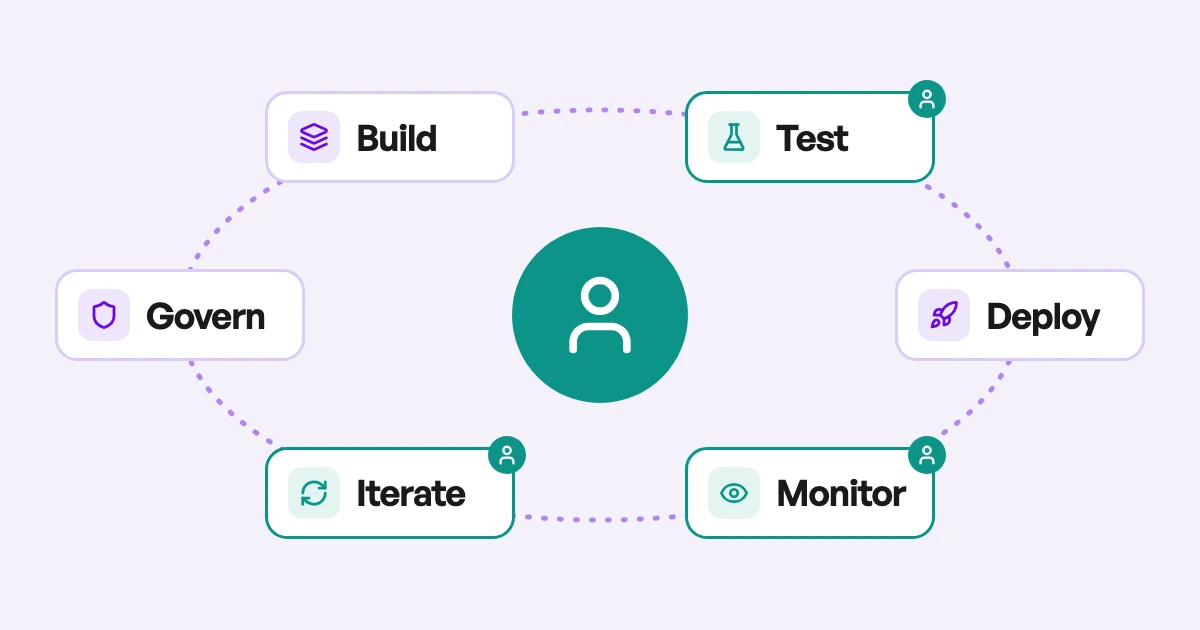
On May 9, 2026, LangChain published its method for building an AI agent and keeping it alive, the agent development lifecycle: build, test, deploy, monitor, iterate, govern. Six common-sense stages, and behind each one, engineering tooling: frameworks, runtimes, datasets, traces, middleware, sandboxes.
Applied to a chatbot that answers from company documents, the method turns into an engineering project. Every building block is a developer's job, and every answer that needs fixing goes back through them. The approach is right, but it is a build project.
At Ask This Guy, we follow the same approach, stage by stage, which makes it a LangChain alternative for document chatbots. The difference fits in one sentence: each stage is a screen in the console, and the business runs it. The hotline lead tests the agent, reviews its answers and fixes its instructions; engineers keep what genuinely takes code.
What is the agent development lifecycle?
The agent development lifecycle is the set of stages that takes an agent from its creation to its continuous improvement in production. LangChain published a detailed version in six parts: Build, Test, Deploy, Monitor, then Iterate and Govern. The order is deliberate, Harrison Chase writes: “Testing should start before an agent reaches production, not after.”
The framework is designed for every kind of agent, including those that write code or work for hours on production systems. So it covers heavy building blocks: runtimes that resume a task after an interruption, sandboxes to run generated code, simulations of whole conversations, LLM judges that grade answers.
The agents we deploy do something simpler. They answer questions from documents: an internal chatbot for teams, a customer chatbot on a website or inside a software product. Their infrastructure comes down to a few settings; their real difficulty is answer accuracy, and accuracy is something domain experts judge.
What does a chatbot built with LangChain take?
The post details what has to be assembled at each stage. To build, pick a framework (LangChain), a runtime (LangGraph) or a harness (Deep Agents). To test, datasets, metrics, experiments and simulations. To deploy, durable execution, sandboxes and dedicated infrastructure. To monitor, traces, signals and dashboards. Each of these blocks is an engineering topic, to the point that LangChain advises large companies to build shared infrastructure so that each team does not rebuild its own evaluation, deployment, traces and dashboards.
LangChain does not shut out non-developers. The post cites no-code tools, its own LangSmith Fleet, Claude Cowork and n8n, which “allow more people to participate in agent development”, and a Context Hub where prompts and context may be edited by people who are not engineers.
The line is still drawn clearly: “no-code tools do not eliminate the need for engineering control”. Domain experts edit prompts, skills and context; engineers keep control of whatever must be reliable, testable and governed. For anything beyond the prompt, the post points to hooks and middleware, in other words to code.
The post does not say who, on the business side, closes the loop. An expert can fix a prompt; re-running the tests, reading the traces and triaging user feedback remain, in practice, an engineer's job. Every fix becomes a ticket in their queue, and once the agent is in production, user feedback is easily lost: the same flaw comes back for weeks without anyone connecting the dots.
How do you build an AI agent without code?
In Ask This Guy, an agent is created in the admin console, from a form: a name, a description, instructions that set its role, tone, rules and limits, then the knowledge categories it can search and the tools it can call (document search, web, file generation, MCP servers). That is LangChain's Build stage, with no framework, runtime or harness to pick.
The agent type is chosen at creation: Webapp for authenticated teams, Widget for a website or a SaaS product. A Playground sits next to the settings, to change an instruction, ask the question again and compare.
Connecting an external tool works the same way. Adding an MCP server takes a URL, an authentication method and a transport type, an operation our documentation describes as “manageable without deep development expertise”.
How do you test an agent before opening it?
Agent evaluation plays the role of LangChain's datasets. You build a question set by typing questions, importing a CSV file, or letting the platform generate them from the agent's documents, with a deliberate mix of relevant and off-topic questions to see how the agent behaves outside its scope.
Each answer comes with its sources, the tools called and the response time. The expert rates it with a thumb and a comment on what was missing. The history keeps every run: you re-run the same set after changing the instructions or adding documents, and see whether the agent improves or regresses.
A run holds 50 questions at most, and that is a choice: 50 answers read by an expert beat 1,000 that nobody reads. The set itself grows over time. A document agent is validated on hundreds, then thousands, of questions, and most of them will come from real conversations, followed in production. LangChain puts it its own way: “The goal is not to create a perfect eval suite on day one.”
Deploying: a setting, not a project
At LangChain, Deploy is the most technical stage: durable execution that resumes after an interruption, human approval mid-task, sandboxes to run code, dedicated infrastructure.
With us, deploying means choosing who gets access. A Webapp agent opens to the whole organization or to a list of people. A Widget agent is embedded with a snippet, with a JWT and allowed origins, or through a WordPress plugin. An edited instruction applies as soon as it is saved, with no release: that is what LangChain aims for with its Context Hub, which changes an agent's behavior “without a full deploy”.
Monitoring what the agent actually answers
Harrison Chase has the right line: “An agent can return a technically successful response and still fail the task itself.” An agent can answer fast, without errors, and still be wrong.
To see it, Conversations can be reviewed message by message, with the reasoning behind each answer (the tools called) and the sources cited: these are LangChain's traces, readable by someone who does not read JSON. Insights tracks volume, detected sentiment and the share of thumbs up and down, per agent and per topic, against the previous period.
LangChain's signals, computed by an LLM judge or a regular expression, take the form of Tags & Alerts in Ask This Guy. The condition is written in plain language (“the customer wants to cancel”, “quote request”), the platform tags matching conversations and can notify someone by email.
Improving an agent: why the loop should go back to the business
This is the core of our disagreement with an engineer-run lifecycle. The people who know whether an answer is right are the hotline lead, the lawyer, the product manager. Our documentation puts it bluntly: without them, every fix goes through an administrator, “who becomes a bottleneck, or the fix never happens”.
Hence the Agent Owner role. An administrator appoints one or more domain experts for each agent. Without becoming administrators, they review their agents' conversations, check their statistics, run evaluations and fix the instructions themselves. They do not touch tools, sources or access.
The Iterate loop runs through the Improvement Tracker. Every answer rated as poor, in the chat, the widget or the Playground, becomes a task there. The Owner sorts it by the fix it needs: agent instructions, missing or outdated document, wrong documents retrieved, new source to connect, bug. They assign it, resolve it or reject it with a reason. The same issue seen in ten conversations is grouped into a single task.
Take a typical case, a wrong answer about an internal procedure. It goes like this: the user gives a thumbs-down, a task opens, the Owner sees the cited document dates from last year, updates it, re-runs the question set, closes the task. No ticket ever reached a technical team.
Governing without slowing down
LangChain files cost, tool access, audit logs and reuse under Govern, with this line: “Good governance is not about slowing teams down.”
With us, governance starts with one decision made for the whole organization: the AI policy, which restricts agents to European providers or opens them to providers worldwide. Sovereignty is part of governance, and it is not set agent by agent. Then come rights: only administrators appoint Owners, an Owner sees only their own agents, an agent's conversations can be made private, and changes are recorded in the agent's history.
LangChain and Ask This Guy, stage by stage
| Stage | At LangChain | In Ask This Guy | Who handles it in ATG |
|---|---|---|---|
| Build | Frameworks, runtimes, harnesses; no-code with Fleet | Agent form, Playground, MCP servers | Administrator |
| Test | Datasets, metrics, experiments, simulations | Sets of up to 50 questions, rated with a thumb, history | Owner |
| Deploy | Durable execution, sandboxes, Context Hub | Webapp access or Widget embed; instructions without redeploying | Administrator |
| Monitor | Traces, LLM or regex signals, dashboards | Conversations, Insights, plain-language Tags & Alerts | Owner |
| Iterate | Hard cases, adjustments, new evals | Improvement Tracker: thumbs-down, task, fix | Owner |
| Govern | Cost, tool access, audit, reuse | AI policy, rights, private conversations, history | Administrator |
What we don't have, and why
To be upfront, Ask This Guy lacks several building blocks of LangChain's framework. There is no durable execution: an ATG agent answers within a conversation, it does not run a multi-hour task that would need to resume after an outage. It does not run generated code, so there is no sandbox. Evaluation asks isolated questions, without multi-turn simulation, and no experiment compares two models on the same set, since the model follows from the organization's AI policy. As for the LLM judge, we kept it out of testing: judgment stays human.
These blocks serve agents that write code, act for a long time or change sensitive systems. For an agent that answers from documents, they add complexity without adding anything. The LLM judge is a special case: it measures how consistent an answer is, not whether it is right for the business, while an expert settles that in seconds. That is our general rule, using as little AI as possible when a human or an algorithm does better.
For an agent that places orders, writes to a database or deploys code, LangChain's full framework is the right one, and engineers are right to run it.
And what about engineers?
They do not disappear. Connecting a business API (CRM, ticketing tool, internal database) is still development: that is the role of tailored tools, which our team builds and whose code belongs to the customer, or of an existing MCP server. Querying a database in natural language also needs technical scoping.
What changes is what they are no longer asked to do. Rewording an answer, flagging an outdated document, adding a question to the test set: these tasks leave the engineering queue and go back to the people who understand them. Even in a team of engineers, that is time given back, for integrations, data or the product.
What a company can take from this
LangChain's approach is the right one; the question is who carries it. A successful document agent depends less on its technology than on the person who looks after it. Before choosing a platform, the first question we would ask is: who will judge the answers, and in how many clicks can they fix them? If the answer is “an engineer, after a ticket”, the improvement loop is likely to run slowly.
Our recommendation comes down to three points. One agent, one or two business Owners, appointed from the start. A first set of about fifty questions before launch, generated and then corrected by the expert, enriched with real user questions and re-run after every change. A weekly review of thumbs-downs, rather than an audit every six months. When an existing chatbot falls short, our RAG audit method helps find what is blocking it.
Frequently asked questions about the agent development lifecycle
What are the stages of the agent development lifecycle?
In the framework LangChain published in May 2026, the agent development lifecycle has four stages, Build, Test, Deploy and Monitor, extended by an improvement loop (Iterate) and wrapped in governance (Govern). Testing before production, not after, is its central principle.
Do you need engineers to build a chatbot with LangChain?
Yes, in most cases. LangChain provides development building blocks, a framework, a runtime and a harness, that a developer assembles. Its own post on the agent lifecycle says so: even with no-code tools, engineering control is still needed. Platforms like Ask This Guy follow the same approach in a console the business uses without code.
Can you build an AI agent without coding?
Yes, for an agent that answers from documents. In a platform like Ask This Guy, the agent is defined through a form: instructions, knowledge sources, allowed tools. Code becomes necessary again to connect a business API that has no MCP server, or for an agent that acts on production systems.
Who should improve an AI agent in production?
The people able to judge whether an answer is right: the domain experts for the area the agent covers. In Ask This Guy, this role is called Agent Owner: the Owner reviews conversations, handles poorly rated answers and fixes the instructions without being a platform administrator.
Do you need an LLM judge to evaluate an AI agent?
Not for a document agent. An LLM judge grades how consistent an answer is, not whether it is right by the company's rules. Test questions read by an expert, then the answers users rate poorly, catch the errors that matter more reliably. LLM judges become useful when volumes rule out any human review.
Is Ask This Guy an alternative to LangChain and LangSmith?
For an agent that answers from documents, yes: testing, conversation review, user feedback and improvement happen in the same console, without code. For an agent that runs code, carries out long tasks or needs multi-turn simulations, LangSmith and the LangChain ecosystem remain a better fit.
LangChain's post ends on an idea we gladly borrow: the best teams “evaluate before deploying, monitor behavior after deployment, and continuously use what they learn”. That leaves the question of who those teams are. For an agent that answers from documents, we think it is first the business, and that a platform should be judged by how many fixes they can make without waiting for anyone.